Torres Miquel Perez, Entwistle Frances, Coote Peter J
Biomedical Sciences Research Complex, School of Biology, University of St Andrews, The North Haugh, St Andrews, Fife, KY16 9ST, UK.
Department of Microbiology, Facultad de Biología, University of Barcelona, Diagonal, 643, 08028, Barcelona, Spain.
Med Microbiol Immunol. 2016 Aug;205(4):333-43. doi: 10.1007/s00430-016-0450-5. Epub 2016 Feb 26.
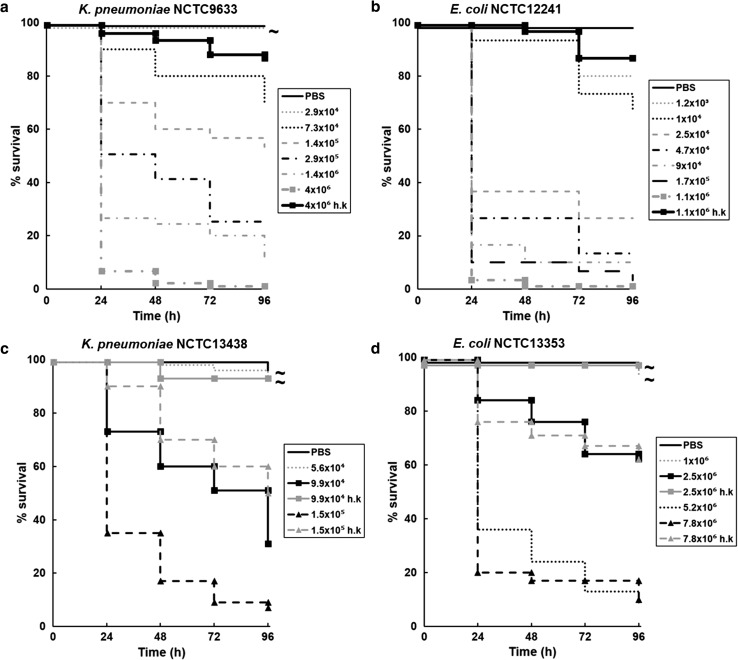
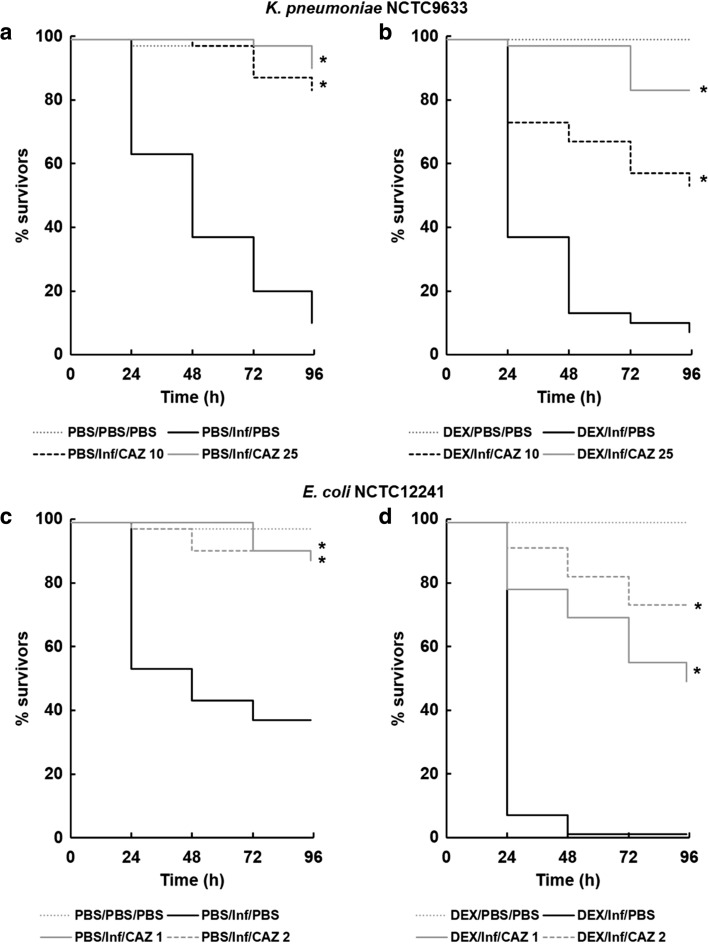
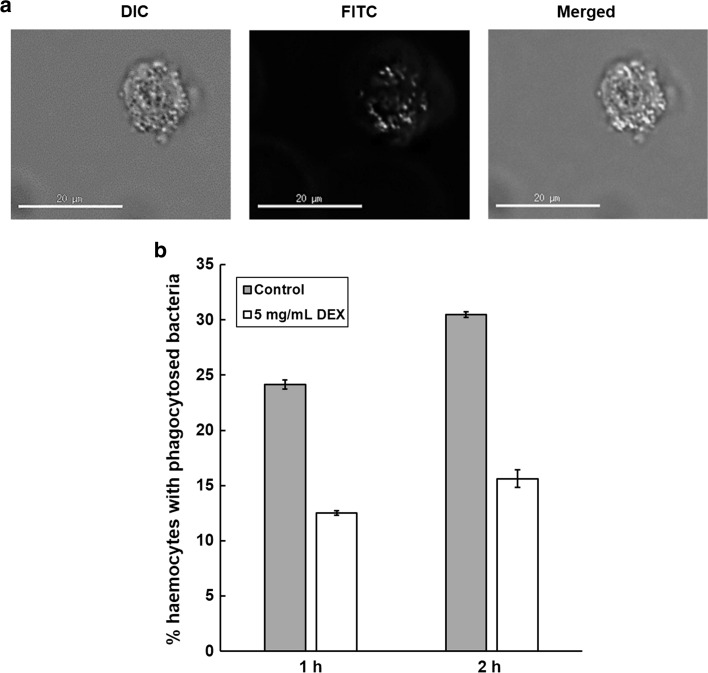
The aim was to evaluate whether immunosuppression with dexamethasone 21-phosphate could be applied to the Galleria mellonella in vivo infection model. Characterised clinical isolates of Escherichia coli or Klebsiella pneumoniae were employed, and G. mellonella larvae were infected with increasing doses of each strain to investigate virulence in vivo. Virulence was then compared with larvae exposed to increasing doses of dexamethasone 21-phosphate. The effect of dexamethasone 21-phosphate on larval haemocyte phagocytosis in vitro was determined via fluorescence microscopy and a burden assay measured the growth of infecting bacteria inside the larvae. Finally, the effect of dexamethasone 21-phosphate treatment on the efficacy of ceftazidime after infection was also noted. The pathogenicity of K. pneumoniae or E. coli in G. mellonella larvae was dependent on high inoculum numbers such that virulence could not be attributed specifically to infection by live bacteria but also to factors associated with dead cells. Thus, for these strains, G. mellonella larvae do not constitute an ideal infection model. Treatment of larvae with dexamethasone 21-phosphate enhanced the lethality induced by infection with E. coli or K. pneumoniae in a dose- and inoculum size-dependent manner. This correlated with proliferation of bacteria in the larvae that could be attributed to dexamethasone inhibiting haemocyte phagocytosis and acting as an immunosuppressant. Notably, prior exposure to dexamethasone 21-phosphate reduced the efficacy of ceftazidime in vivo. In conclusion, demonstration of an effective immunosuppressant regimen can improve the specificity and broaden the applications of the G. mellonella model to address key questions regarding infection.
目的是评估21 - 磷酸地塞米松免疫抑制是否可应用于黄粉虫体内感染模型。使用了具有特征性的大肠杆菌或肺炎克雷伯菌临床分离株,用递增剂量的每种菌株感染黄粉虫幼虫以研究体内毒力。然后将毒力与暴露于递增剂量21 - 磷酸地塞米松的幼虫进行比较。通过荧光显微镜确定21 - 磷酸地塞米松对幼虫血细胞体外吞噬作用的影响,并通过负荷试验测量幼虫体内感染细菌的生长。最后,还记录了21 - 磷酸地塞米松处理对感染后头孢他啶疗效的影响。肺炎克雷伯菌或大肠杆菌在黄粉虫幼虫中的致病性取决于高接种量,因此毒力不能仅归因于活菌感染,还与死细胞相关因素有关。因此,对于这些菌株,黄粉虫幼虫不构成理想的感染模型。用21 - 磷酸地塞米松处理幼虫以剂量和接种量依赖的方式增强了大肠杆菌或肺炎克雷伯菌感染诱导的致死率。这与幼虫体内细菌增殖相关,这可归因于地塞米松抑制血细胞吞噬作用并作为免疫抑制剂起作用。值得注意的是,预先暴露于21 - 磷酸地塞米松会降低头孢他啶在体内的疗效。总之,证明有效的免疫抑制方案可以提高特异性并拓宽黄粉虫模型的应用范围,以解决有关感染的关键问题。