Vrinten Charlotte, Wardle Jane
Health Behaviour Research Centre, Department of Epidemiology and Public Health, University College London, Gower Street, London, WC1E 6BT, United Kingdom.
Health Behaviour Research Centre, Department of Epidemiology and Public Health, University College London, Gower Street, London, WC1E 6BT, United Kingdom.
Eur J Cancer. 2016 Mar;56:172-178. doi: 10.1016/j.ejca.2015.12.018.
Despite improved outcomes, cancer remains widely feared, often because of its association with a long and protracted death as opposed to the quick death that people associate with that other common cause of adult mortality: heart disease. Former editor-in-chief of the BMJ Richard Smith's view that 'cancer is the best way to die' therefore attracted much criticism. We examined middle-aged and older adults' agreement with this view and compared their attitudes towards dying from cancer versus heart disease in terms of which was a good death.
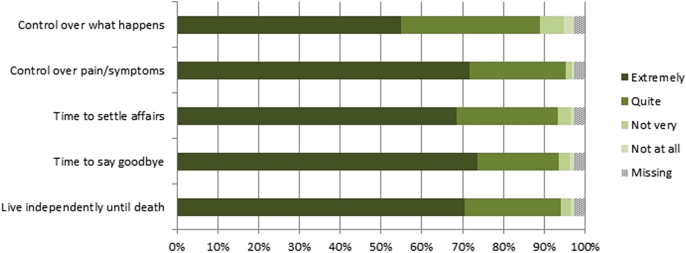
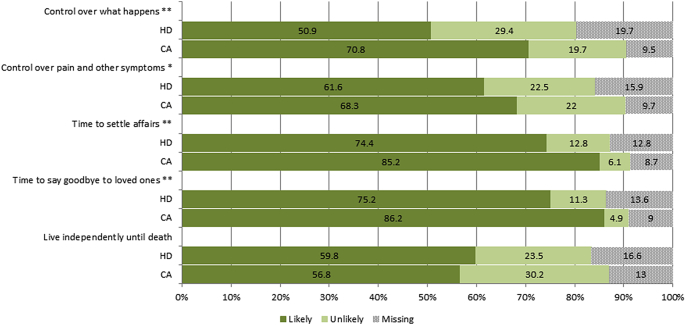
This study was part of an online survey (February 2015) in a United Kingdom (UK) population sample of 50- to 70-year olds (n = 391), with sampling quotas for gender and education. Five characteristics of 'a good death' were selected from the end-of-life literature. Respondents were asked to rate the importance of each characteristic for their own death to ensure their relevance to a population sample and the likelihood of each for death from cancer and heart disease. We also asked whether they agreed with Smith's view.
At least 95% of respondents considered the selected five characteristics important for their own death. Death from cancer was rated as more likely to provide control over what happens (p < 0.001), control over pain and other symptoms (p < 0.01), time to settle affairs (p < 0.001), and time to say goodbye to loved ones (p < 0.001) compared with death from heart disease, but there were no differences in expectation of living independently until death (p > 0.05). Almost half (40%) agreed that cancer is 'the best way to die', with no differences by age (p = 0.40), gender (p = 0.85), or education (p = 0.27).
Despite the media commotion, a surprisingly high proportion of middle-aged and older adults viewed cancer as 'the best way to die' and rated cancer death as better than heart disease. Given that one in two of us are likely to be diagnosed with cancer, conversations about a good death from cancer may in a small way mitigate fear of cancer. Future research could explore variations by type of cancer or heart disease and by previous experience of these illnesses in others.
尽管癌症治疗效果有所改善,但人们仍普遍对其心怀恐惧,这通常是因为癌症往往与漫长而痛苦的死亡联系在一起,而不像人们认为的成人常见死因——心脏病那样会带来快速死亡。因此,《英国医学杂志》前主编理查德·史密斯提出的“癌症是最好的死亡方式”这一观点引发了诸多批评。我们调查了中老年人对这一观点的认同情况,并比较了他们对死于癌症和死于心脏病的态度,看哪种被认为是“善终”。
本研究是2015年2月在英国进行的一项在线调查的一部分,样本为50至70岁的人群(n = 391),在性别和教育程度方面设定了抽样配额。从临终文献中选取了“善终”的五个特征。要求受访者对每个特征对自己死亡的重要性进行评分,以确保其与总体样本相关,并评估死于癌症和心脏病的可能性。我们还询问了他们是否认同史密斯的观点。
至少95%的受访者认为所选的五个特征对自己的死亡很重要。与死于心脏病相比,死于癌症被认为更有可能让人掌控所发生的事情(p < 0.001)、控制疼痛和其他症状(p < 0.01)、有时间处理事务(p < 0.001)以及有时间与亲人告别(p < 0.001),但在独立生活直至死亡的期望方面没有差异(p > 0.05)。近一半(40%)的人认同癌症是“最好的死亡方式”,在年龄(p = 0.40)、性别(p = 0.85)或教育程度(p = 0.27)方面没有差异。
尽管引发了媒体的热议,但令人惊讶的是,相当高比例的中老年人认为癌症是“最好的死亡方式”,并认为死于癌症比死于心脏病更好。鉴于我们中有二分之一的人可能会被诊断出患有癌症,关于癌症善终的讨论或许能在一定程度上减轻对癌症的恐惧。未来的研究可以探索不同类型的癌症或心脏病以及其他人此前对这些疾病的经历所产生的差异。