Helen Decleyre, Kim Heylen, Tytgat Bjorn, Anne Willems
Laboratory of Microbiology (LM-UGent), Department of Biochemistry and Microbiology, Ghent University, K.L. Ledeganckstraat 35, B-9000, Ghent, Belgium.
BMC Genomics. 2016 Feb 29;17:155. doi: 10.1186/s12864-016-2465-0.
Copper dependent nitrite reductase, NirK, catalyses the key step in denitrification, i.e. nitrite reduction to nitric oxide. Distinct structural NirK classes and phylogenetic clades of NirK-type denitrifiers have previously been observed based on a limited set of NirK sequences, however, their environmental distribution or ecological strategies are currently unknown. In addition, environmental nirK-type denitrifiers are currently underestimated in PCR-dependent surveys due to primer coverage limitations that can be attributed to their broad taxonomic diversity and enormous nirK sequence divergence. Therefore, we revisited reported analyses on partial NirK sequences using a taxonomically diverse, full-length NirK sequence dataset.
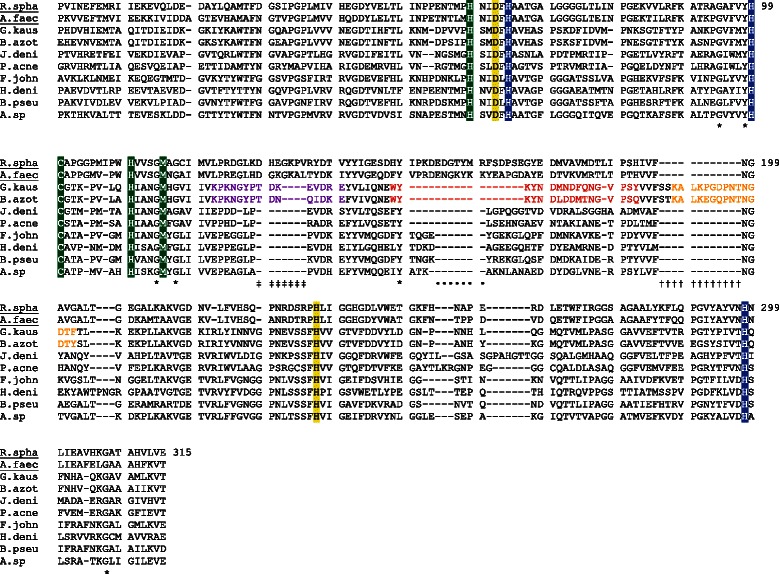
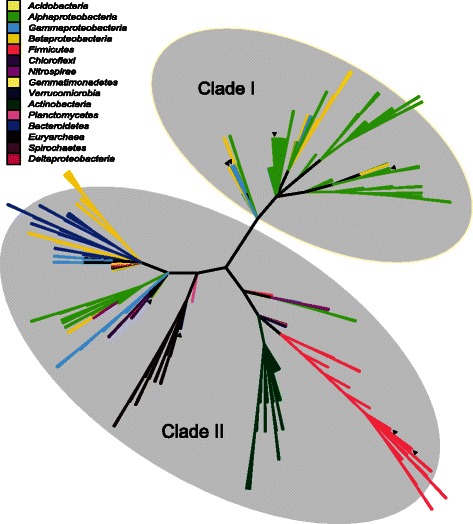
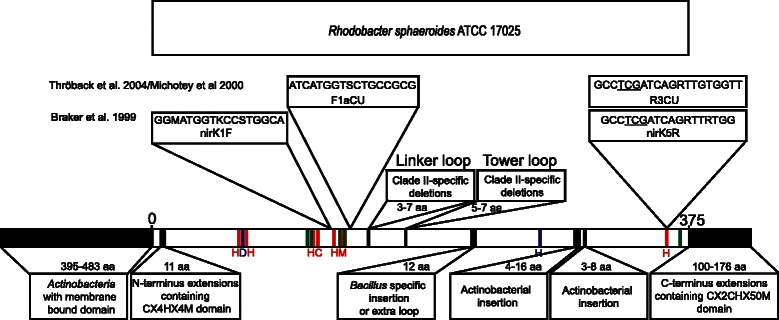
Division of NirK sequences into two phylogenetically distinct clades was confirmed, with Clade I mainly comprising Alphaproteobacteria (plus some Gamma- and Betaproteobacteria) and Clade II harbouring more diverse taxonomic groups like Archaea, Bacteroidetes, Chloroflexi, Gemmatimonadetes, Nitrospirae, Firmicutes, Actinobacteria, Planctomycetes and Proteobacteria (mainly Beta and Gamma). Failure of currently available primer sets to target diverse NirK-type denitrifiers in environmental surveys could be attributed to mismatches over the whole length of the primer binding regions including the 3' site, with Clade II sequences containing higher sequence divergence than Clade I sequences. Simultaneous presence of both the denitrification and DNRA pathway could be observed in 67% of all NirK-type denitrifiers.
The previously reported division of NirK into two distinct phylogenetic clades was confirmed using a taxonomically diverse set of full-length NirK sequences. Enormous sequence divergence of nirK gene sequences, probably due to variable nirK evolutionary trajectories, will remain an issue for covering diverse NirK-type denitrifiers in amplicon-based environmental surveys. The potential of a single organism to partition nitrate to either denitrification or dissimilatory nitrate reduction to ammonium appeared to be more widespread than originally anticipated as more than half of all NirK-type denitrifiers were shown to contain both pathways in their genome.
铜依赖型亚硝酸还原酶NirK催化反硝化作用中的关键步骤,即将亚硝酸盐还原为一氧化氮。基于有限的NirK序列,此前已观察到不同结构的NirK类别和NirK型反硝化菌的系统发育分支,然而,它们的环境分布或生态策略目前尚不清楚。此外,由于引物覆盖范围的限制,在依赖聚合酶链式反应(PCR)的调查中,环境中的nirK型反硝化菌目前被低估,这可归因于它们广泛的分类多样性和巨大的nirK序列差异。因此,我们使用分类多样的全长NirK序列数据集重新审视了关于部分NirK序列的已报道分析。
证实了NirK序列可分为两个系统发育上不同的分支,分支I主要由α-变形菌纲(加上一些γ-和β-变形菌纲)组成,分支II包含更多样化的分类群,如古菌、拟杆菌门、绿弯菌门、芽单胞菌门、硝化螺旋菌门、厚壁菌门、放线菌门、浮霉菌门和变形菌门(主要是β和γ)。在环境调查中,目前可用的引物组无法靶向多种nirK型反硝化菌,这可能归因于引物结合区域全长(包括3'位点)的错配,分支II序列的序列差异高于分支I序列。在所有nirK型反硝化菌中,有67%可同时观察到反硝化途径和异化硝酸盐还原为铵(DNRA)途径。
使用分类多样的全长NirK序列集证实了先前报道的将NirK分为两个不同系统发育分支的划分。nirK基因序列的巨大差异,可能是由于nirK进化轨迹的不同,对于在基于扩增子的环境调查中覆盖多种nirK型反硝化菌来说,仍将是一个问题。单个生物体将硝酸盐分配到反硝化或异化硝酸盐还原为铵的潜力似乎比最初预期的更为普遍,因为超过一半的nirK型反硝化菌在其基因组中显示同时包含这两种途径。