Faculty of Chemistry, Biotechnology and Food Science, Norwegian University of Life Sciences, Ås, Norway.
Department of Microbiology, Cornell University, Ithaca, NY, USA.
ISME J. 2022 Jan;16(1):26-37. doi: 10.1038/s41396-021-01045-2. Epub 2021 Jul 1.
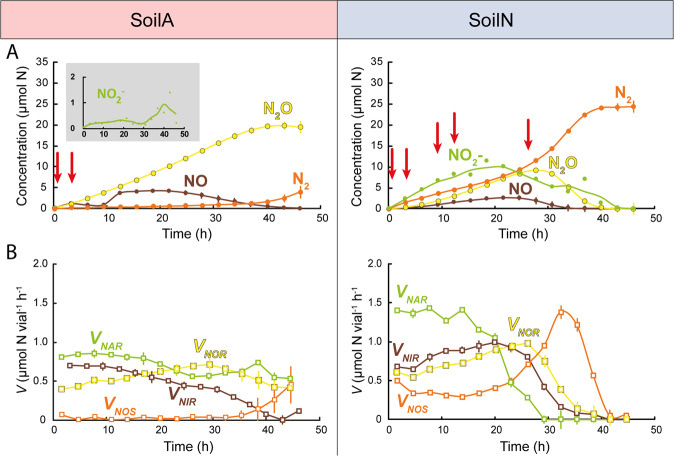
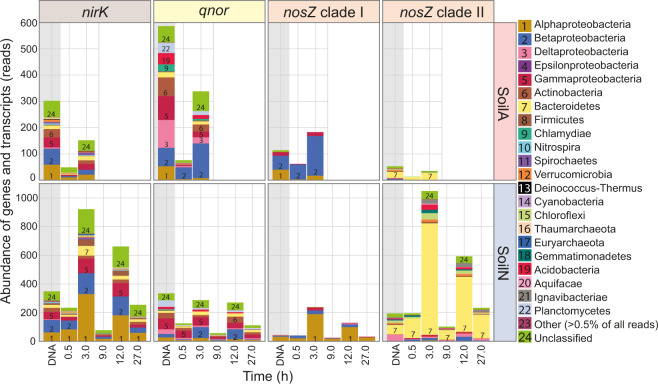
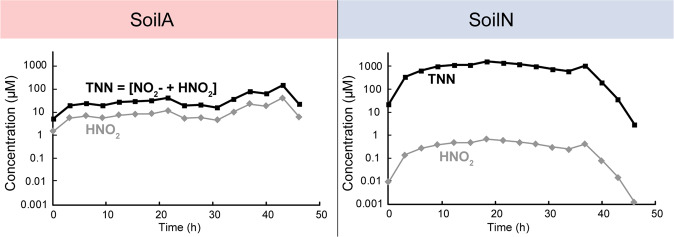
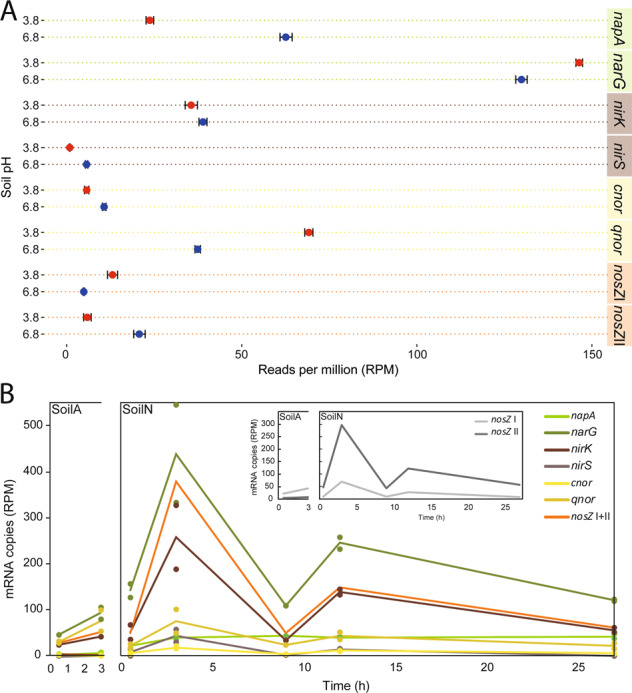
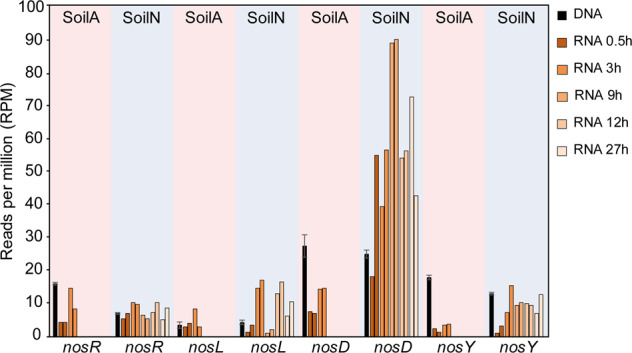
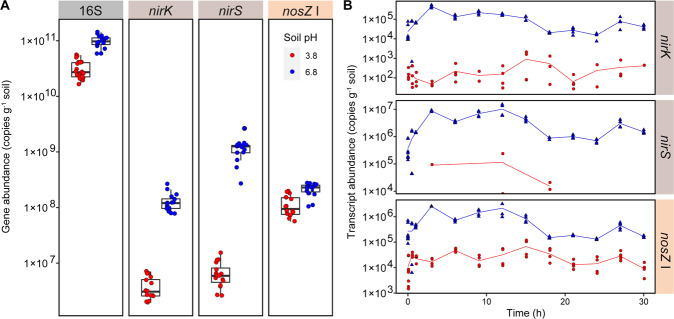
Soil pH is a key controller of denitrification. We analysed the metagenomics/transcriptomics and phenomics of two soils from a long-term liming experiment, SoilN (pH 6.8) and un-limed SoilA (pH 3.8). SoilA had severely delayed NO reduction despite early transcription of nosZ (mainly clade I), encoding NO reductase, by diverse denitrifiers. This shows that post-transcriptionally hampered maturation of the NosZ apo-protein at low pH is a generic phenomenon. Identification of transcript reads of several accessory genes in the nos cluster indicated that enzymes for NosZ maturation were present across a range of organisms, eliminating their absence as an explanation for the failure to produce a functional enzyme. nir transcript abundances (for NO reductase) in SoilA suggest that low NO concentrations in acidic soils, often ascribed to abiotic degradation, are primarily due to biological activity. The accumulation of NO in neutral soil was ascribed to high nar expression (nitrate reductase). The -omics results revealed dominance of nirK over nirS in both soils while qPCR showed the opposite, demonstrating that standard primer pairs only capture a fraction of the nirK pool. qnor encoding NO reductase was strongly expressed in SoilA, implying an important role in controlling NO. Production of HONO, for which some studies claim higher, others lower, emissions from NO accumulating soil, was estimated to be ten times higher from SoilA than from SoilN. The study extends our understanding of denitrification-driven gas emissions and the diversity of bacteria involved and demonstrates that gene and transcript quantifications cannot always reliably predict community phenotypes.
土壤 pH 是反硝化作用的关键控制因素。我们分析了来自长期石灰处理实验的两种土壤(SoilN,pH 值为 6.8 和未施石灰的 SoilA,pH 值为 3.8)的宏基因组学/转录组学和表型组学数据。尽管早期多样的反硝化菌转录了编码硝酸还原酶的 nosZ(主要为 I 型),但 SoilA 中的硝酸盐还原仍严重延迟。这表明在低 pH 条件下,反硝化酶的 NosZ 脱辅基蛋白的转录后成熟受阻是一种普遍现象。nos 簇中几个辅助基因的转录本读数表明,在一系列生物体中都存在用于 NosZ 成熟的酶,因此不存在酶的缺乏不能解释其不能产生功能酶的问题。SoilA 中 nir 转录本(用于硝酸还原酶)的丰度表明,酸性土壤中通常归因于非生物降解的低 NO 浓度主要是由于生物活性所致。中性土壤中 NO 的积累归因于高 nar 表达(硝酸盐还原酶)。组学结果表明,两种土壤中 nirK 的丰度均高于 nirS,而 qPCR 结果则相反,这表明标准引物对仅捕获了 nirK 库的一部分。SoilA 中编码硝酸还原酶的 qnor 强烈表达,暗示其在控制 NO 方面发挥重要作用。一些研究声称,在积累 NO 的土壤中,HONO 的排放更高,而其他研究则认为其排放更低,本研究估计 HONO 的排放量是 SoilN 的 10 倍。该研究扩展了我们对反硝化作用驱动的气体排放以及涉及的细菌多样性的理解,并表明基因和转录本定量分析并不总是能够可靠地预测群落表型。