Cartapanis Olivier, Bianchi Daniele, Jaccard Samuel L, Galbraith Eric D
Institute of Geological Sciences and Oeschger Centre for Climate Change Research, University of Bern, 3012 Bern, Switzerland.
Department of Earth and Planetary Sciences, McGill University, Montreal, Canada H3A 2A7.
Nat Commun. 2016 Feb 29;7:10796. doi: 10.1038/ncomms10796.
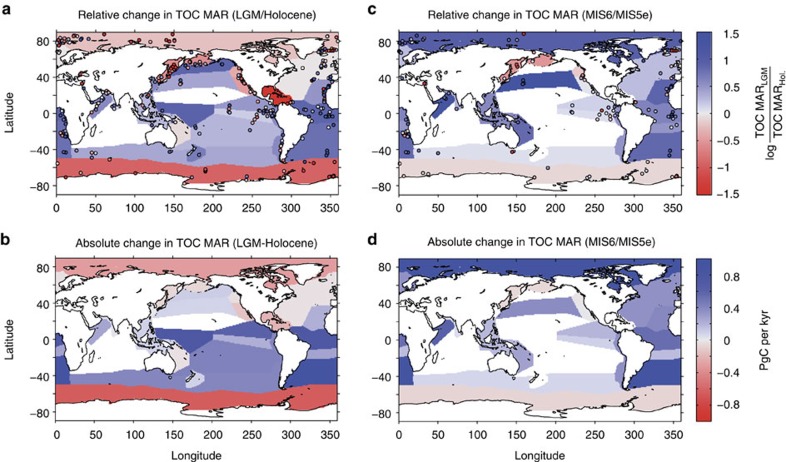
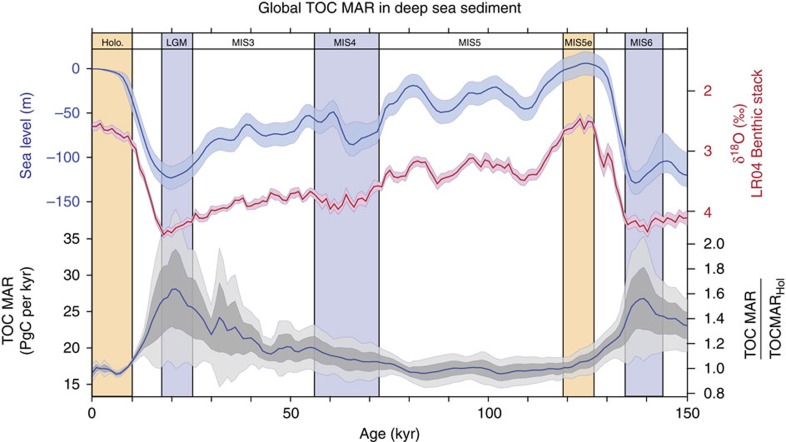
The burial of organic carbon in marine sediments removes carbon dioxide from the ocean-atmosphere pool, provides energy to the deep biosphere, and on geological timescales drives the oxygenation of the atmosphere. Here we quantify natural variations in the burial of organic carbon in deep-sea sediments over the last glacial cycle. Using a new data compilation of hundreds of sediment cores, we show that the accumulation rate of organic carbon in the deep sea was consistently higher (50%) during glacial maxima than during interglacials. The spatial pattern and temporal progression of the changes suggest that enhanced nutrient supply to parts of the surface ocean contributed to the glacial burial pulses, with likely additional contributions from more efficient transfer of organic matter to the deep sea and better preservation of organic matter due to reduced oxygen exposure. These results demonstrate a pronounced climate sensitivity for this global carbon cycle sink.
海洋沉积物中有机碳的埋藏从海洋 - 大气库中去除二氧化碳,为深层生物圈提供能量,并在地质时间尺度上推动大气的氧化。在这里,我们量化了上一个冰期旋回中深海沉积物中有机碳埋藏的自然变化。利用数百个沉积岩芯的新数据汇编,我们表明,在末次盛冰期期间,深海中有机碳的积累速率始终比间冰期高(50%)。变化的空间格局和时间进程表明,表层海洋部分区域营养物质供应的增加促成了冰期埋藏脉冲,可能还有其他因素的贡献,包括有机物质向深海的更有效转移以及由于氧气暴露减少而对有机物质更好的保存。这些结果表明这个全球碳循环汇对气候具有显著的敏感性。