Stöckigt Florian, Peche Vivek Shahaji, Linhart Markus, Nickenig Georg, Noegel Angelika Anna, Schrickel Jan Wilko
Department of Medicine - Cardiology, University Hospital Bonn, Bonn, Germany.
Institute of Biochemistry I, University of Cologne, Cologne, Germany; Center for Molecular Medicine Cologne (CMMC), Cologne Excellence Cluster on Cellular Stress Responses in Aging-Associated Diseases (CECAD), University of Cologne, Cologne, Germany.
Arch Med Sci. 2016 Feb 1;12(1):188-98. doi: 10.5114/aoms.2015.54146. Epub 2016 Feb 2.
Cyclase-associated protein 2 (CAP2) plays a major role in regulating the actin cytoskeleton. Since inactivation of CAP2 in a mouse model by a gene trap approach (Cap2 (gt/gt) ) results in cardiomyopathy and increased mortality, we hypothesized that CAP2 has a major impact on arrhythmias and electrophysiological parameters.
We performed long-term-ECG recordings in transgenic CAP2 deficient mice (C57BL/6) to detect spontaneous arrhythmias. In vivo electrophysiological studies by right heart catheterization and ex vivo epicardial mapping were used to analyze electrophysiological parameters, the inducibility of arrhythmias, and conduction velocities. Expression and distribution of cardiac connexins and the amount of cardiac fibrosis were evaluated.
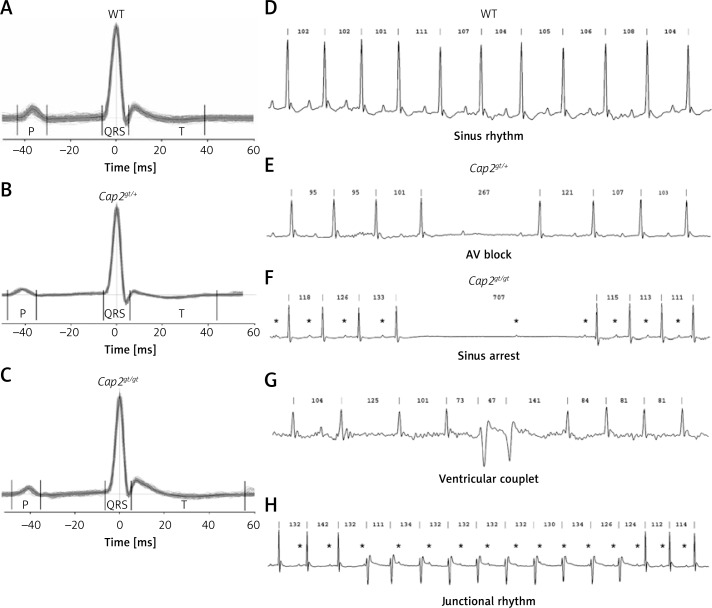
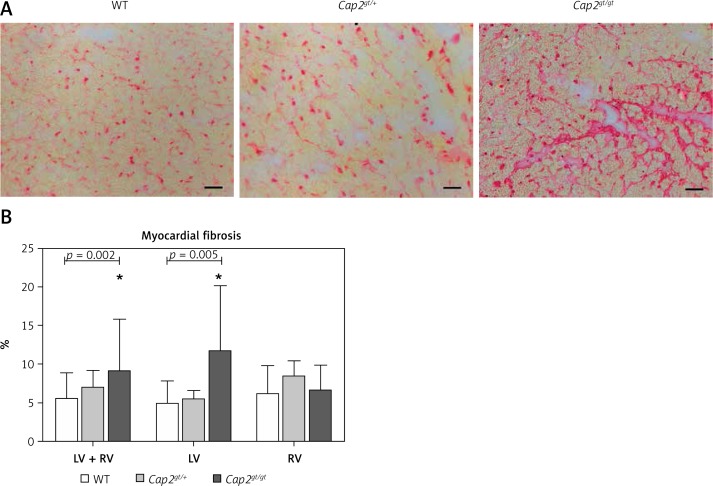
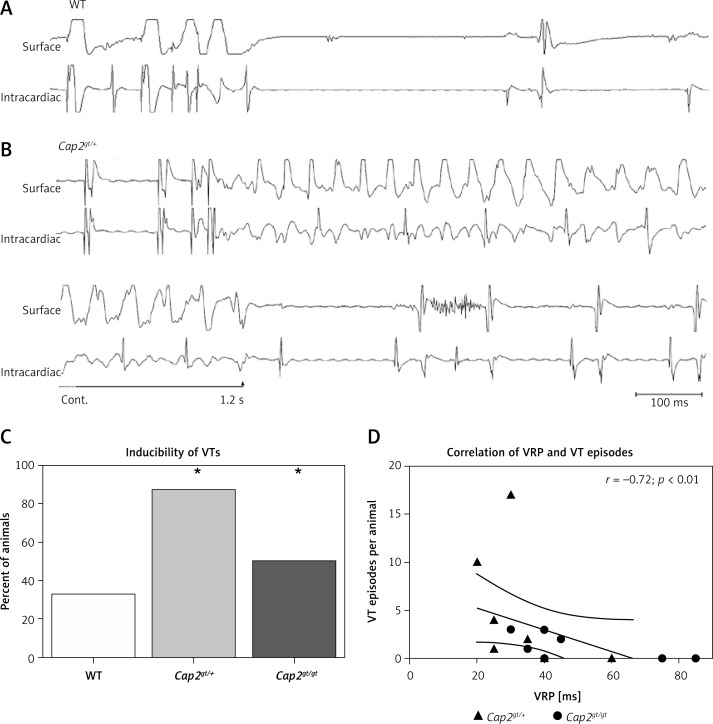
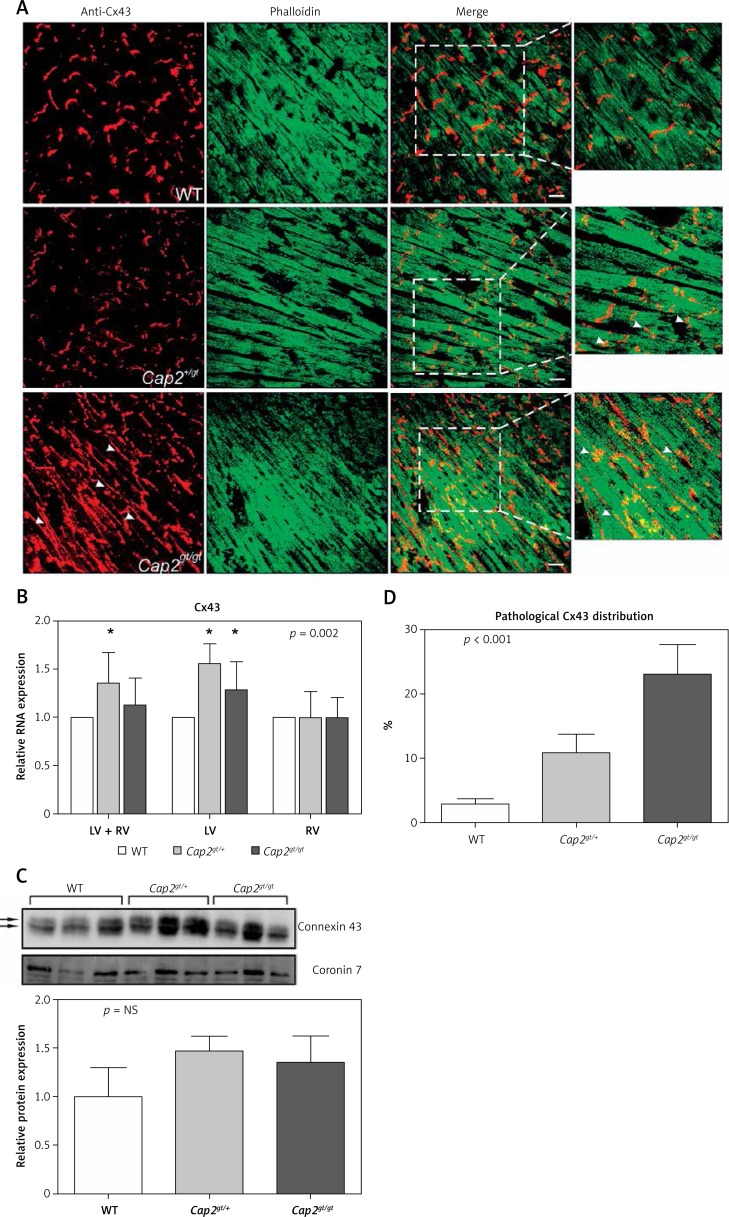
Spontaneous ventricular arrhythmias could be detected in Cap2 (gt/gt) during the long-term-ECG recording. Cap2 (gt/gt) showed marked conduction delays at atrial and ventricular levels, including a reduced heart rate (421.0 ±40.6 bpm vs. 450.8 ±27.9 bpm; p < 0.01), and prolongations of PQ (46.3 ±4.1 ms vs. 38.6 ±6.5 ms; p < 0.01), QRS (16.2 ±2.6 ms vs. 12.6 ±1.4 ms; p < 0.01), and QTc interval (55.8 ±6.0 ms vs. 45.2 ±3.3 ms; p = 0.02) in comparison to wild type mice. The PQ prolongation was due to an infra-Hisian conduction delay (HV: 9.7 ±2.1 ms vs. 6.5 ±3.1 ms; p = 0.02). The inducibility of ventricular tachycardias during the electrophysiological studies was significantly elevated in the mutant mice (inducible animals: 88% vs. 33%; p = 0.04). Cap2 (gt/gt) showed more abnormal distribution of connexin43 compared to WT (23.0 ±4.7% vs. 2.9 ±0.8%; p < 0.01). Myocardial fibrosis was elevated in Cap2 (gt/gt) hearts (9.1 ±6.7% vs. 5.5 ±3.3%; p < 0.01).
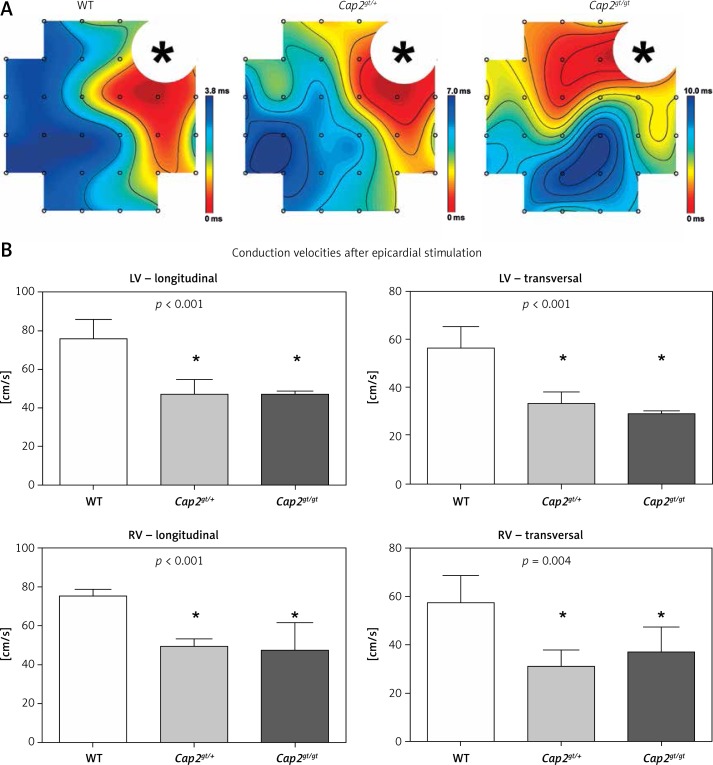
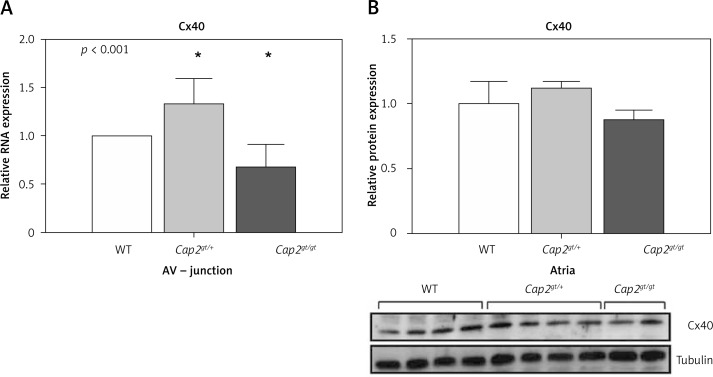
Loss of CAP2 results in marked electrophysiological disturbances including impaired sinus node function, conduction delays, and susceptibility to malignant arrhythmias. Structural changes in Cap2 (gt/gt) are associated with alterations in myocardial connexins and fibrosis.
环化酶相关蛋白2(CAP2)在调节肌动蛋白细胞骨架中起主要作用。由于通过基因陷阱方法使小鼠模型中的CAP2失活(Cap2(gt/gt))会导致心肌病和死亡率增加,我们推测CAP2对心律失常和电生理参数有重大影响。
我们对转基因CAP2缺陷小鼠(C57BL/6)进行了长期心电图记录,以检测自发性心律失常。通过右心导管插入术进行体内电生理研究,并进行离体心外膜标测,以分析电生理参数、心律失常的诱导性和传导速度。评估了心脏连接蛋白的表达和分布以及心脏纤维化的程度。
在长期心电图记录期间,Cap2(gt/gt)小鼠可检测到自发性室性心律失常。Cap2(gt/gt)小鼠在心房和心室水平均表现出明显的传导延迟,包括心率降低(421.0±40.6次/分钟对450.8±27.9次/分钟;p<0.01),PQ间期延长(46.3±4.1毫秒对38.6±6.5毫秒;p<0.01),QRS间期延长(16.2±2.6毫秒对12.6±1.4毫秒;p<0.01),以及QTc间期延长(55.8±6.0毫秒对45.2±3.3毫秒;p = 0.02)。与野生型小鼠相比,PQ间期延长是由于希氏束下传导延迟(HV:9.7±2.1毫秒对6.5±3.1毫秒;p = 0.02)。在电生理研究期间,突变小鼠室性心动过速的诱导率显著升高(可诱导动物:88%对33%;p = 0.04)。与野生型相比,Cap2(gt/gt)小鼠中连接蛋白43的分布异常更为明显(23.0±4.7%对2.9±0.8%;p<0.01)。Cap2(gt/gt)小鼠心脏中的心肌纤维化程度升高(9.1±6.7%对5.5±3.3%;p<0.01)。
CAP2的缺失导致明显的电生理紊乱,包括窦房结功能受损、传导延迟和对恶性心律失常的易感性。Cap2(gt/gt)小鼠的结构变化与心肌连接蛋白和纤维化的改变有关。