Ferreira Rafael M, Moreira Leandro M, Ferro Jesus A, Soares Marcia R R, Laia Marcelo L, Varani Alessandro M, de Oliveira Julio C F, Ferro Maria Ines T
Departamento de Tecnologia, Universidade Estadual Paulista "Júlio de Mesquita Filho", Jaboticabal, São Paulo, Brazil.
Departamento de Ciências Biológicas-Núcleo de Pesquisas em Ciências Biológicas-NUPEB, Universidade Federal de Ouro Preto, Ouro Preto, Minas Gerais, Brazil.
PeerJ. 2016 Feb 23;4:e1734. doi: 10.7717/peerj.1734. eCollection 2016.
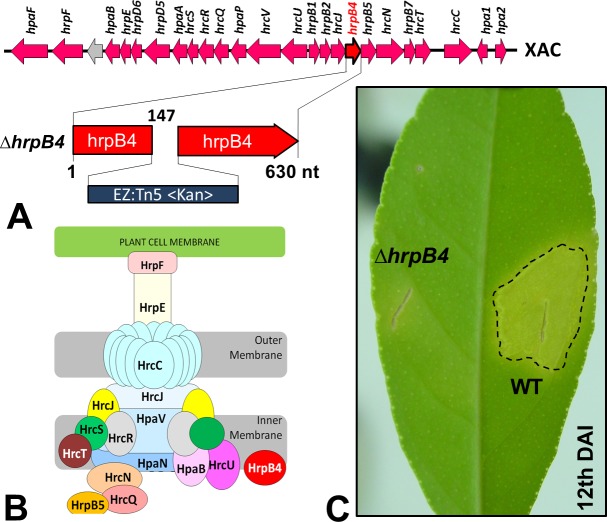
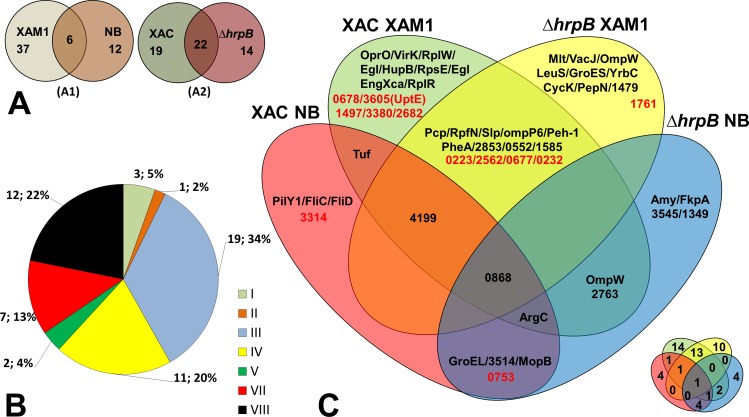
Citrus canker is a major disease affecting citrus production in Brazil. It's mainly caused by Xanthomonas citri subsp. citri strain 306 pathotype A (Xac). We analysed the differential expression of proteins secreted by wild type Xac and an asymptomatic mutant for hrpB4 (ΔhrpB4) grown in Nutrient Broth (NB) and a medium mimicking growth conditions in the plant (XAM1). This allowed the identification of 55 secreted proteins, of which 37 were secreted by both strains when cultured in XAM1. In this secreted protein repertoire, the following stand out: Virk, Polyphosphate-selective porin, Cellulase, Endoglucanase, Histone-like protein, Ribosomal proteins, five hypothetical proteins expressed only in the wild type strain, Lytic murein transglycosylase, Lipoprotein, Leucyl-tRNA synthetase, Co-chaperonin, Toluene tolerance, C-type cytochrome biogenesis membrane protein, Aminopeptidase and two hypothetical proteins expressed only in the ΔhrpB4 mutant. Furthermore, Peptidoglycan-associated outer membrane protein, Regulator of pathogenicity factor, Outer membrane proteins, Endopolygalacturonase, Chorismate mutase, Peptidyl-prolyl cis-trans isomerase and seven hypothetical proteins were detected in both strains, suggesting that there was no relationship with the secretion mediated by the type III secretory system, which is not functional in the mutant strain. Also worth mentioning is the Elongation factor Tu (EF-Tu), expressed only the wild type strain, and Type IV pilus assembly protein, Flagellin (FliC) and Flagellar hook-associated protein, identified in the wild-type strain secretome when grown only in NB. Noteworthy, that FliC, EF-Tu are classically characterized as PAMPs (Pathogen-associated molecular patterns), responsible for a PAMP-triggered immunity response. Therefore, our results highlight proteins potentially involved with the virulence. Overall, we conclude that the use of secretome data is a valuable approach that may bring more knowledge of the biology of this important plant pathogen, which ultimately can lead to the establishment of new strategies to combat citrus canker.
柑橘溃疡病是影响巴西柑橘生产的一种主要病害。它主要由柑橘溃疡病菌致病型A菌株306(Xac)引起。我们分析了野生型Xac和hrpB4无症状突变体(ΔhrpB4)在营养肉汤(NB)和模拟植物生长条件的培养基(XAM1)中生长时分泌蛋白的差异表达。这使得我们鉴定出了55种分泌蛋白,其中37种在XAM1中培养时由两种菌株共同分泌。在这个分泌蛋白库中,以下几种蛋白较为突出:Virk、多聚磷酸盐选择性孔蛋白、纤维素酶、内切葡聚糖酶、组蛋白样蛋白、核糖体蛋白、仅在野生型菌株中表达的5种假定蛋白、溶菌胞壁质转糖基酶、脂蛋白、亮氨酰 - tRNA合成酶、共伴侣蛋白、甲苯耐受性、C型细胞色素生物合成膜蛋白、氨肽酶以及仅在ΔhrpB4突变体中表达的2种假定蛋白。此外,在两种菌株中均检测到肽聚糖相关外膜蛋白、致病因子调节蛋白、外膜蛋白、内切多聚半乳糖醛酸酶、分支酸变位酶、肽基 - 脯氨酰顺反异构酶以及7种假定蛋白,这表明其与III型分泌系统介导的分泌无关,因为该突变体菌株中的III型分泌系统无功能。同样值得一提的是,延伸因子Tu(EF - Tu)仅在野生型菌株中表达,以及IV型菌毛组装蛋白、鞭毛蛋白(FliC)和鞭毛钩相关蛋白,它们在仅在NB中生长的野生型菌株分泌组中被鉴定出来。值得注意的是,FliC、EF - Tu传统上被归类为病原体相关分子模式(PAMP),负责引发PAMP触发的免疫反应。因此,我们的结果突出了可能与毒力相关的蛋白。总体而言,我们得出结论,利用分泌组数据是一种有价值的方法,可能会带来关于这种重要植物病原体生物学的更多知识,最终可导致制定防治柑橘溃疡病的新策略。