Ayzenberg Ilya, Hoepner Robert, Kleiter Ingo
Department of Neurology, St Josef Hospital, Ruhr University Bochum, Bochum, Germany.
Ther Clin Risk Manag. 2016 Feb 19;12:261-72. doi: 10.2147/TCRM.S65558. eCollection 2016.
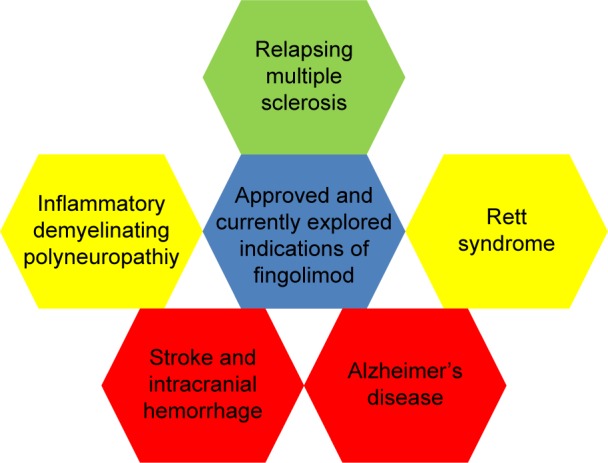
Fingolimod (FTY720), an immunotherapeutic drug targeting the sphingosine-1-phosphate receptor, is a widely used medication for relapsing-remitting multiple sclerosis (MS). Apart from the pivotal Phase III trials demonstrating efficacy against placebo and interferon-β-1a once weekly, sufficient clinical data are now available to assess its real-world efficacy and safety profile. Approved indications of fingolimod differ between countries. This discrepancy, to some extent, reflects the intermediate position of fingolimod in the expanding lineup of MS medications. With individualization of therapy, appropriate patient selection gets more important. We discuss various scenarios for fingolimod use in relapsing-remitting MS and their pitfalls: as first-line therapy, as escalation therapy after failure of previous immunotherapies, and as de-escalation therapy following highly potent immunotherapies. Potential side effects such as bradycardia, infections, macular edema, teratogenicity, and progressive multifocal leukoencephalopathy as well as appropriate safety precautions are outlined. Disease reactivation has been described upon fingolimod cessation; therefore, patients should be closely monitored for MS activity for several months after stopping fingolimod. Finally, we discuss preclinical and clinical data indicating neuroprotective effects of fingolimod, which might open the way to future indications such as stroke, Alzheimer's disease, and other neurodegenerative disorders.
芬戈莫德(FTY720)是一种靶向鞘氨醇-1-磷酸受体的免疫治疗药物,是复发缓解型多发性硬化症(MS)广泛使用的药物。除了关键的III期试验证明其对安慰剂和每周一次的干扰素-β-1a有效外,现在有足够的临床数据来评估其实际疗效和安全性。芬戈莫德在不同国家的获批适应症有所不同。这种差异在一定程度上反映了芬戈莫德在不断扩大的MS药物阵容中的中间地位。随着治疗的个体化,合适的患者选择变得更加重要。我们讨论了芬戈莫德在复发缓解型MS中的各种使用情况及其陷阱:作为一线治疗、作为先前免疫治疗失败后的升级治疗以及作为强效免疫治疗后的降级治疗。概述了潜在的副作用,如心动过缓、感染、黄斑水肿、致畸性和进行性多灶性白质脑病以及适当的安全预防措施。在停用芬戈莫德后已描述了疾病再激活;因此,在停用芬戈莫德后应密切监测患者数月的MS活动情况。最后,我们讨论了表明芬戈莫德具有神经保护作用的临床前和临床数据,这可能为未来的适应症,如中风、阿尔茨海默病和其他神经退行性疾病开辟道路。