Cheng Nai-Ming, Fang Yu-Hua Dean, Tsan Din-Li, Hsu Ching-Han, Yen Tzu-Chen
Departments of Nuclear Medicine, Chang Gung Memorial Hospita, Linkou, Chang Gung University College of Medicine, Taoyuan City 33305, Taiwan.
Department of Biomedical Engineering and Environmental Sciences, National Tsing Hua University, Hsinchu City, 30071, Taiwan.
PLoS One. 2016 Mar 1;11(3):e0150509. doi: 10.1371/journal.pone.0150509. eCollection 2016.
We compared attenuation correction of PET images with helical CT (PET/HCT) and respiration-averaged CT (PET/ACT) in patients with non-small-cell lung cancer (NSCLC) with the goal of investigating the impact of respiration-averaged CT on 18F FDG PET texture parameters.
A total of 56 patients were enrolled. Tumors were segmented on pretreatment PET images using the adaptive threshold. Twelve different texture parameters were computed: standard uptake value (SUV) entropy, uniformity, entropy, dissimilarity, homogeneity, coarseness, busyness, contrast, complexity, grey-level nonuniformity, zone-size nonuniformity, and high grey-level large zone emphasis. Comparisons of PET/HCT and PET/ACT were performed using Wilcoxon signed-rank tests, intraclass correlation coefficients, and Bland-Altman analysis. Receiver operating characteristic (ROC) curves as well as univariate and multivariate Cox regression analyses were used to identify the parameters significantly associated with disease-specific survival (DSS). A fixed threshold at 45% of the maximum SUV (T45) was used for validation.
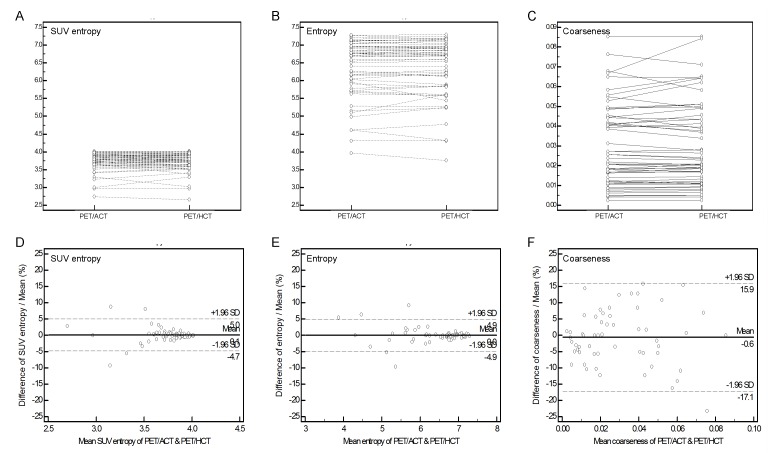
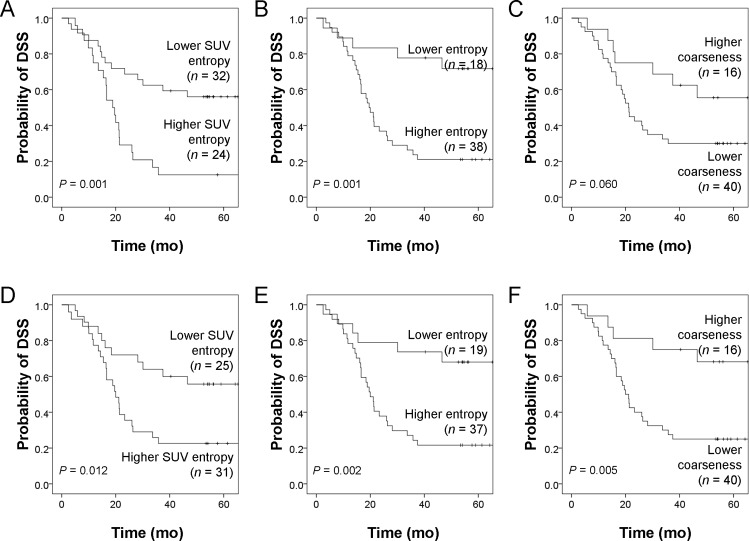
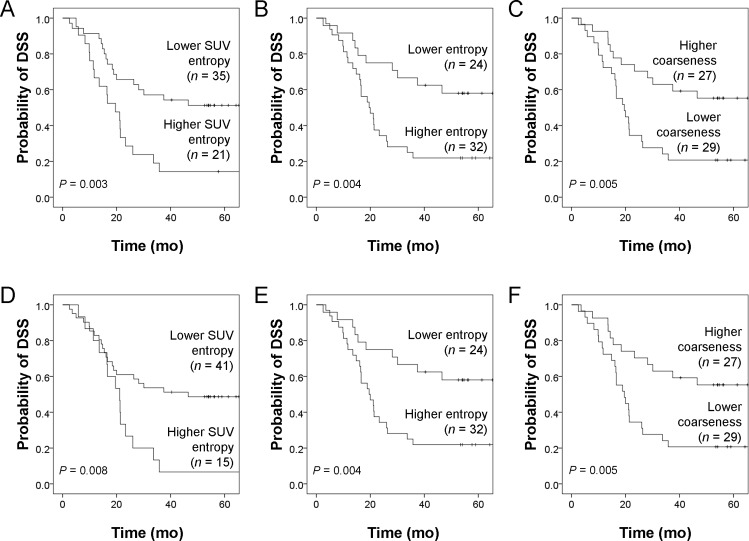
SUV maximum and total lesion glycolysis (TLG) were significantly higher in PET/ACT. However, texture parameters obtained with PET/ACT and PET/HCT showed a high degree of agreement. The lowest levels of variation between the two modalities were observed for SUV entropy (9.7%) and entropy (9.8%). SUV entropy, entropy, and coarseness from both PET/ACT and PET/HCT were significantly associated with DSS. Validation analyses using T45 confirmed the usefulness of SUV entropy and entropy in both PET/HCT and PET/ACT for the prediction of DSS, but only coarseness from PET/ACT achieved the statistical significance threshold.
Our results indicate that 1) texture parameters from PET/ACT are clinically useful in the prediction of survival in NSCLC patients and 2) SUV entropy and entropy are robust to attenuation correction methods.
我们比较了非小细胞肺癌(NSCLC)患者中,PET图像与螺旋CT(PET/HCT)及呼吸平均CT(PET/ACT)的衰减校正,目的是研究呼吸平均CT对18F FDG PET纹理参数的影响。
共纳入56例患者。使用自适应阈值在治疗前PET图像上分割肿瘤。计算了12种不同的纹理参数:标准摄取值(SUV)熵、均匀性、熵、差异性、同质性、粗糙度、繁忙度、对比度、复杂性、灰度非均匀性、区域大小非均匀性以及高灰度大区域强调。使用Wilcoxon符号秩检验、组内相关系数和Bland-Altman分析对PET/HCT和PET/ACT进行比较。采用受试者操作特征(ROC)曲线以及单变量和多变量Cox回归分析来确定与疾病特异性生存(DSS)显著相关的参数。使用最大SUV的45%处的固定阈值(T45)进行验证。
PET/ACT中的SUV最大值和总病变糖酵解(TLG)显著更高。然而,PET/ACT和PET/HCT获得的纹理参数显示出高度一致性。两种模式之间变化最小的是SUV熵(9.7%)和熵(9.8%)。PET/ACT和PET/HCT的SUV熵、熵和粗糙度均与DSS显著相关。使用T45的验证分析证实了PET/HCT和PET/ACT中的SUV熵和熵在预测DSS方面的有用性,但只有PET/ACT的粗糙度达到了统计学意义阈值。
我们的结果表明:1)PET/ACT的纹理参数在预测NSCLC患者生存方面具有临床实用性;2)SUV熵和熵对衰减校正方法具有鲁棒性。