Zhong Zhi-Ming, Shen Zhen-Xi, Fu Gang
Lhasa Plateau Ecosystem Research Station, Key Laboratory of Ecosystem Network Observation and Modeling, Institute of Geographic Sciences and Natural Resources Research, Chinese Academy of Sciences, Beijing, 100101 China.
Springerplus. 2016 Feb 20;5:137. doi: 10.1186/s40064-016-1761-0. eCollection 2016.
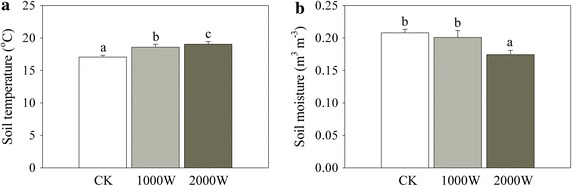
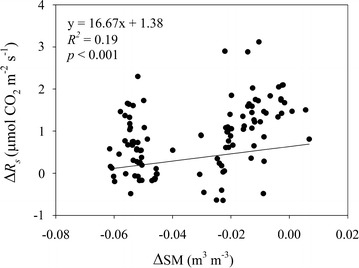
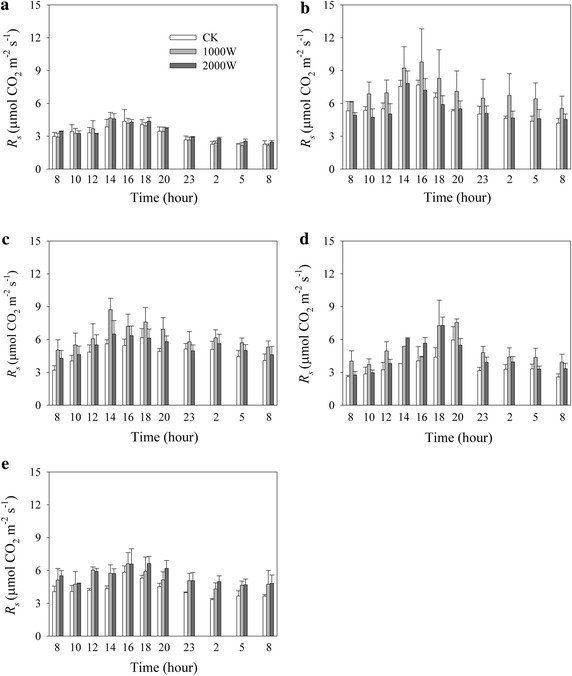
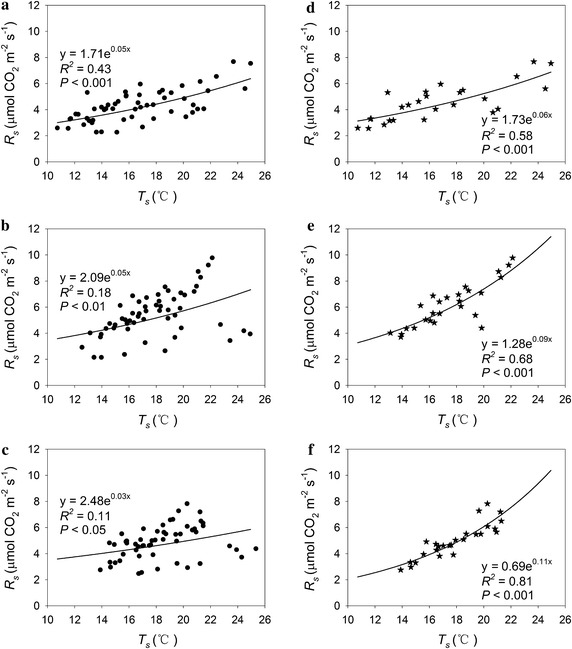
Highland barley is an important dominant crop in the Tibet and the croplands of the Tibet are experiencing obvious climatic warming. However, information about how soil respiration will respond to climatic warming in the highland barley system is still lacking. A field warming experiment using infrared heaters with two warming magnitudes was conducted in a highland barley system of the Tibet in May 2014. Five daily cycles of soil respiration was measured using a CO2 flux system (Li-8100, Li-COR Biosciences, Lincoln, NE, USA) during the period from early June to early September in 2014. The high and low experimental warming significantly increased soil temperature by 1.98 and 1.52 °C over the whole study period, respectively. The high experimental warming significantly decreased soil moisture. Soil respiration and its temperature sensitivity did not significantly change under both the high and low experimental warming. The response of soil respiration to experimental warming did not linearly correlate with warming magnitudes because a greater experimental warming resulted in a higher soil drying. Our findings suggested that clarifying the response of soil CO2 production and its temperature sensitivity to climatic warming need consider water availability in the highland barley system of the Tibet.
青稞是西藏重要的优势作物,且西藏的农田正经历着显著的气候变暖。然而,关于土壤呼吸在青稞系统中如何响应气候变暖的信息仍然匮乏。2014年5月,在西藏的一个青稞系统中利用红外加热器进行了一项有两个增温幅度的田间增温实验。在2014年6月初至9月初期间,使用二氧化碳通量系统(Li-8100,美国内布拉斯加州林肯市Li-COR生物科学公司)测量了五个每日周期的土壤呼吸。在整个研究期间,高、低实验增温分别使土壤温度显著升高了1.98℃和1.52℃。高实验增温显著降低了土壤湿度。在高、低实验增温条件下,土壤呼吸及其温度敏感性均未发生显著变化。土壤呼吸对实验增温的响应与增温幅度并非线性相关,因为更大的实验增温导致了更高的土壤干燥程度。我们的研究结果表明,在西藏的青稞系统中,阐明土壤二氧化碳产生及其温度敏感性对气候变暖的响应需要考虑水分有效性。