Hartel Maximilian J, Petersik Andreas, Schmidt Anne, Kendoff Daniel, Nüchtern Jakob, Rueger Johannes M, Lehmann Wolfgang, Grossterlinden Lars G
Department of Trauma, Hand and Reconstructive Surgery, University Medical Center Hamburg-Eppendorf, Germany.
Stryker Trauma GmbH, Kiel-Schönkirchen, Germany.
PLoS One. 2016 Mar 2;11(3):e0149480. doi: 10.1371/journal.pone.0149480. eCollection 2016.
Exact knowledge of femoral neck inclination and torsion angles is important in recognizing, understanding and treating pathologic conditions in the hip joint. However, published results vary widely between different studies, which indicates that there are persistent difficulties in carrying out exact measurements.
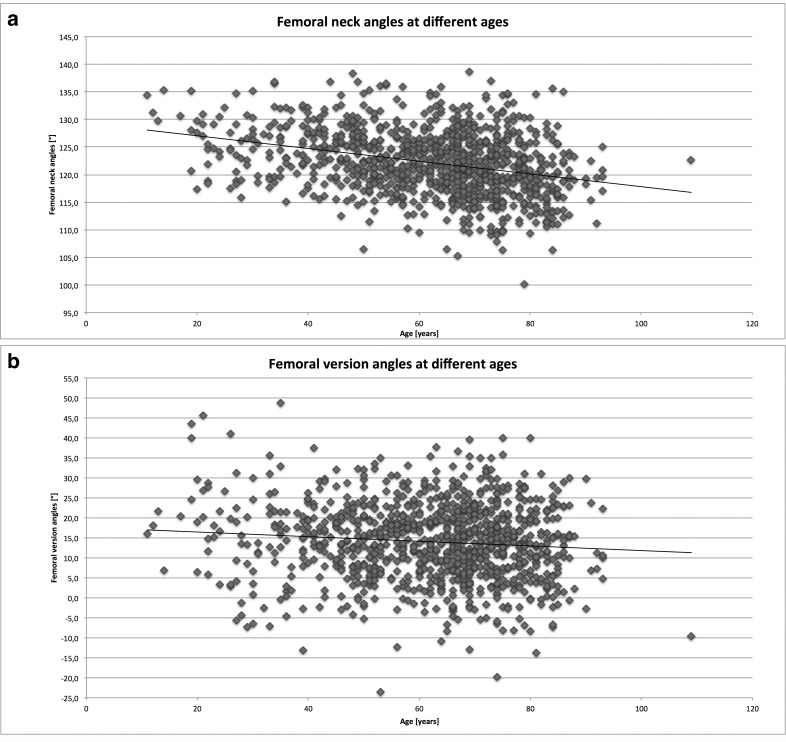
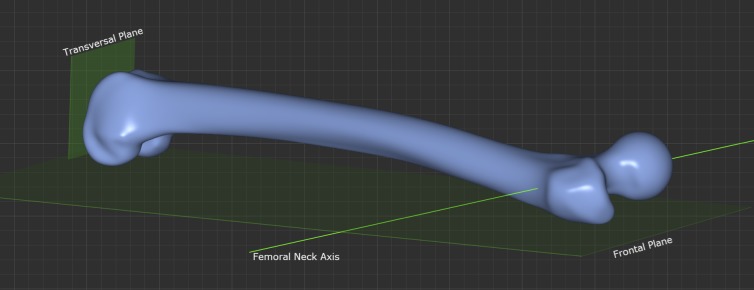
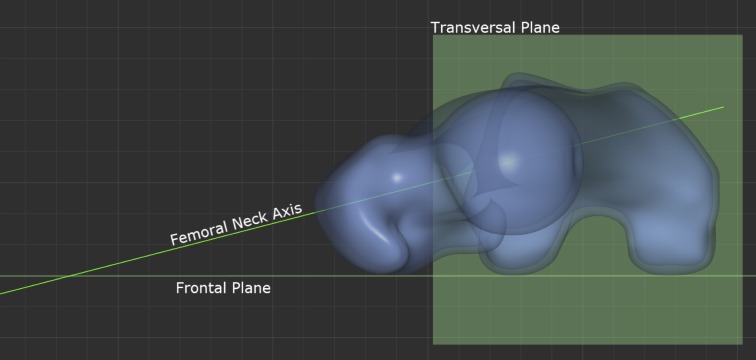
A three dimensional modeling and analytical technology was used for the analysis of 1070 CT datasets of skeletally mature femurs. Individual femoral neck angles and torsion angles were precisely computed, in order to establish whether gender, age, body mass index and ethnicity influence femoral neck angles and torsion angles.
The median femoral neck angle was 122.2° (range 100.1-146.2°, IQR 117.9-125.6°). There are significant gender (female 123.0° vs. male 121.5°; p = 0.007) and ethnic (Asian 123.2° vs. Caucasian 121.9°; p = 0.0009) differences. The median femoral torsion angle was 14.2° (-23.6-48.7°, IQR 7.4-20.4°). There are significant gender differences (female 16.4° vs. male 12.1°; p = 0.0001). Femoral retroversion was found in 7.8% of the subjects.
Precise femoral neck and torsion angles were obtained in over one thousand cases. Systematic deviations in measurement due to human error were eliminated by using automated high accuracy morphometric analysis. Small but significant gender and ethnic differences were found in femoral neck and torsion angles.
准确了解股骨颈倾斜角和扭转角对于识别、理解和治疗髋关节疾病至关重要。然而,不同研究发表的结果差异很大,这表明在进行精确测量方面仍存在持续困难。
采用三维建模和分析技术对1070例骨骼成熟股骨的CT数据集进行分析。精确计算个体的股骨颈角和扭转角,以确定性别、年龄、体重指数和种族是否会影响股骨颈角和扭转角。
股骨颈角中位数为122.2°(范围100.1 - 146.2°,四分位间距117.9 - 125.6°)。存在显著的性别差异(女性123.0° vs. 男性121.5°;p = 0.007)和种族差异(亚洲人123.2° vs. 白种人121.9°;p = 0.0009)。股骨扭转角中位数为14.2°(-23.6 - 48.7°,四分位间距7.4 - 20.4°)。存在显著的性别差异(女性16.4° vs. 男性12.1°;p = 0.0001)。7.8%的受试者存在股骨前倾。
在一千多例病例中获得了精确的股骨颈角和扭转角。通过使用自动化高精度形态测量分析消除了人为误差导致的测量系统偏差。在股骨颈角和扭转角方面发现了虽小但显著的性别和种族差异。