Perić Zinaida, Desnica Lana, Duraković Nadira, Ostojić Alen, Pulanić Dražen, Serventi-Seiwerth Ranka, Prenc Ema, Basak Grzegorz, Vrhovac Radovan, Pavletic Steven Z, Nemet Damir
Zinaida Perić, Department of Internal Medicine, University of Zagreb, School of Medicine, Zagreb, Croatia,
Croat Med J. 2016 Feb;57(1):6-15. doi: 10.3325/cmj.2016.57.6.
To investigate the ability of two standard quality of life (QOL) questionnaires - The Short Form (36-item) Health Survey (SF-36) and The European Organisation for Research and Treatment of Cancer Quality of Life Questionnaire-Core 30 (EORTC QLQ C30) to evaluate QOL in patients with chronic graft-vs-host disease (cGVHD) graded according to National Institutes of Health (NIH) consensus criteria.
In this cross-sectional study, QOL was assessed in patients who underwent allogeneic stem cell transplantation (allo-SCT) at the University Hospital Centre Zagreb and were alive and in complete remission for more than one year after allo-SCT.
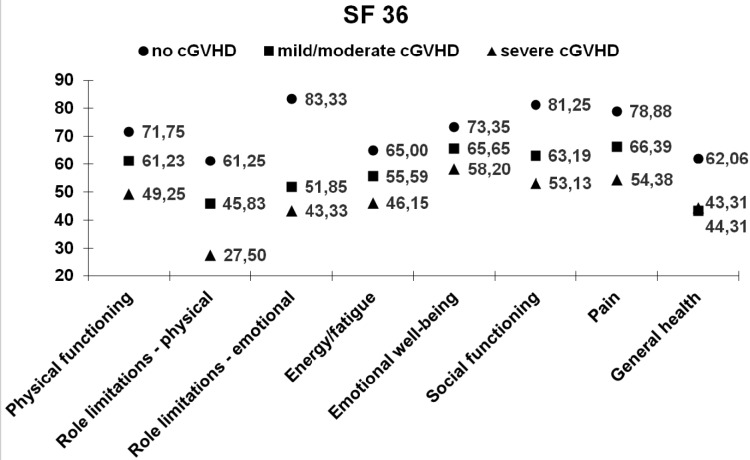
The study included 58 patients, 38 patients with cGVHD and 20 controls, patients without cGVHD. Patients with cGVHD scored according to the NIH criteria had significantly lower scores of global health status and lower QOL on all SF-36 subscales and most of QLQ C30 functional subscales (P<0.050 for all comparisons). Furthermore, patients with active cGVHD had significantly lower QOL scores than patients with inactive cGVHD, and this difference was most evident in physical functioning subscale of SF-36 (P=0.0007) and social functioning subscale of QLQ C30 (P=0.009).
cGVHD scored according to the NIH criteria is correlated with patient-reported QOL, particularly in the physical domains as detected by SF-36. QLQ C30 questionnaire adds more information on social functioning and should be used as a valuable tool in the evaluation of social domains in cGVHD patients.
研究两种标准生活质量(QOL)问卷——简明健康状况调查量表(SF - 36)和欧洲癌症研究与治疗组织生活质量核心问卷30(EORTC QLQ C30)评估根据美国国立卫生研究院(NIH)共识标准分级的慢性移植物抗宿主病(cGVHD)患者生活质量的能力。
在这项横断面研究中,对在萨格勒布大学医院中心接受异基因干细胞移植(allo - SCT)且在allo - SCT后存活且完全缓解超过一年的患者进行生活质量评估。
该研究纳入了58例患者,38例cGVHD患者和20例对照,即无cGVHD的患者。根据NIH标准评分的cGVHD患者在整体健康状况方面得分显著更低,并且在所有SF - 36子量表以及大多数QLQ C30功能子量表上的生活质量得分也更低(所有比较的P < 0.050)。此外,活动性cGVHD患者的生活质量得分显著低于非活动性cGVHD患者,这种差异在SF - 36的身体功能子量表(P = 0.0007)和QLQ C30的社会功能子量表(P = 0.009)中最为明显。
根据NIH标准评分的cGVHD与患者报告的生活质量相关,尤其是在SF - 36检测到的身体领域。QLQ C30问卷在社会功能方面提供了更多信息,应作为评估cGVHD患者社会领域的有价值工具。