Cornet Edouard, Mossafa Hossein, Courel Karine, Lesesve Jean-François, Troussard Xavier
Laboratory of Hematology, Caen University Hospital, Caen, 14000, France.
University of Caen, Medical School, Caen, 14000, France.
BMC Res Notes. 2016 Mar 2;9:138. doi: 10.1186/s13104-015-1742-3.
Persistent Polyclonal Binucleated B-cell Lymphocytosis (PPBL) is characterized by a chronic polyclonal B-cell lymphocytosis with binucleated lymphocytes and a polyclonal increase in serum immunoglobulin-M. Cytogenetic is characterized by the presence of a supernumerary isochromosome +i(3)(q10), premature chromosome condensation and chromosomal instability. Outcome of PPBL patients is mostly benign, but subsequent malignancies could occur. The aim of our study is to provide an update of clinical and cytogenetic characteristics of our large cohort of PPBL patients, to describe subsequent malignancies occurring during the follow-up, and to investigate the role of the long arm of chromosome 3 in PPBL.
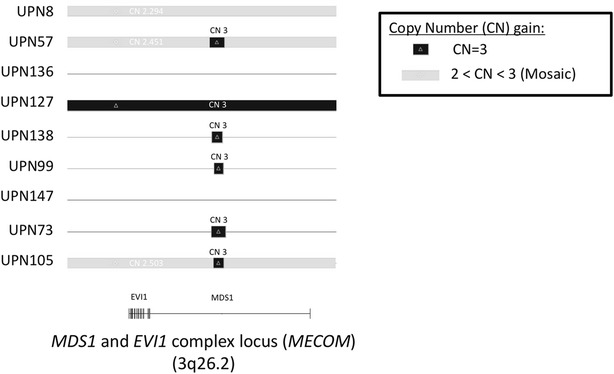
We analyzed clinical, biological and cytogenetic characteristics (conventional cytogenetic analysis and fluorescent in situ hybridization) of 150 patients diagnosed with PPBL. We performed high-resolution SNP arrays in 10 PPBL patients, comparing CD19(+) versus CD19(-) lymphoid cells. We describe the cytogenetic characteristics in 150 PPBL patients consisting in the presence of supernumerary isochromosome +i(3)(q10) (59%) and chromosomal instability (55%). In CD19(+) B-cells, we observed recurrent copy number aberrations of 143 genes with 129 gains (90%) on 3q and a common minimal amplified genomic region in the MECOM gene. After a median follow-up of 60 months, we observed the occurrence of 12 subsequent malignancies (12%), 6 solid tumors and 6 Non-Hodgkin's Lymphomas, and 6 monoclonal gammopathies of undetermined significance (MGUS), requiring a long-term clinical follow-up.
Our clinical and cytogenetic observations lead us to hypothesize that isochromosome 3q, especially MECOM abnormality, could play a key role in PPBL.
持续性多克隆双核B细胞淋巴细胞增多症(PPBL)的特征为慢性多克隆B细胞淋巴细胞增多伴双核淋巴细胞以及血清免疫球蛋白M多克隆性升高。细胞遗传学特征为存在额外的等臂染色体+i(3)(q10)、染色体早熟凝集和染色体不稳定性。PPBL患者的预后大多为良性,但后续可能发生恶性肿瘤。我们研究的目的是更新我们大队列PPBL患者的临床和细胞遗传学特征,描述随访期间发生的后续恶性肿瘤,并研究3号染色体长臂在PPBL中的作用。
我们分析了150例诊断为PPBL患者的临床、生物学和细胞遗传学特征(传统细胞遗传学分析和荧光原位杂交)。我们对10例PPBL患者进行了高分辨率SNP阵列分析,比较CD19(+)与CD19(-)淋巴细胞。我们描述了150例PPBL患者的细胞遗传学特征,包括存在额外的等臂染色体+i(3)(q10)(59%)和染色体不稳定性(55%)。在CD19(+)B细胞中,我们观察到143个基因反复出现拷贝数异常,其中129个在3q上有增益(90%),且在MECOM基因中有一个常见的最小扩增基因组区域。中位随访60个月后,我们观察到12例后续恶性肿瘤(12%)发生,6例实体瘤、6例非霍奇金淋巴瘤以及6例意义未明的单克隆丙种球蛋白病(MGUS),需要长期临床随访。
我们的临床和细胞遗传学观察结果使我们推测3号染色体长臂,尤其是MECOM异常,可能在PPBL中起关键作用。