Foster Chris M, Addis Donna Rose, Ford Jaclyn H, Kaufer Daniel I, Burke James R, Browndyke Jeffrey N, Welsh-Bohmer Kathleen A, Giovanello Kelly S
Department of Psychology, The University of North Carolina, Chapel Hill, NC, United States.
Department of Psychology and the Centre for Brain Research, The University of Auckland, Auckland, New Zealand.
Neuroimage Clin. 2016 Jan 15;11:158-166. doi: 10.1016/j.nicl.2016.01.008. eCollection 2016.
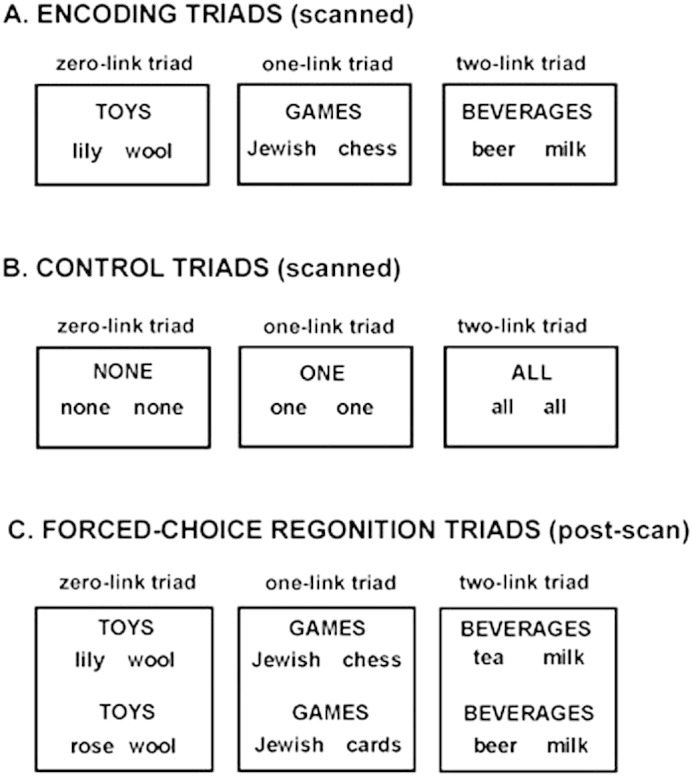
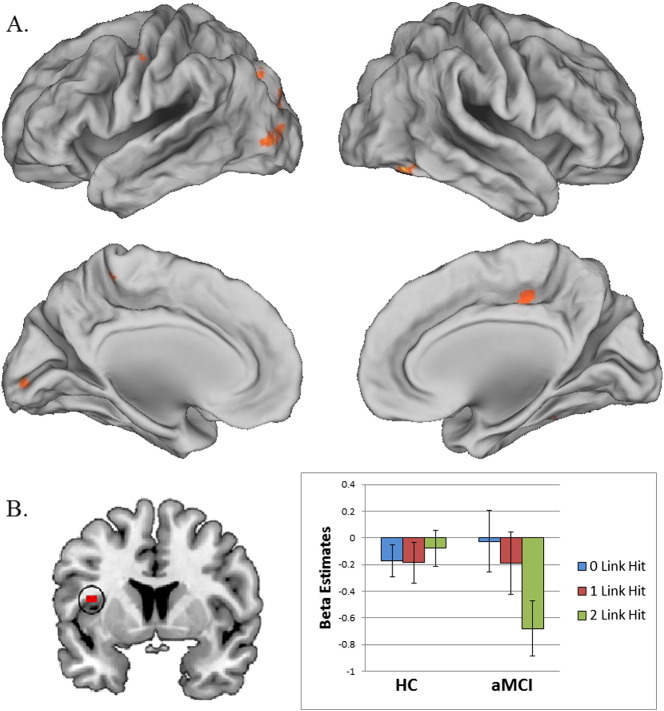
Relational memory declines are well documented as an early marker for amnestic mild cognitive impairment (aMCI). Episodic memory formation relies on relational processing supported by two mnemonic mechanisms, generation and binding. Neuroimaging studies using functional magnetic resonance imaging (fMRI) have primarily focused on binding deficits which are thought to be mediated by medial temporal lobe dysfunction. In this study, prefrontal contributions to relational encoding were also investigated using fMRI by parametrically manipulating generation demands during the encoding of word triads. Participants diagnosed with aMCI and healthy control subjects encoded word triads consisting of a category word with either, zero, one, or two semantically related exemplars. As the need to generate increased (i.e., two- to one- to zero-link triads), both groups recruited a core set of regions associated with the encoding of word triads including the parahippocampal gyrus, superior temporal gyrus, and superior parietal lobule. Participants diagnosed with aMCI also parametrically recruited several frontal regions including the inferior frontal gyrus and middle frontal gyrus as the need to generate increased, whereas the control participants did not show this modulation. While there is some functional overlap in regions recruited by generation demands between the groups, the recruitment of frontal regions in the aMCI participants coincides with worse memory performance, likely representing a form of neural inefficiency associated with Alzheimer's disease.
关系记忆衰退作为遗忘型轻度认知障碍(aMCI)的早期标志物已有充分记录。情景记忆的形成依赖于由生成和绑定这两种记忆机制支持的关系处理。使用功能磁共振成像(fMRI)的神经影像学研究主要关注被认为由内侧颞叶功能障碍介导的绑定缺陷。在本研究中,还通过在对三联词进行编码时对生成需求进行参数化操作,使用fMRI研究了前额叶对关系编码的贡献。被诊断为aMCI的参与者和健康对照受试者对由一个类别词以及零个、一个或两个语义相关示例组成的三联词进行编码。随着生成需求的增加(即从两个相关示例到一个相关示例再到零个相关示例的三联词),两组都激活了一组与三联词编码相关的核心区域,包括海马旁回、颞上回和顶上小叶。被诊断为aMCI的参与者在生成需求增加时还会参数化地激活几个额叶区域包括额下回和额中回,而对照参与者则未表现出这种调节。虽然两组之间因生成需求而激活的区域存在一些功能重叠,但aMCI参与者中额叶区域的激活与较差的记忆表现一致,这可能代表了一种与阿尔茨海默病相关的神经效率低下的形式。