Ravn Kirstine, Schönewolf-Greulich Bitten, Hansen Rikke M, Bohr Anna-Helene, Duno Morten, Wibrand Flemming, Ostergaard Elsebet
Department of Clinical Genetics, Copenhagen University Hospital Rigshospitalet, Blegdamsvej 9, Copenhagen, Denmark.
Department of Clinical Genetics, Kennedy Center, Copenhagen University Hospital, Rigshospitalet, Glostrup, Denmark.
Mol Genet Metab Rep. 2015 Feb 20;3:5-10. doi: 10.1016/j.ymgmr.2015.01.004. eCollection 2015 Jun.
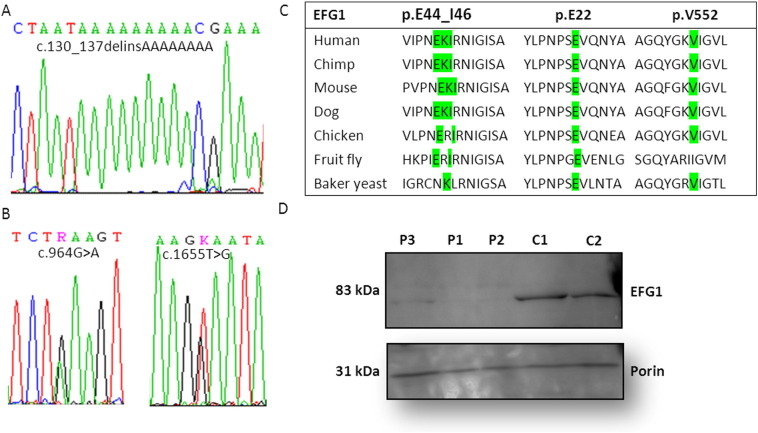
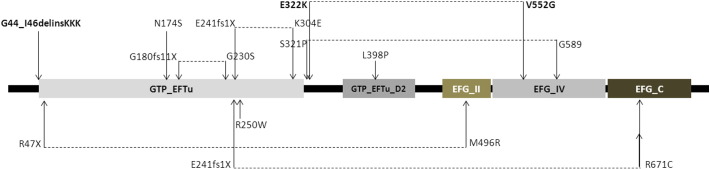
Disorders caused by defects in the mitochondrial translation system are clinically and genetically heterogeneous. The elongation phase of mitochondrial protein synthesis requires, among many other components, three nuclear-encoded elongation factors: EFTu (TUFM; 602389), EFTs (TSFM; 604723), and EFG1 (GFM1; 606639). Mutations have been identified in the genes encoding all three elongation factors, and they result in combined respiratory chain deficiencies and severe phenotypes with an early fatal outcome. So far, only eleven patients have been reported with mutations in GFM1. Here we describe an additional three patients with novel GFM1 mutations. Our results confirm the tissue-specific effect of GFM1 mutations, since we found only slightly decreased respiratory chain enzyme activities in muscle and fibroblasts, but a severe deficiency in the liver. Hence, a thorough biochemical evaluation is important to guide genetic investigation in patients suspected for a mitochondrial disorder.
由线粒体翻译系统缺陷引起的疾病在临床和遗传上具有异质性。线粒体蛋白质合成的延伸阶段除许多其他成分外,还需要三种核编码的延伸因子:EFTu(TUFM;602389)、EFTs(TSFM;604723)和EFG1(GFM1;606639)。已在编码所有三种延伸因子的基因中鉴定出突变,这些突变导致呼吸链联合缺陷和严重表型,并早期致命。到目前为止,仅报道了11例GFM1突变患者。在此,我们描述另外3例具有新型GFM1突变的患者。我们的结果证实了GFM1突变的组织特异性效应,因为我们发现肌肉和成纤维细胞中的呼吸链酶活性仅略有下降,但肝脏中存在严重缺陷。因此,全面的生化评估对于指导疑似线粒体疾病患者的基因研究很重要。