Weng Xiaoyuan, Zheng Song, Shui Hanli, Lin Guosheng, Zhou Yongjian
Department of Surgery, Department of Clinical Medicine, Quanzhou Medical College, Quanzhou, Fujian 362010, P.R. China.
Department of Medical Oncology, Affiliated Hangzhou First People's Hospital, Zhejiang Chinese Medical University Affiliated Hangzhou First Hospital, Hangzhou, Zhejiang 310006, P.R. China.
Oncol Lett. 2020 Nov;20(5):250. doi: 10.3892/ol.2020.12113. Epub 2020 Sep 17.
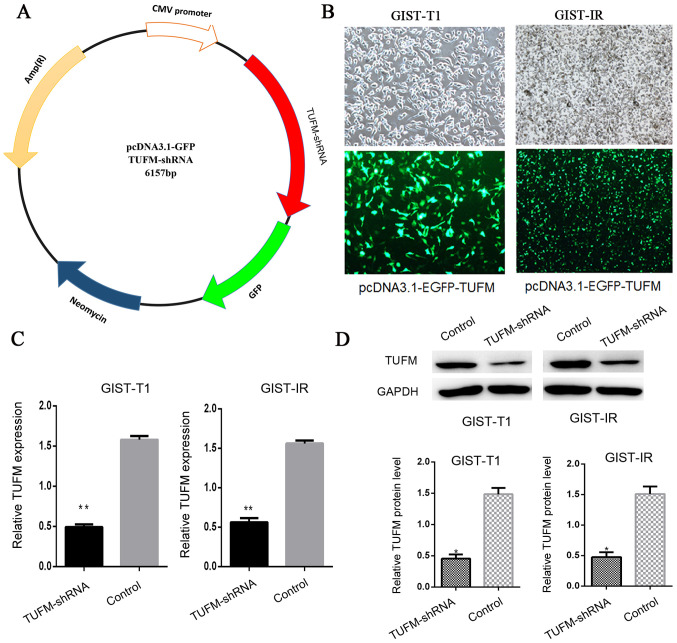
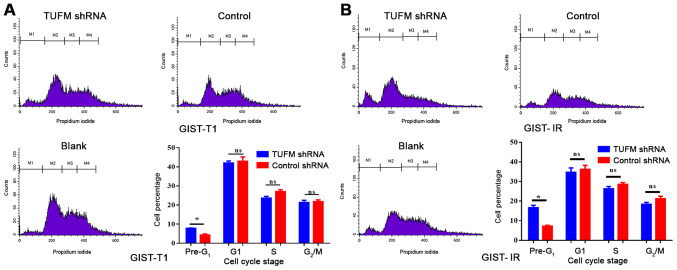
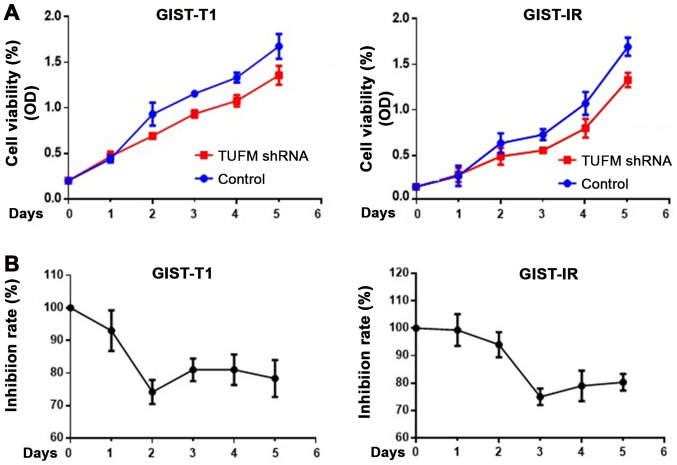
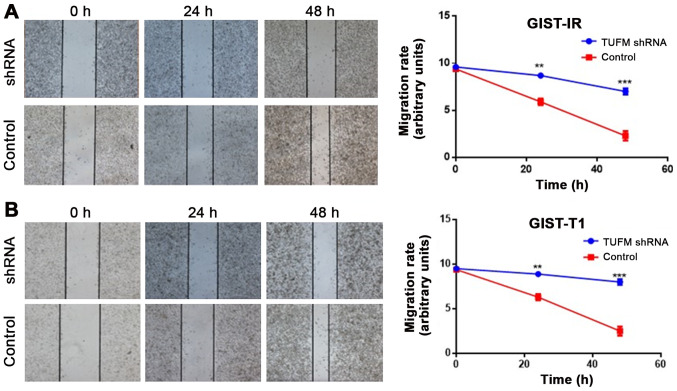
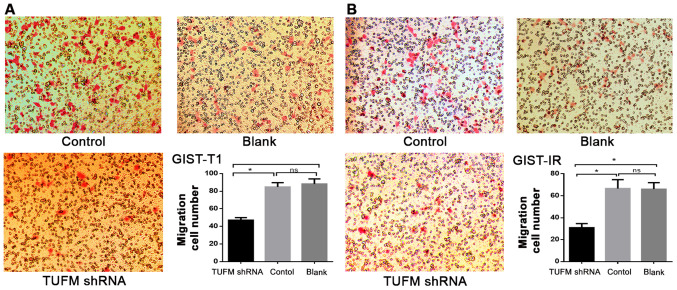
Gastrointestinal stromal tumors (GISTs) are the most common pathologic type of mesenchymal tumor in the digestive tract. Patients with GIST face the risk of metastasis, postoperative recurrence and imatinib mesylate (IM) resistance. Mitochondrial Tu translation elongation factor (TUFM) is highly expressed in GISTs, and is associated with oncogenesis, progression and prognosis. There is evidence that TUFM is involved in tumor invasion and metastasis. However, the effect of TUFM on GIST-T1 cells and the IM-resistant GIST-IR cell line remains unclear. The present study aimed to evaluate the effects of TUFM on the proliferation, migration and apoptosis of GIST cells . TUFM short hairpin (sh)RNA expression plasmids were transfected into GIST-T1 and GIST-IR cells by electroporation. The expression levels of enhanced green fluorescent protein were observed by fluorescence microscopy to evaluate the electroporation efficiency. The expression levels of TUFM were detected by western blot analysis and reverse transcription-quantitative PCR. Cell proliferation was assessed by counting cells and using a Cell Counting Kit-8 assay. Cell migration was analyzed using wound healing and Transwell migration assays. Cell cycle distribution and late apoptosis were assessed by flow cytometry. TUFM shRNA expression plasmids were successfully transfected into the GIST cell line by electroporation. The transfection efficiency was >75%, and the TUFM gene silencing efficiency was 73.2±1.4%. TUFM-knockdown decreased the proliferation and migration capacity of GIST-T1 and GIST-IR cells. The proportion of cells in the pre-G1 stage was increased without change in the proportions of cells in the G, S and G/M stages after TUFM silencing in GIST-T1 and GIST-IR cells. TUFM may be related to GIST infiltration and metastatic recurrence, suggesting that TUFM may be an effective target for preventing the progression and metastasis of GISTs.
胃肠道间质瘤(GISTs)是消化道中最常见的间充质肿瘤病理类型。GIST患者面临转移、术后复发和甲磺酸伊马替尼(IM)耐药的风险。线粒体Tu翻译延伸因子(TUFM)在GISTs中高表达,且与肿瘤发生、进展及预后相关。有证据表明TUFM参与肿瘤侵袭和转移。然而,TUFM对GIST-T1细胞和IM耐药的GIST-IR细胞系的影响仍不清楚。本研究旨在评估TUFM对GIST细胞增殖、迁移和凋亡的影响。通过电穿孔将TUFM短发夹(sh)RNA表达质粒转染至GIST-T1和GIST-IR细胞中。通过荧光显微镜观察增强型绿色荧光蛋白的表达水平以评估电穿孔效率。采用蛋白质免疫印迹分析和逆转录-定量PCR检测TUFM的表达水平。通过细胞计数和使用细胞计数试剂盒-8检测评估细胞增殖。采用伤口愈合实验和Transwell迁移实验分析细胞迁移。通过流式细胞术评估细胞周期分布和晚期凋亡。通过电穿孔成功将TUFM shRNA表达质粒转染至GIST细胞系中。转染效率>75%,TUFM基因沉默效率为73.2±1.4%。敲低TUFM可降低GIST-T1和GIST-IR细胞的增殖和迁移能力。在GIST-T1和GIST-IR细胞中沉默TUFM后,G1期前细胞比例增加,而G、S和G/M期细胞比例无变化。TUFM可能与GIST浸润及转移复发有关,提示TUFM可能是预防GIST进展和转移的有效靶点。