Torres-Cosme José Luis, Rolón-Porras Constanza, Aguinaga-Ríos Mónica, Acosta-Granado Pedro Manuel, Reyes-Muñoz Enrique, Murguía-Peniche Teresa
Research Division, Community Interventions, Instituto Nacional de Perinatología 'Isidro Espinosa de los Reyes', Mexico City, Mexico.
Genetics Department, Research Division, Instituto Nacional de Perinatología 'Isidro Espinosa de los Reyes', Mexico City, Mexico.
PLoS One. 2016 Mar 3;11(3):e0150422. doi: 10.1371/journal.pone.0150422. eCollection 2016.
Temporal trends in mortality from congenital heart disease (CHD) vary among regions. It is therefore necessary to study this problem in each country. In Mexico, congenital anomalies were responsible for 24% of infant mortality in 2013 and CHD represented 55% of total deaths from congenital anomalies among children under 1 year of age. The objectives of this study were to analyze the trends in infant mortality from CHD in Mexico (1998 to 2013), its specific causes, age at death and associated socio-demographic factors.
Population-based study which calculated the compounded annual growth rate of death rom CHD between 1998 and 2013. Specific causes, age at which death from CHD occurred and risk factors associated with mortality were analyzed for the year 2013.
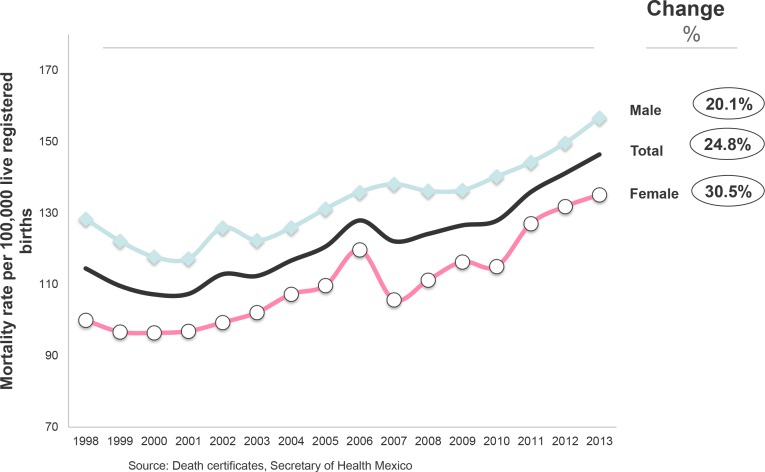
Infant mortality from CHD increased 24.8% from 1998 to 2013 (114.4 to 146.4/ 100,000 live births). A total of 3,593 CHD deaths occurred in 2013; the main causes were CHD with left-to-right shunt (n = 487; 19.8/100,000 live births) and cyanotic heart disease (n = 410; 16.7/100,000). A total of 1,049 (29.2%) deaths from CHD occurred during the first week of life. Risk factors associated with mortality from CHD were, in order of magnitude: non-institutional birth, rural area, birth in a public hospital and male sex.
Mortality from CHD has increased in Mexico. The main causes were CHD with left-to-right shunt, which are not necessarily fatal if treated promptly. Populations vulnerable to death from CHD were identified. Approximately one-third of the CHD occurred during the first week of life. It is important to promote early diagnosis, especially for non-institutional births.
先天性心脏病(CHD)死亡率的时间趋势在不同地区有所差异。因此,有必要在每个国家研究这一问题。在墨西哥,2013年先天性异常导致了24%的婴儿死亡,而CHD占1岁以下儿童先天性异常总死亡人数的55%。本研究的目的是分析墨西哥CHD婴儿死亡率的趋势(1998年至2013年)、其具体病因、死亡年龄以及相关的社会人口学因素。
基于人群的研究,计算了1998年至2013年CHD死亡的复合年增长率。分析了2013年CHD死亡的具体病因、死亡年龄以及与死亡率相关的危险因素。
1998年至2013年,CHD婴儿死亡率上升了24.8%(从114.4/10万活产儿增至146.4/10万活产儿)。2013年共发生3593例CHD死亡;主要病因是左向右分流型CHD(n = 487;19.8/10万活产儿)和青紫型心脏病(n = 410;16.7/10万)。共有1049例(29.2%)CHD死亡发生在出生后第一周。与CHD死亡率相关的危险因素按重要程度依次为:非机构分娩、农村地区、在公立医院出生和男性。
墨西哥CHD死亡率有所上升。主要病因是左向右分流型CHD,如果及时治疗不一定致命。确定了易患CHD死亡的人群。约三分之一的CHD死亡发生在出生后第一周。促进早期诊断很重要,尤其是对于非机构分娩。