Barbier Mariette, Damron F Heath
West Virginia University School of Medicine, Department of Microbiology, Immunology and Cell Biology, Morgantown, West Virginia, United States of America.
PLoS One. 2016 Mar 3;11(3):e0146827. doi: 10.1371/journal.pone.0146827. eCollection 2016.
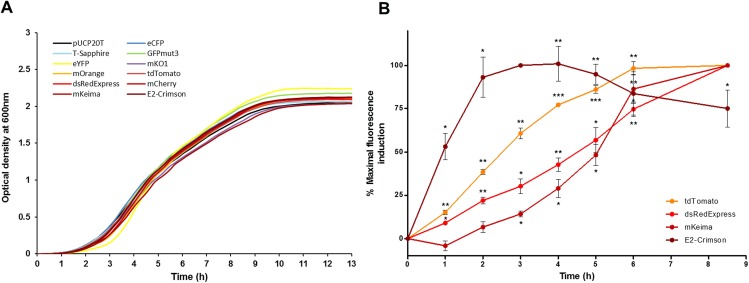
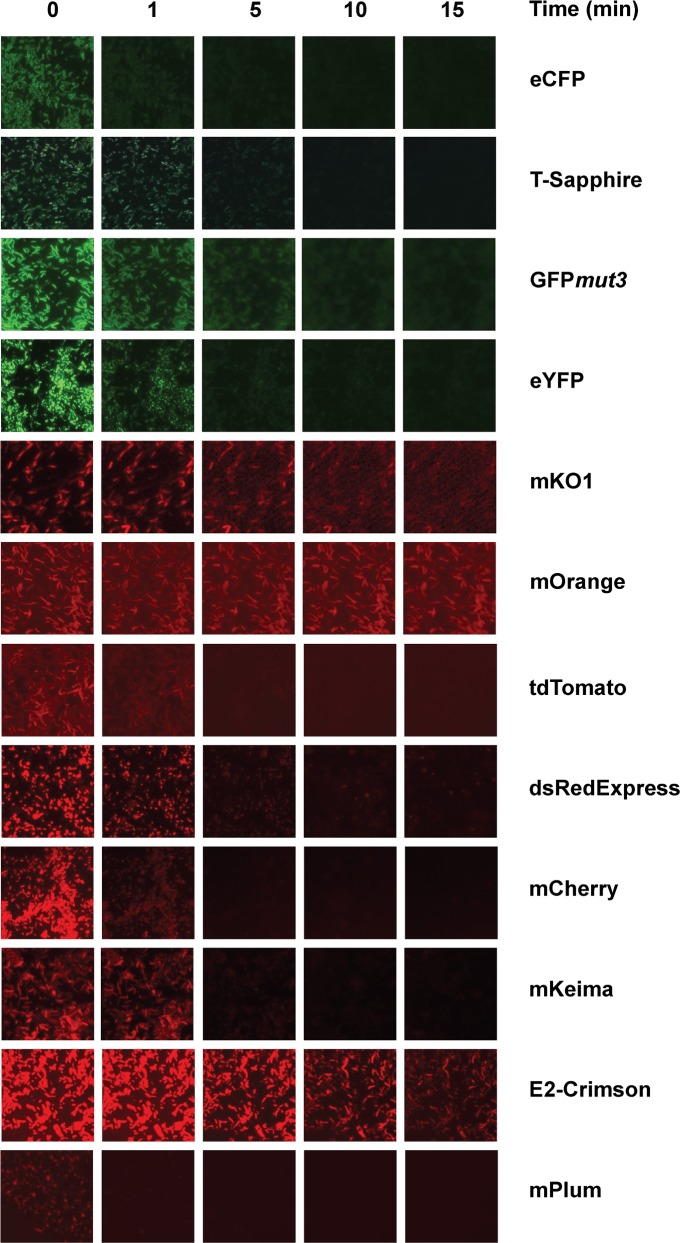
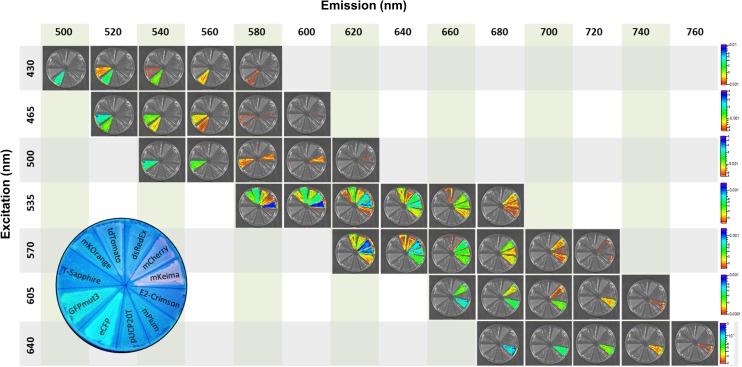
Since their discovery, fluorescent proteins have been widely used to study protein function, localization or interaction, promoter activity and regulation, drug discovery or for non-invasive imaging. They have been extensively modified to improve brightness, stability, and oligomerization state. However, only a few studies have focused on understanding the dynamics of fluorescent proteins expression in bacteria. In this work, we developed a set plasmids encoding 12 fluorescent proteins for bacterial labeling to facilitate the study of pathogen-host interactions. These broad-spectrum plasmids can be used with a wide variety of Gram-negative microorganisms including Escherichia coli, Pseudomonas aeruginosa, Burkholderia cepacia, Bordetella bronchiseptica, Shigella flexneri or Klebsiella pneumoniae. For comparison, fluorescent protein expression and physical characteristics in Escherichia coli were analyzed using fluorescence microscopy, flow cytometry and in vivo imaging. Fluorescent proteins derived from the Aequorea Victoria family showed high photobleaching, while proteins form the Discosoma sp. and the Fungia coccina family were more photostable for microscopy applications. Only E2-Crimson, mCherry and mKeima were successfully detected for in vivo applications. Overall, E2-Crimson was the fastest maturing protein tested in E. coli with the best overall performance in the study parameters. This study provides a unified comparison and comprehensive characterization of fluorescent protein photostability, maturation and toxicity, and offers general recommendations on the optimal fluorescent proteins for in vitro and in vivo applications.
自荧光蛋白被发现以来,它们已被广泛用于研究蛋白质功能、定位或相互作用、启动子活性和调控、药物发现或用于非侵入性成像。人们对其进行了广泛修饰以提高亮度、稳定性和寡聚化状态。然而,只有少数研究专注于了解荧光蛋白在细菌中的表达动态。在这项工作中,我们开发了一组编码12种用于细菌标记的荧光蛋白的质粒,以促进对病原体-宿主相互作用的研究。这些广谱质粒可与多种革兰氏阴性微生物一起使用,包括大肠杆菌、铜绿假单胞菌、洋葱伯克霍尔德菌、支气管败血波氏杆菌、福氏志贺菌或肺炎克雷伯菌。为了进行比较,我们使用荧光显微镜、流式细胞术和体内成像分析了大肠杆菌中荧光蛋白的表达和物理特性。源自维多利亚水母家族的荧光蛋白表现出较高的光漂白现象,而来自盘状珊瑚属和球珊瑚属家族的蛋白在显微镜应用中更具光稳定性。在体内应用中,仅成功检测到E2-深红色荧光蛋白、mCherry和mKeima。总体而言,E2-深红色荧光蛋白是在大肠杆菌中测试的成熟最快的蛋白,在研究参数方面具有最佳的整体性能。这项研究对荧光蛋白的光稳定性、成熟和毒性进行了统一比较和全面表征,并就体外和体内应用的最佳荧光蛋白提供了一般性建议。