Légaré France, Robitaille Hubert, Gane Claire, Hébert Jessica, Labrecque Michel, Rousseau François
Population Health and Practice-Changing Research Group, Centre hospitalier universitaire de Québec Research Centre, Quebec, Canada.
Department of Family Medicine and Emergency Medicine, Laval University, Quebec, Canada.
PLoS One. 2016 Mar 3;11(3):e0150123. doi: 10.1371/journal.pone.0150123. eCollection 2016.
Knowledge translation (KT) interventions are attempts to change behavior in keeping with scientific evidence. While genetic tests are increasingly available to healthcare consumers in the clinic, evidence about their benefits is unclear and decisions about genetic testing are thus difficult for all parties.
We sought to identify KT interventions that involved decisions about genetic testing in the clinical context and to assess their effectiveness for improving decision making in terms of behavior change, increased knowledge and wellbeing.
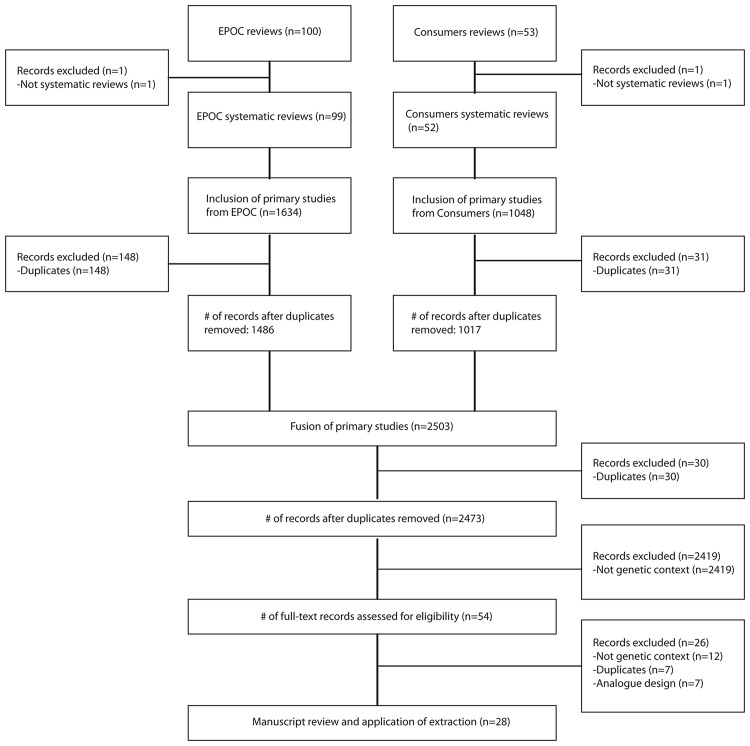
We searched for trials assessing KT interventions in the context of genetic testing up to March 2014 in all systematic reviews (n = 153) published by two Cochrane review groups: Effective Practice and Organisation of Care (EPOC) and Consumers and Communication.
We retrieved 2473 unique trials of which we retained only 28 (1%). Two EPOC reviews yielded two trials of KT interventions: audit and feedback (n = 1) and educational outreach (n = 1). Both targeted health professionals and the KT intervention they assessed was found to be effective. Four Consumers and Communication reviews yielded 26 trials: decision aids (n = 15), communication of DNA-based disease risk estimates (n = 7), personalized risk communication (n = 3) and mobile phone messaging (n = 1). Among these, 25 trials targeted only health consumers or patients and the KT interventions were found to be effective in four trials, partly effective in seven, and ineffective in four. Lastly, only one trial targeted both physicians and patients and was found to be effective.
More research on the effectiveness of KT interventions regarding genetic testing in the clinical context may contribute to patients making informed value-based decisions and drawing the maximum benefit from clinical applications of genetic and genomic innovations.
知识转化(KT)干预旨在促使行为与科学证据保持一致。虽然临床中医疗消费者越来越容易获得基因检测服务,但关于其益处的证据尚不明确,因此各方在基因检测决策上都面临困难。
我们试图确定在临床环境中涉及基因检测决策的KT干预措施,并评估其在改善决策方面的有效性,包括行为改变、知识增加和幸福感提升。
我们在截至2014年3月的所有系统评价中搜索评估基因检测背景下KT干预措施的试验,这些系统评价由两个Cochrane评价小组发表:有效实践与护理组织(EPOC)以及消费者与沟通小组(n = 153)。
我们检索到2473项独特试验,仅保留了28项(1%)。两项EPOC评价产生了两项KT干预试验:审核与反馈(n = 1)和教育推广(n = 1)。两者均针对卫生专业人员,且他们评估的KT干预措施被认为是有效的。四项消费者与沟通评价产生了26项试验:决策辅助工具(n = 15)、基于DNA的疾病风险估计的沟通(n = 7)、个性化风险沟通(n = 3)和手机短信(n = 1)。其中,25项试验仅针对卫生消费者或患者,发现KT干预措施在四项试验中有效,在七项试验中部分有效,在四项试验中无效。最后,只有一项试验针对医生和患者,且被认为是有效的。
对临床环境中基因检测的KT干预措施有效性进行更多研究,可能有助于患者做出基于价值的明智决策,并从基因和基因组创新的临床应用中获得最大益处。