Mozaffarian Rebecca S, Gortmaker Steven L, Kenney Erica L, Carter Jill E, Howe M Caitlin Westfall, Reiner Jennifer F, Cradock Angie L
Department of Social and Behavioral Sciences, Harvard T.H. Chan School of Public Health, 401 Park Dr, 4th Floor West, Boston, MA 02215. Email:
Harvard T.H. Chan School of Public Health, Boston, Massachusetts.
Prev Chronic Dis. 2016 Mar 3;13:E32. doi: 10.5888/pcd13.150483.
Competitive beverages are drinks sold outside of the federally reimbursable school meals program and include beverages sold in vending machines, a la carte lines, school stores, and snack bars. Competitive beverages include sugar-sweetened beverages, which are associated with overweight and obesity. We described competitive beverage availability 9 years after the introduction in 2004 of district-wide nutrition standards for competitive beverages sold in Boston Public Schools.
In 2013, we documented types of competitive beverages sold in 115 schools. We collected nutrient data to determine compliance with the standards. We evaluated the extent to which schools met the competitive-beverage standards and calculated the percentage of students who had access to beverages that met or did not meet the standards.
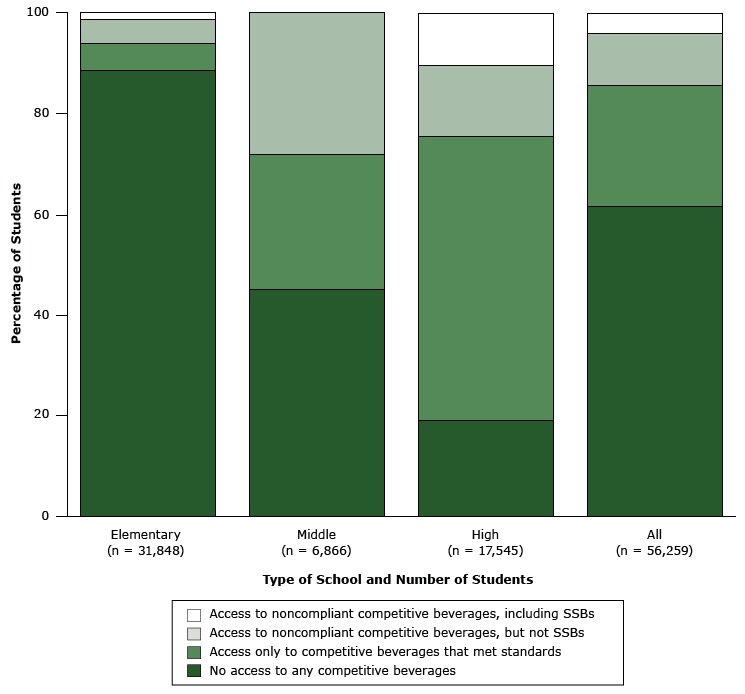
Of 115 schools, 89.6% met the competitive beverage nutrition standards; 88.5% of elementary schools and 61.5% of middle schools did not sell competitive beverages. Nutrition standards were met in 79.2% of high schools; 37.5% did not sell any competitive beverages, and 41.7% sold only beverages meeting the standards. Overall, 85.5% of students attended schools meeting the standards. Only 4.0% of students had access to sugar-sweetened beverages.
A comprehensive, district-wide competitive beverage policy with implementation support can translate into a sustained healthful environment in public schools.
竞争性饮料是指在联邦政府可报销的学校膳食计划之外销售的饮料,包括自动售货机、点菜窗口、学校商店和小吃店出售的饮料。竞争性饮料包括含糖饮料,而含糖饮料与超重和肥胖有关。我们描述了2004年波士顿公立学校引入全学区竞争性饮料营养标准9年后竞争性饮料的供应情况。
2013年,我们记录了115所学校出售的竞争性饮料类型。我们收集了营养数据以确定是否符合标准。我们评估了学校达到竞争性饮料标准的程度,并计算了能够获得符合或不符合标准饮料的学生百分比。
在115所学校中,89.6%达到了竞争性饮料营养标准;88.5%的小学和61.5%的中学不出售竞争性饮料。79.2%的高中达到了营养标准;37.5%不出售任何竞争性饮料,41.7%只出售符合标准的饮料。总体而言,85.5%的学生就读于符合标准的学校。只有4.0%的学生能够获得含糖饮料。
一项全面的、全学区的竞争性饮料政策,并辅以实施支持,能够在公立学校营造一个持续健康的环境。