Hapuarachchi Hapuarachchige Chanditha, Koo Carmen, Kek Relus, Xu Helen, Lai Yee Ling, Liu Lilac, Kok Suet Yheng, Shi Yuan, Chuen Raphael Lee Tze, Lee Kim-Sung, Maurer-Stroh Sebastian, Ng Lee Ching
Environmental Health Institute, National Environment Agency, 11, Biopolis Way, #06-05-08, Singapore 138667.
Bioinformatics Institute (BII), Agency for Science, Technology and Research (A*STAR), 30 Biopolis Street #07-01, Matrix Building, Singapore 138671.
Sci Rep. 2016 Mar 4;6:22592. doi: 10.1038/srep22592.
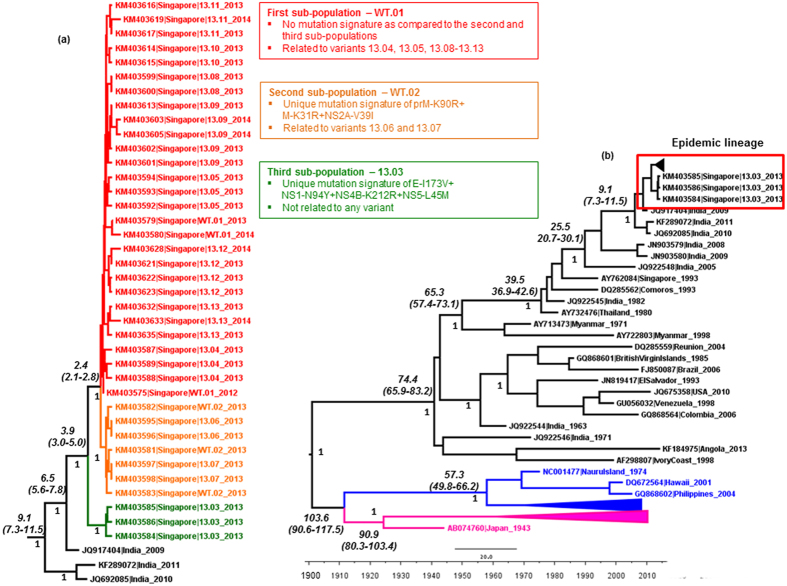
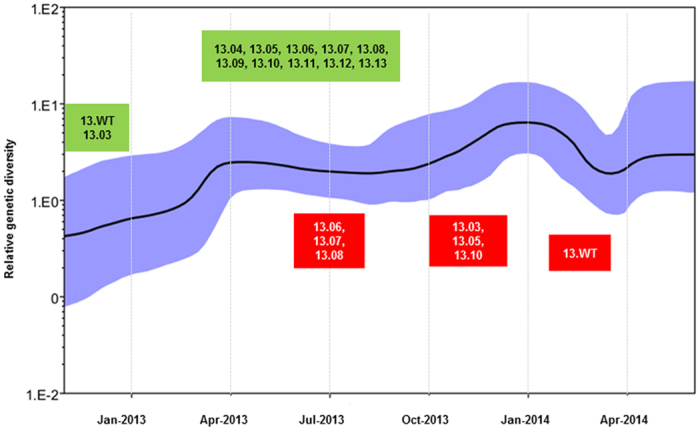
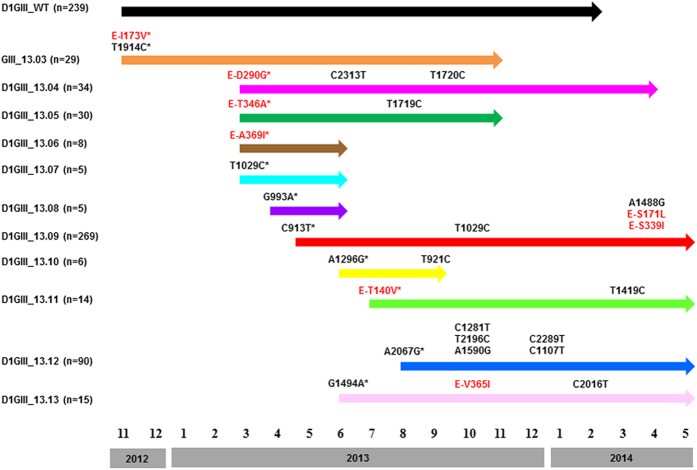
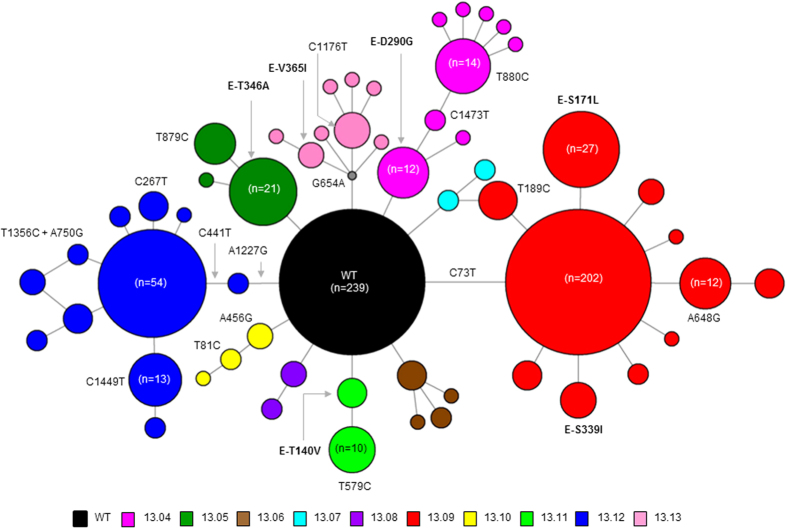
Dengue virus (DENV) is currently the most prevalent mosquito-borne viral pathogen. DENVs naturally exist as highly heterogeneous populations. Even though the descriptions on DENV diversity are plentiful, only a few studies have narrated the dynamics of intra-epidemic virus diversity at a fine scale. Such accounts are important to decipher the reciprocal relationship between viral evolutionary dynamics and disease transmission that shape dengue epidemiology. In the current study, we present a micro-scale genetic analysis of a monophyletic lineage of DENV-1 genotype III (epidemic lineage) detected from November 2012 to May 2014. The lineage was involved in an unprecedented dengue epidemic in Singapore during 2013-2014. Our findings showed that the epidemic lineage was an ensemble of mutants (variants) originated from an initial mixed viral population. The composition of mutant spectrum was dynamic and positively correlated with case load. The close interaction between viral evolution and transmission intensity indicated that tracking genetic diversity through time is potentially a useful tool to infer DENV transmission dynamics and thereby, to assess the epidemic risk in a disease control perspective. Moreover, such information is salient to understand the viral basis of clinical outcome and immune response variations that is imperative to effective vaccine design.
登革病毒(DENV)是目前最普遍的蚊媒病毒病原体。登革病毒自然以高度异质的群体形式存在。尽管关于登革病毒多样性的描述很多,但只有少数研究在精细尺度上阐述了流行期间病毒多样性的动态变化。这些描述对于解读塑造登革热流行病学的病毒进化动态与疾病传播之间的相互关系至关重要。在本研究中,我们对2012年11月至2014年5月期间检测到的登革病毒1型基因型III的一个单系谱系(流行谱系)进行了微观尺度的基因分析。该谱系在2013 - 2014年期间引发了新加坡前所未有的登革热疫情。我们的研究结果表明,该流行谱系是一个源自初始混合病毒群体的突变体(变体)集合。突变谱的组成是动态的,且与病例数呈正相关。病毒进化与传播强度之间的密切相互作用表明,随时间追踪遗传多样性可能是推断登革病毒传播动态的有用工具,从而从疾病控制角度评估疫情风险。此外,此类信息对于理解临床结果和免疫反应变异的病毒基础至关重要,而这对于有效的疫苗设计必不可少。