Cardim Danilo, Robba C, Bohdanowicz M, Donnelly J, Cabella B, Liu X, Cabeleira M, Smielewski P, Schmidt B, Czosnyka M
Brain Physics Laboratory, Division of Neurosurgery, Department of Clinical Neurosciences, University of Cambridge, Box 167, Cambridge Biomedical Campus, Cambridge, CB2 0QQ, UK.
Neurosciences Critical Care Unit, Addenbrooke's Hospital, Cambridge University Hospitals NHS Foundation, Cambridge, UK.
Neurocrit Care. 2016 Dec;25(3):473-491. doi: 10.1007/s12028-016-0258-6.
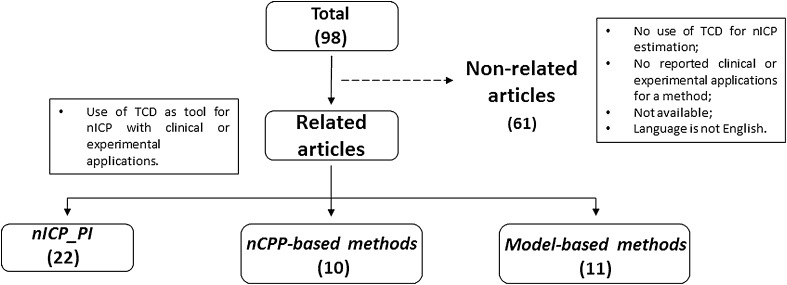
Although intracranial pressure (ICP) is essential to guide management of patients suffering from acute brain diseases, this signal is often neglected outside the neurocritical care environment. This is mainly attributed to the intrinsic risks of the available invasive techniques, which have prevented ICP monitoring in many conditions affecting the intracranial homeostasis, from mild traumatic brain injury to liver encephalopathy. In such scenario, methods for non-invasive monitoring of ICP (nICP) could improve clinical management of these conditions. A review of the literature was performed on PUBMED using the search keywords 'Transcranial Doppler non-invasive intracranial pressure.' Transcranial Doppler (TCD) is a technique primarily aimed at assessing the cerebrovascular dynamics through the cerebral blood flow velocity (FV). Its applicability for nICP assessment emerged from observation that some TCD-derived parameters change during increase of ICP, such as the shape of FV pulse waveform or pulsatility index. Methods were grouped as: based on TCD pulsatility index; aimed at non-invasive estimation of cerebral perfusion pressure and model-based methods. Published studies present with different accuracies, with prediction abilities (AUCs) for detection of ICP ≥20 mmHg ranging from 0.62 to 0.92. This discrepancy could result from inconsistent assessment measures and application in different conditions, from traumatic brain injury to hydrocephalus and stroke. Most of the reports stress a potential advantage of TCD as it provides the possibility to monitor changes of ICP in time. Overall accuracy for TCD-based methods ranges around ±12 mmHg, with a great potential of tracing dynamical changes of ICP in time, particularly those of vasogenic nature.
尽管颅内压(ICP)对于指导急性脑疾病患者的治疗至关重要,但在神经重症监护环境之外,该信号常常被忽视。这主要归因于现有侵入性技术的固有风险,这些风险使得在许多影响颅内稳态的情况下,从轻度创伤性脑损伤到肝性脑病,都无法进行ICP监测。在这种情况下,非侵入性监测ICP(nICP)的方法可以改善这些疾病的临床管理。使用搜索关键词“经颅多普勒无创颅内压”在PUBMED上进行了文献综述。经颅多普勒(TCD)是一种主要旨在通过脑血流速度(FV)评估脑血管动力学的技术。其在nICP评估中的适用性源于观察到一些TCD衍生参数在ICP升高时会发生变化,例如FV脉冲波形的形状或搏动指数。方法分为:基于TCD搏动指数的方法;旨在无创估计脑灌注压的方法和基于模型的方法。已发表的研究具有不同的准确性,检测ICP≥20 mmHg的预测能力(AUC)范围为0.62至0.92。这种差异可能是由于评估措施不一致以及在从创伤性脑损伤到脑积水和中风等不同情况下的应用所致。大多数报告强调了TCD的一个潜在优势,即它提供了及时监测ICP变化的可能性。基于TCD的方法的总体准确性约为±12 mmHg,具有及时追踪ICP动态变化的巨大潜力,特别是血管源性变化。