Cardim D, Czosnyka M, Donnelly J, Robba C, Cabella B C T, Liu X, Cabeleira M T, Smielewsky P, Haubrich C, Garnett M R, Pickard J D, Czosnyka Z
Brain Physics Laboratory, Division of Neurosurgery, Department of Clinical Neurosciences, University of Cambridge, Box 167, Cambridge Biomedical Campus, Cambridge, CB2 0QQ, UK.
Institute of Electronic Systems, Warsaw University of Technology, Warsaw, Poland.
Acta Neurochir (Wien). 2016 Feb;158(2):279-87; discussion 287. doi: 10.1007/s00701-015-2661-8. Epub 2015 Dec 23.
This study aimed to compare four non-invasive intracranial pressure (nICP) methods in a prospective cohort of hydrocephalus patients whose cerebrospinal fluid dynamics was investigated using infusion tests involving controllable test-rise of ICP.
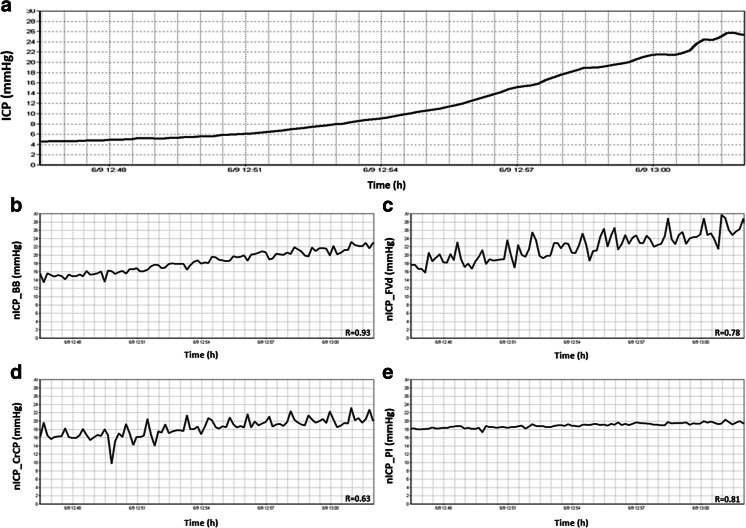
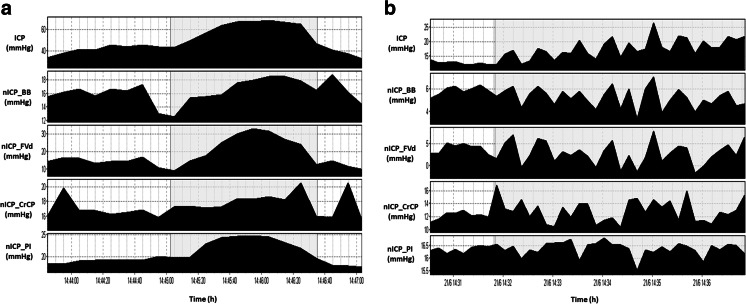
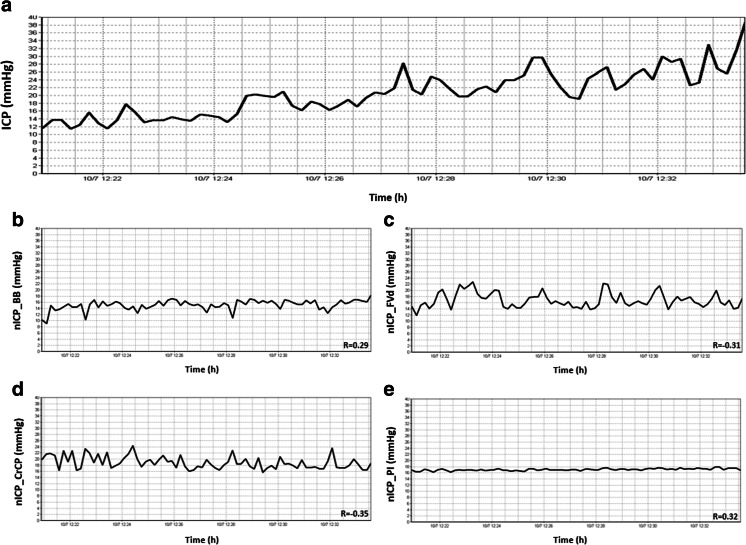
Cerebral blood flow velocity (FV), ICP and non-invasive arterial blood pressure (ABP) were recorded in 53 patients diagnosed for hydrocephalus. Non-invasive ICP methods were based on: (1) interaction between FV and ABP using black-box model (nICP_BB); (2) diastolic FV (nICP_FVd); (3) critical closing pressure (nICP_CrCP); (4) transcranial Doppler-derived pulsatility index (nICP_PI). Correlation between rise in ICP (∆ICP) and ∆nICP and averaged correlations for changes in time between ICP and nICP during infusion test were investigated.
From baseline to plateau, all nICP estimators increased significantly. Correlations between ∆ICP and ∆nICP were better represented by nICP_PI and nICP_BB: 0.45 and 0.30 (p < 0.05). nICP_FVd and nICP_CrCP presented non-significant correlations: -0.17 (p = 0.21), 0.21 (p = 0.13). For changes in ICP during individual infusion test nICP_PI, nICP_BB and nICP_FVd presented similar correlations with ICP: 0.39 ± 0.40, 0.39 ± 0.43 and 0.35 ± 0.41 respectively. However, nICP_CrCP presented a weaker correlation (R = 0.29 ± 0.24).
Out of the four methods, nICP_PI was the one with best performance for predicting changes in ∆ICP during infusion test, followed by nICP_BB. Unreliable correlations were shown by nICP_FVd and nICP_CrCP. Changes of ICP observed during the test were expressed by nICP values with only moderate correlations.
本研究旨在比较四种非侵入性颅内压(nICP)测量方法,研究对象为一组脑积水患者的前瞻性队列,这些患者的脑脊液动力学通过涉及可控颅内压测试升高的输液试验进行研究。
记录了53例诊断为脑积水患者的脑血流速度(FV)、颅内压和无创动脉血压(ABP)。非侵入性颅内压测量方法基于:(1)使用黑箱模型(nICP_BB)的FV与ABP之间的相互作用;(2)舒张期FV(nICP_FVd);(3)临界关闭压(nICP_CrCP);(4)经颅多普勒衍生的搏动指数(nICP_PI)。研究了颅内压升高(∆ICP)与∆nICP之间的相关性,以及输液试验期间颅内压与nICP随时间变化的平均相关性。
从基线到平台期,所有nICP估计值均显著增加。nICP_PI和nICP_BB显示的∆ICP与∆nICP之间的相关性更好:分别为0.45和0.30(p < 0.05)。nICP_FVd和nICP_CrCP呈现非显著相关性:-0.17(p = 0.21),0.21(p = 0.13)。在个体输液试验期间颅内压变化时,nICP_PI、nICP_BB和nICP_FVd与颅内压呈现相似的相关性:分别为0.39±0.40、0.39±0.43和0.35±0.41。然而,nICP_CrCP呈现较弱的相关性(R = 0.29±0.24)。
在这四种方法中,nICP_PI在预测输液试验期间∆ICP变化方面表现最佳,其次是nICP_BB。nICP_FVd和nICP_CrCP显示出不可靠的相关性。试验期间观察到的颅内压变化仅通过nICP值以中等相关性表示。