
春化需求和染色体VRN1区域会影响草地羊茅的抗冻性及冷调控基因的表达。
Vernalization Requirement and the Chromosomal VRN1-Region can Affect Freezing Tolerance and Expression of Cold-Regulated Genes in Festuca pratensis.
作者信息
Ergon Åshild, Melby Tone I, Höglind Mats, Rognli Odd A
机构信息
Department of Plant Sciences, Norwegian University of Life Sciences Klepp Stasjon, Norway.
Food and Agriculture Division, Norwegian Institute of Bioeconomy Research Klepp Stasjon, Norway.
出版信息
Front Plant Sci. 2016 Feb 25;7:207. doi: 10.3389/fpls.2016.00207. eCollection 2016.
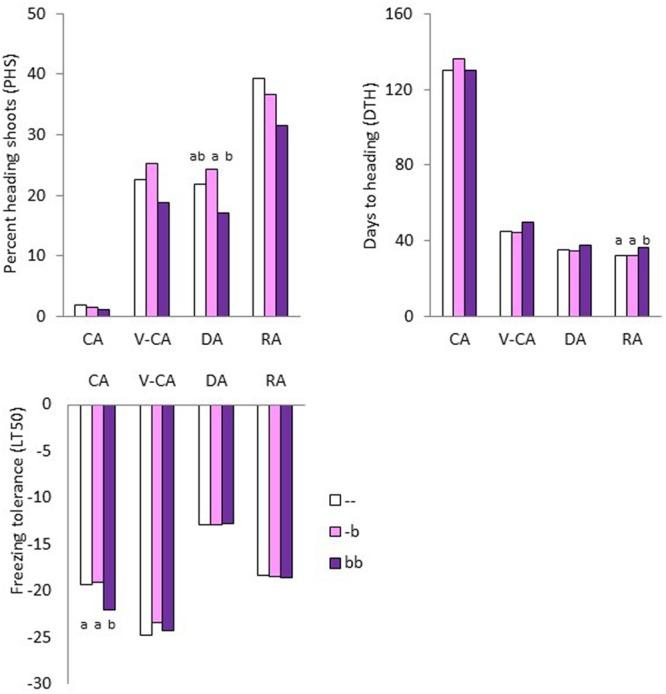
Plants adapted to cold winters go through annual cycles of gain followed by loss of freezing tolerance (cold acclimation and deacclimation). Warm spells during winter and early spring can cause deacclimation, and if temperatures drop, freezing damage may occur. Many plants are vernalized during winter, a process making them competent to flower in the following summer. In winter cereals, a coincidence in the timing of vernalization saturation, deacclimation, downregulation of cold-induced genes, and reduced ability to reacclimate, occurs under long photoperiods and is under control of the main regulator of vernalization requirement in cereals, VRN1, and/or closely linked gene(s). Thus, the probability of freezing damage after a warm spell may depend on both vernalization saturation and photoperiod. We investigated the role of vernalization and the VRN1-region on freezing tolerance of meadow fescue (Festuca pratensis Huds.), a perennial grass species. Two F2 populations, divergently selected for high and low vernalization requirement, were studied. Each genotype was characterized for the copy number of one of the four parental haplotypes of the VRN1-region. Clonal plants were cold acclimated for 2 weeks or vernalized/cold acclimated for a total of 9 weeks, after which the F2 populations reached different levels of vernalization saturation. Vernalized and cold acclimated plants were deacclimated for 1 week and then reacclimated for 2 weeks. All treatments were given at 8 h photoperiod. Flowering response, freezing tolerance and expression of the cold-induced genes VRN1, MADS3, CBF6, COR14B, CR7 (BLT14), LOS2, and IRI1 was measured. We found that some genotypes can lose some freezing tolerance after vernalization and a deacclimation-reacclimation cycle. The relationship between vernalization and freezing tolerance was complex. We found effects of the VRN1-region on freezing tolerance in plants cold acclimated for 2 weeks, timing of heading after 9 weeks of vernalization, expression of COR14B, CBF6, and LOS2 in vernalized and/or deacclimated treatments, and restoration of freezing tolerance during reacclimation. While expression of VRN1, COR14B, CBF6, LOS2, and IRI1 was correlated, CR7 was associated with vernalization requirement by other mechanisms, and appeared to play a role in freezing tolerance in reacclimated plants.
适应寒冷冬季的植物会经历年度性的耐寒性增加随后又丧失的循环过程(冷驯化和去驯化)。冬季和早春的温暖期会导致去驯化,如果气温随后下降,可能会发生冻害。许多植物在冬季进行春化处理,这一过程使它们能够在次年夏天开花。在冬性谷类作物中,春化饱和、去驯化、冷诱导基因下调以及重新适应能力降低的时间巧合,发生在长日照条件下,并且受谷类作物春化需求的主要调节因子VRN1和/或紧密连锁基因的控制。因此,温暖期后发生冻害的可能性可能取决于春化饱和程度和光周期。我们研究了春化作用以及VRN1区域对多年生禾本科植物草地羊茅(Festuca pratensis Huds.)耐寒性的作用。研究了两个因春化需求高低而被差异选择的F2群体。对每个基因型的VRN1区域的四种亲本单倍型之一的拷贝数进行了表征。克隆植物进行2周的冷驯化,或总共进行9周的春化/冷驯化,之后F2群体达到不同程度的春化饱和。对经过春化和冷驯化的植物进行1周的去驯化,然后再进行2周的重新驯化。所有处理均在8小时光周期下进行。测定了开花反应、耐寒性以及冷诱导基因VRN1、MADS3、CBF6、COR14B、CR7(BLT14)、LOS2和IRI1的表达。我们发现,一些基因型在春化以及去驯化 - 重新驯化循环后会丧失一些耐寒性。春化与耐寒性之间的关系很复杂。我们发现VRN1区域对经过2周冷驯化的植物的耐寒性、春化9周后的抽穗时间、春化和/或去驯化处理中COR14B、CBF6和LOS2的表达以及重新驯化过程中耐寒性的恢复有影响。虽然VRN1、COR14B、CBF6、LOS2和IRI1的表达相关,但CR7通过其他机制与春化需求相关,并且似乎在重新驯化的植物的耐寒性中起作用。




 Zotero 插件