Kurz Ilan, Gimmon Yoav, Shapiro Amir, Debi Ronen, Snir Yoram, Melzer Itshak
Schwartz Movement Analysis & Rehabilitation Laboratory, Department of Physical Therapy, Recanati School for Community Health Professions, Faculty of Health Sciences, Ben-Gurion University of the Negev, P.O.B. 653, Beer-Sheva, 84105, Israel.
Department of Mechanical Engineering, Faculty of Engineering, Ben-Gurion University of the Negev, Beer-Sheva, Israel.
BMC Geriatr. 2016 Mar 4;16:58. doi: 10.1186/s12877-016-0223-4.
Falls are common among elderly, most of them occur while slipping or tripping during walking. We aimed to explore whether a training program that incorporates unexpected loss of balance during walking able to improve risk factors for falls.
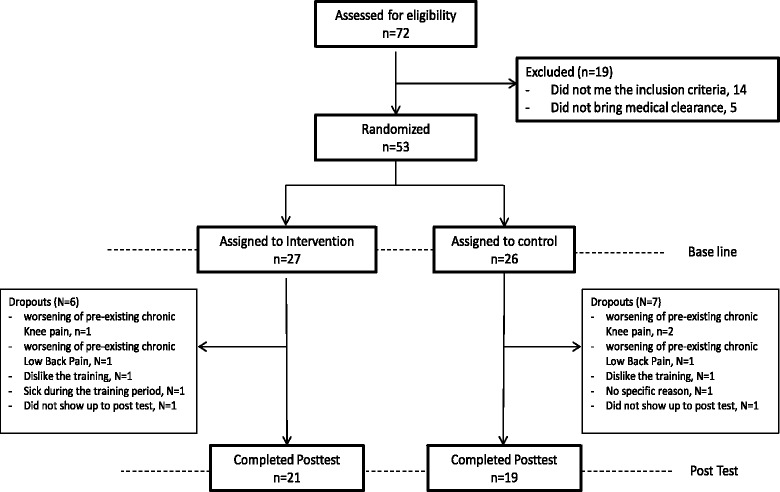
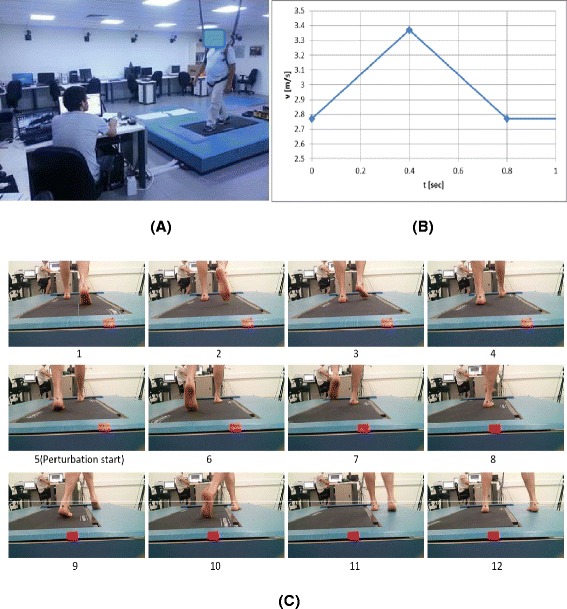
In a double-blind randomized controlled trial 53 community dwelling older adults (age 80.1±5.6 years), were recruited and randomly allocated to an intervention group (n = 27) or a control group (n = 26). The intervention group received 24 training sessions over 3 months that included unexpected perturbation of balance exercises during treadmill walking. The control group performed treadmill walking with no perturbations. The primary outcome measures were the voluntary step execution times, traditional postural sway parameters and Stabilogram-Diffusion Analysis. The secondary outcome measures were the fall efficacy Scale (FES), self-reported late life function (LLFDI), and Performance-Oriented Mobility Assessment (POMA).
Compared to control, participation in intervention program that includes unexpected loss of balance during walking led to faster Voluntary Step Execution Times under single (p = 0.002; effect size [ES] =0.75) and dual task (p = 0.003; [ES] = 0.89) conditions; intervention group subjects showed improvement in Short-term Effective diffusion coefficients in the mediolateral direction of the Stabilogram-Diffusion Analysis under eyes closed conditions (p = 0.012, [ES] = 0.92). Compared to control there were no significant changes in FES, LLFDI, and POMA.
An intervention program that includes unexpected loss of balance during walking can improve voluntary stepping times and balance control, both previously reported as risk factors for falls. This however, did not transferred to a change self-reported function and FES.
ClinicalTrials.gov
NCT01439451 .
跌倒在老年人中很常见,大多数跌倒发生在行走时滑倒或绊倒。我们旨在探讨一个在行走过程中纳入意外平衡丧失的训练计划是否能够改善跌倒的危险因素。
在一项双盲随机对照试验中,招募了53名社区居住的老年人(年龄80.1±5.6岁),并将他们随机分配到干预组(n = 27)或对照组(n = 26)。干预组在3个月内接受24次训练课程,其中包括在跑步机行走过程中进行意外平衡扰动练习。对照组进行无扰动的跑步机行走。主要结局指标为自主步执行时间、传统姿势摆动参数和稳定图扩散分析。次要结局指标为跌倒效能量表(FES)、自我报告的晚年功能(LLFDI)和以性能为导向的移动性评估(POMA)。
与对照组相比,参与包括行走过程中意外平衡丧失的干预计划,在单任务(p = 0.002;效应量[ES] = 0.75)和双任务(p = 0.003;[ES] = 0.89)条件下导致更快的自主步执行时间;干预组受试者在闭眼条件下稳定图扩散分析的中外侧方向短期有效扩散系数有所改善(p = 0.012,[ES] = 0.92)。与对照组相比,FES、LLFDI和POMA没有显著变化。
一个包括行走过程中意外平衡丧失的干预计划可以改善自主步速和平衡控制,这两者之前都被报道为跌倒的危险因素。然而,这并没有转化为自我报告功能和FES的变化。
ClinicalTrials.gov
NCT01439451 。