Miller Danny E, Smith Clarissa B, Kazemi Nazanin Yeganeh, Cockrell Alexandria J, Arvanitakis Alexandra V, Blumenstiel Justin P, Jaspersen Sue L, Hawley R Scott
Stowers Institute for Medical Research, University of Kansas Medical Center, Kansas City, Missouri 64110 Department of Molecular and Integrative Physiology, University of Kansas Medical Center, Kansas City, Kansas 66160.
Stowers Institute for Medical Research, University of Kansas Medical Center, Kansas City, Missouri 64110.
Genetics. 2016 May;203(1):159-71. doi: 10.1534/genetics.115.186486. Epub 2016 Mar 4.
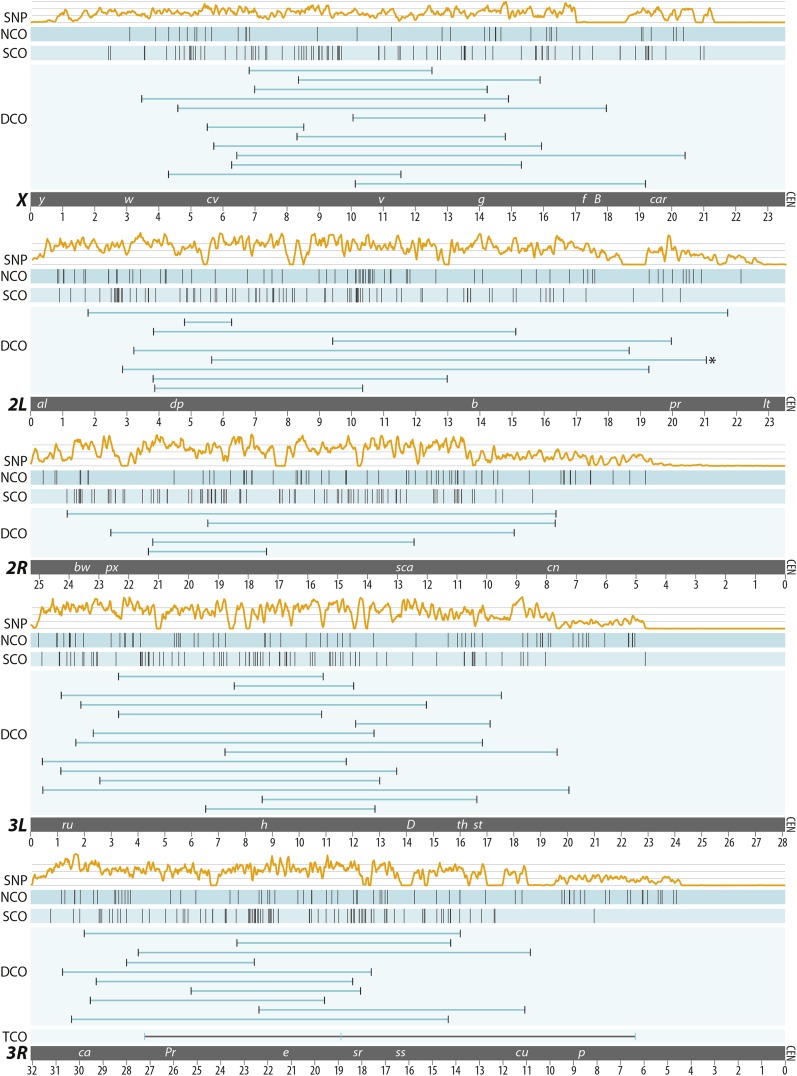
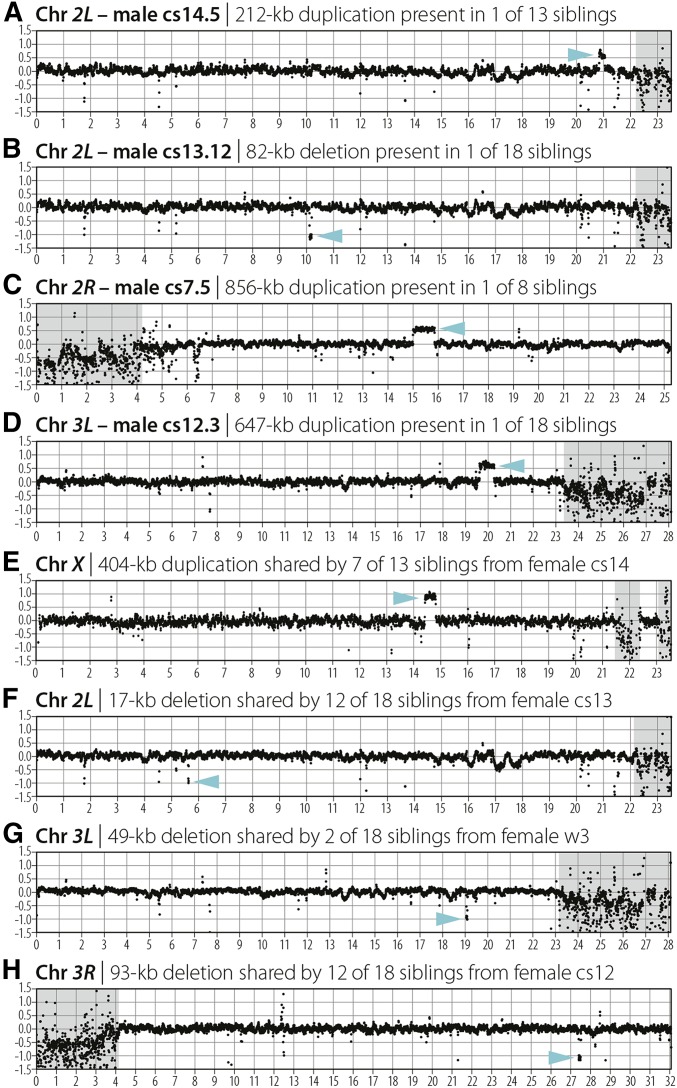
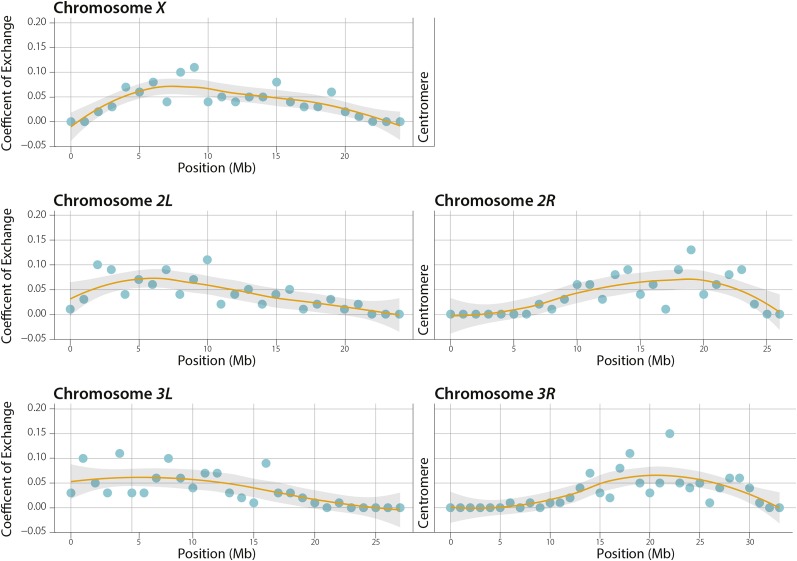
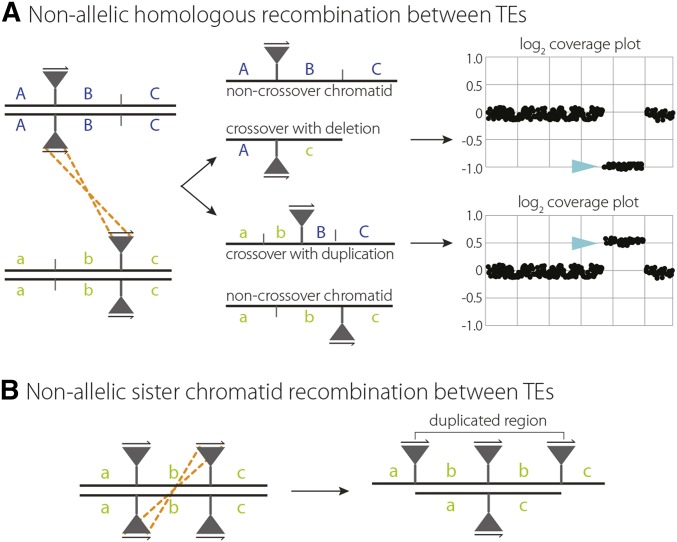
A century of genetic analysis has revealed that multiple mechanisms control the distribution of meiotic crossover events. In Drosophila melanogaster, two significant positional controls are interference and the strongly polar centromere effect. Here, we assess the factors controlling the distribution of crossovers (COs) and noncrossover gene conversions (NCOs) along all five major chromosome arms in 196 single meiotic divisions to generate a more detailed understanding of these controls on a genome-wide scale. Analyzing the outcomes of single meiotic events allows us to distinguish among different classes of meiotic recombination. In so doing, we identified 291 NCOs spread uniformly among the five major chromosome arms and 541 COs (including 52 double crossovers and one triple crossover). We find that unlike COs, NCOs are insensitive to the centromere effect and do not demonstrate interference. Although the positions of COs appear to be determined predominately by the long-range influences of interference and the centromere effect, each chromosome may display a different pattern of sensitivity to interference, suggesting that interference may not be a uniform global property. In addition, unbiased sequencing of a large number of individuals allows us to describe the formation of de novo copy number variants, the majority of which appear to be mediated by unequal crossing over between transposable elements. This work has multiple implications for our understanding of how meiotic recombination is regulated to ensure proper chromosome segregation and maintain genome stability.
一个世纪的遗传学分析表明,多种机制控制着减数分裂交叉事件的分布。在黑腹果蝇中,两个重要的位置控制因素是干涉和强烈的着丝粒极性效应。在这里,我们评估了196个单减数分裂过程中控制交叉(CO)和非交叉基因转换(NCO)沿所有五条主要染色体臂分布的因素,以便在全基因组范围内更详细地了解这些控制。分析单减数分裂事件的结果使我们能够区分不同类别的减数分裂重组。通过这样做,我们在五条主要染色体臂中均匀鉴定出291个NCO和541个CO(包括52个双交换和1个三交换)。我们发现,与CO不同,NCO对着丝粒效应不敏感,也不表现出干涉。虽然CO的位置似乎主要由干涉和着丝粒效应的远距离影响决定,但每条染色体对干涉的敏感性可能表现出不同的模式,这表明干涉可能不是一种统一的全局特性。此外,对大量个体进行无偏差测序使我们能够描述新生拷贝数变异的形成,其中大多数似乎是由转座元件之间的不等交换介导的。这项工作对于我们理解减数分裂重组如何被调控以确保正确的染色体分离和维持基因组稳定性具有多重意义。