Janssen Anna Bugge, Tunster Simon J, Heazell Alexander E P, John Rosalind M
Cardiff School of Biosciences, Cardiff University, Cardiff, Wales, CF10 3AX, UK.
Maternal and Fetal Health Research Centre, University of Manchester, Manchester, UK.
BMC Med Genet. 2016 Mar 5;17:17. doi: 10.1186/s12881-016-0279-1.
Maternal perception of reduced fetal movements (RFM) is associated with increased risk of fetal growth restriction (FGR) and stillbirth, mediated by placental insufficiency. The maternally expressed imprinted gene PHLDA2 controls fetal growth, placental development and placental lactogen production in a mouse model. A number of studies have also demonstrated abnormally elevated placental PHLDA2 expression in human growth restricted pregnancies. This study examined whether PHLDA2 was aberrantly expressed in placentas of RFM pregnancies resulting in delivery of an FGR infant and explored a possible relationship between PHLDA2 expression and placental lactogen release from the human placenta.
Villous trophoblast samples were obtained from a cohort of women reporting RFM (N = 109) and PHLDA2 gene expression analysed. hPL levels were assayed in the maternal serum (N = 74).
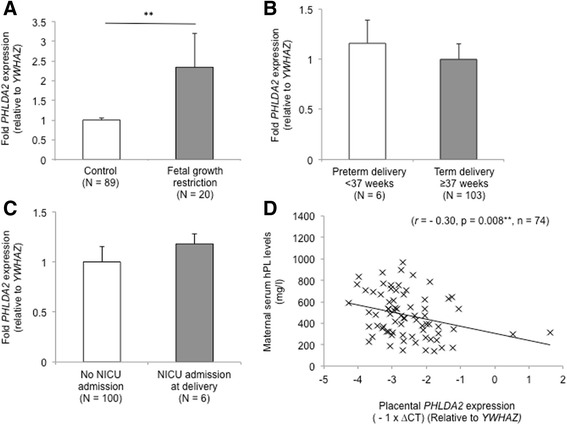
Placental PHLDA2 expression was significantly 2.3 fold higher in RFM pregnancies resulting in delivery of an infant with FGR (p < 0.01), with highest levels of PHLDA2 expression in the most severe cases. Placental PHLDA2 expression was associated with maternal serum hPL levels (r = -0.30, p = 0.008, n = 74) although this failed to reach statistical significance in multiple linear regression analysis controlling for birth weight (p = 0.07).
These results further highlight a role for placental PHLDA2 in poor perinatal outcomes, specifically FGR associated with RFM. Furthermore, this study suggests a potential relationship between placental PHLDA2 expression and hPL production by the placenta, an association that requires further investigation in a larger cohort.
母亲感知到胎动减少(RFM)与胎儿生长受限(FGR)和死产风险增加相关,其介导因素为胎盘功能不全。在小鼠模型中,母源表达的印记基因PHLDA2控制胎儿生长、胎盘发育和胎盘催乳素的产生。多项研究还表明,在人类生长受限的妊娠中,胎盘PHLDA2表达异常升高。本研究检测了PHLDA2在因胎动减少妊娠而分娩出胎儿生长受限婴儿的胎盘中是否异常表达,并探讨了PHLDA2表达与人类胎盘释放胎盘催乳素之间的可能关系。
从报告胎动减少的一组女性(N = 109)中获取绒毛滋养层样本,并分析PHLDA2基因表达。检测母体血清中的人胎盘催乳素(hPL)水平(N = 74)。
因胎动减少妊娠而分娩出胎儿生长受限婴儿的胎盘中,胎盘PHLDA2表达显著高出2.3倍(p < 0.01),在最严重的病例中PHLDA2表达水平最高。胎盘PHLDA2表达与母体血清hPL水平相关(r = -0.30,p = 0.008,n = 74),尽管在控制出生体重的多元线性回归分析中这一相关性未达到统计学显著性(p = 0.07)。
这些结果进一步凸显了胎盘PHLDA2在不良围产期结局中的作用,特别是与胎动减少相关的胎儿生长受限。此外,本研究提示胎盘PHLDA2表达与胎盘产生hPL之间存在潜在关系,这种关联需要在更大的队列中进一步研究。