Pediatrics, Department of Clinical Sciences, Faculty of Medicine, Umeå University, Umeå, Sweden;
Pediatrics, Department of Clinical Sciences, Faculty of Medicine, Umeå University, Umeå, Sweden.
Food Nutr Res. 2016 Mar 3;60:30045. doi: 10.3402/fnr.v60.30045. eCollection 2016.
High latitude of residence where sun exposure is limited affects vitamin D status. Although vitamin D levels have been associated with poor bone health, cut-off values for optimising bone health are yet to be decided.
To assess vitamin D intake and status among young school children living at latitude 63-64 °N, in northern Sweden and to examine the association between vitamin D status and bone mineral content (BMC) and bone mineral density (BMD).
In a cross-sectional study, diet was assessed by a 4-day food diary and a food frequency questionnaire in 8- to 9-year-old children (n=120). Energy, vitamin D, and calcium intakes were calculated. Physical activity was assessed using a pedometer for 7 days. Serum 25-hydroxyvitamin D (S-25[OH]D) levels were analysed by high-pressure liquid chromatography-atmospheric pressure chemical ionisation-mass spectrometry (n=113). BMC and BMD were assessed by dual energy X-ray absorptiometry scan. Height and weight were measured by standard procedures and BMI z-score was calculated using WHO AnthroPlus programme.
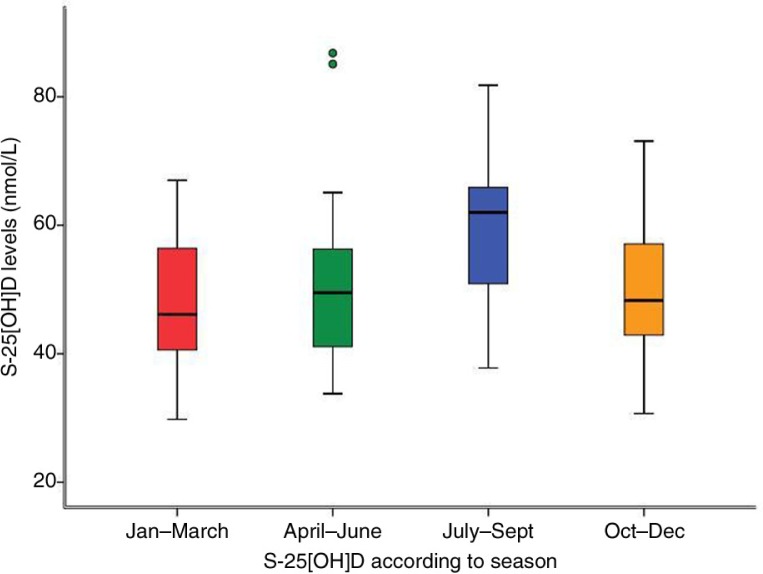
The majority of children, 91%, did not reach the recommended vitamin D intake of 7.5 µg/day and 50% had insufficient S-25[OH]D levels defined as <50 nmol/l. The highest concentrations of S-25[OH]D were observed during the summer months (p=0.01). Body mass (p<0.01) but not S-25[OH]D was associated with measures of BMC and BMD. Furthermore, boys had higher total BMC (p=0.01), total body less head BMC (p=0.02), fat free mass (p<0.01), and a higher degree of physical activity (p=0.01) compared to girls.
Body mass was related to BMC and BMD measures in a population of prepubertal school children living at high latitudes in Sweden. Despite insufficient S-25[OH]D levels and low vitamin D intake, this did not appear to affect bone parameters. Prospective studies with repeated assessment of vitamin D status are needed to examine cut-off values for optimising bone health.
居住在高纬度地区,阳光照射有限会影响维生素 D 状况。尽管维生素 D 水平与骨骼健康不良有关,但优化骨骼健康的截止值尚未确定。
评估居住在北纬 63-64°的瑞典北部的 8-9 岁儿童的维生素 D 摄入量和状况,并研究维生素 D 状况与骨矿物质含量 (BMC) 和骨矿物质密度 (BMD) 之间的关系。
在一项横断面研究中,通过 4 天的食物日记和食物频率问卷评估 8-9 岁儿童(n=120)的饮食。计算能量、维生素 D 和钙的摄入量。使用计步器评估 7 天的身体活动。通过高效液相色谱-大气压化学电离-质谱法(n=113)分析血清 25-羟维生素 D (S-25[OH]D) 水平。通过双能 X 射线吸收法扫描评估 BMC 和 BMD。通过标准程序测量身高和体重,并使用 WHO AnthroPlus 程序计算 BMI z 评分。
大多数儿童(91%)未达到推荐的 7.5 µg/天的维生素 D 摄入量,50%的儿童 S-25[OH]D 水平不足(定义为 <50 nmol/l)。S-25[OH]D 浓度最高的时期是夏季(p=0.01)。体重(p<0.01)而不是 S-25[OH]D 与 BMC 和 BMD 相关。此外,与女孩相比,男孩的总 BMC(p=0.01)、总身体非头部 BMC(p=0.02)、无脂肪量(p<0.01)和更高的身体活动度(p=0.01)更高。
在瑞典高纬度地区生活的青春期前儿童中,体重与 BMC 和 BMD 相关。尽管 S-25[OH]D 水平和维生素 D 摄入量不足,但这似乎并未影响骨骼参数。需要进行前瞻性研究,反复评估维生素 D 状况,以确定优化骨骼健康的截止值。