Xu Bao-Lei, Wang Rong, Ma Li-Na, Dong Wen, Zhao Zhi-Wei, Zhang Jing-Shuang, Wang Yu-Lan, Zhang Xu
Central Laboratory, Xuanwu Hospital, Capital Medical University, Key Laboratory for Neurodegenerative Disease of Ministry of Education, Beijing Geriatric Medical Research Center, No. 45 Changchun Street, Xicheng District, Beijing 100053, China; Department of Neurology, Beijing Anzhen Hospital, Capital Medical University, No. 2 Anzhen Road, Chaoyang District, Beijing 100029, China.
Central Laboratory, Xuanwu Hospital, Capital Medical University, Key Laboratory for Neurodegenerative Disease of Ministry of Education, Beijing Geriatric Medical Research Center, No. 45 Changchun Street, Xicheng District, Beijing 100053, China; Center of Alzheimer's Disease, Beijing Institute for Brain Disorders, Capital Medical University, Beijing 100069, China.
Iran J Basic Med Sci. 2015 Nov;18(11):1118-23.
Both caloric restriction (CR) and resveratrol (RSV) have been shown to improve learning and memory, but their potential effects in juvenile animals were unknown. Here, we evaluated the effects of RSV and CR on learning and memory function in juvenile mice and investigated potential molecular mechanisms.
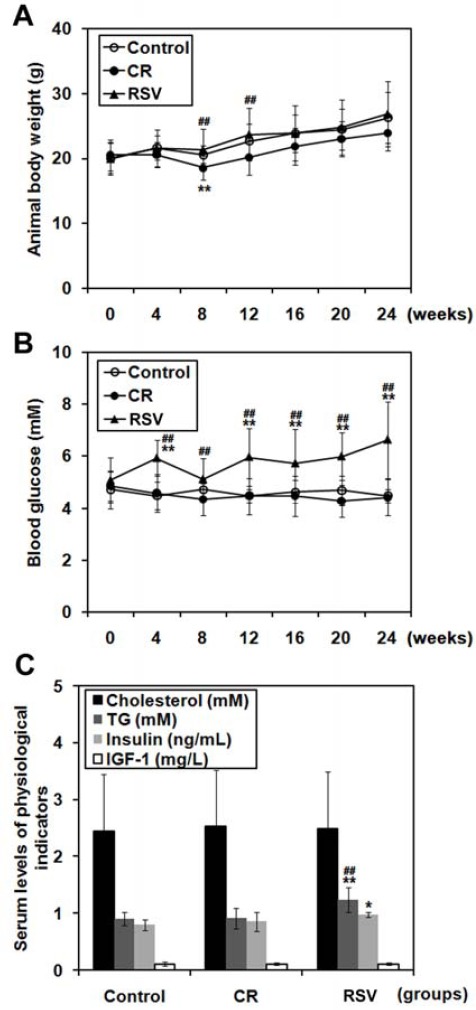
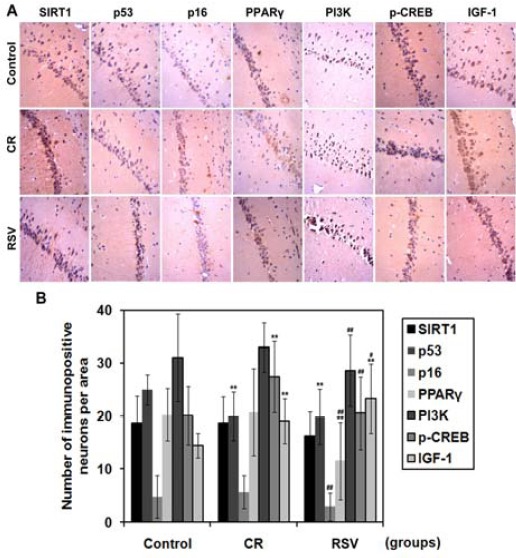
Six-week-old C57BL/6J mice were assigned to one of three different dietary groups: normal control (stock diet) (n=12), CR diet (30% caloric reduction diet) (n=12), and RSV diet (stock diet supplemented with 18.6 mg/kg RSV) (n=12), for 6 months. Body weight and blood glucose were measured every 4 weeks. Serum cholesterol and serum triglyceride levels were examined using biochemical methods. Serum insulin and insulin-like growth factor 1 (IGF-1) levels were evaluated using enzyme linked immunosorbant assay (ELISA), and protein expression of silent mating type information regulation 2 homology 1 (SIRT1), p53, p16, peroxisome proliferator-activated receptor γ (PPARγ), phosphatidylinositol-4,5-bisphosphate 3-kinase (PI3K), phosphorylated-cAMP response element-binding protein (p-CREB), and IGF-1 were examined with immunohistochemistry.
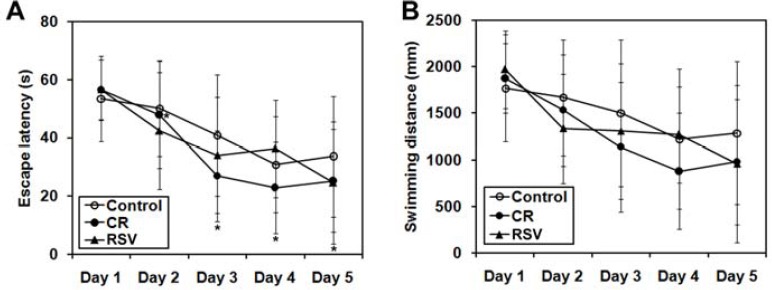
Although long-term CR diet did not alter physiological conditions in juvenile mice relative to control, RSV supplementation slightly elevated blood glucose, serum triglyceride, and serum insulin levels. Both CR and RSV improved learning and memory function, although the effect of CR was significantly greater. Both CR and RSV downregulated p53 and upregulated IGF-1 in hippocampal CA1 region of mice.
We demonstrate that CR and RSV may improve learning and memory by downregulating p53 and upregulating IGF-1 in hippocampal CA1 region of juvenile mice.
热量限制(CR)和白藜芦醇(RSV)均已被证明可改善学习和记忆,但它们对幼年动物的潜在影响尚不清楚。在此,我们评估了RSV和CR对幼年小鼠学习和记忆功能的影响,并研究了潜在的分子机制。
将6周龄的C57BL/6J小鼠分为三个不同饮食组之一:正常对照组(标准饮食)(n = 12)、CR饮食组(热量减少30%的饮食)(n = 12)和RSV饮食组(添加18.6 mg/kg RSV的标准饮食)(n = 12),持续6个月。每4周测量一次体重和血糖。采用生化方法检测血清胆固醇和血清甘油三酯水平。使用酶联免疫吸附测定(ELISA)评估血清胰岛素和胰岛素样生长因子1(IGF-1)水平,并用免疫组织化学法检测沉默交配型信息调节2同源物1(SIRT1)、p53、p16、过氧化物酶体增殖物激活受体γ(PPARγ)、磷脂酰肌醇-4,5-二磷酸3激酶(PI3K)、磷酸化环磷酸腺苷反应元件结合蛋白(p-CREB)和IGF-1的蛋白表达。
尽管长期CR饮食相对于对照组未改变幼年小鼠的生理状况,但补充RSV会使血糖、血清甘油三酯和血清胰岛素水平略有升高。CR和RSV均改善了学习和记忆功能,尽管CR的效果明显更大。CR和RSV均下调了小鼠海马CA1区的p53并上调了IGF-1。
我们证明,CR和RSV可能通过下调幼年小鼠海马CA1区的p53并上调IGF-1来改善学习和记忆。