Sugden Scott M, Bego Mariana G, Pham Tram N Q, Cohen Éric A
Laboratory of Human Retrovirology, Institut de Recherches Cliniques de Montréal (IRCM), 110 Pine Avenue West, Montreal, QC H2W 1R7, Canada.
Department of Microbiology, Infectiology and Immunology, Université de Montréal, C.P. 6128, Succursale Centre-ville, Montréal, QC H3C 3J7, Canada.
Viruses. 2016 Mar 3;8(3):67. doi: 10.3390/v8030067.
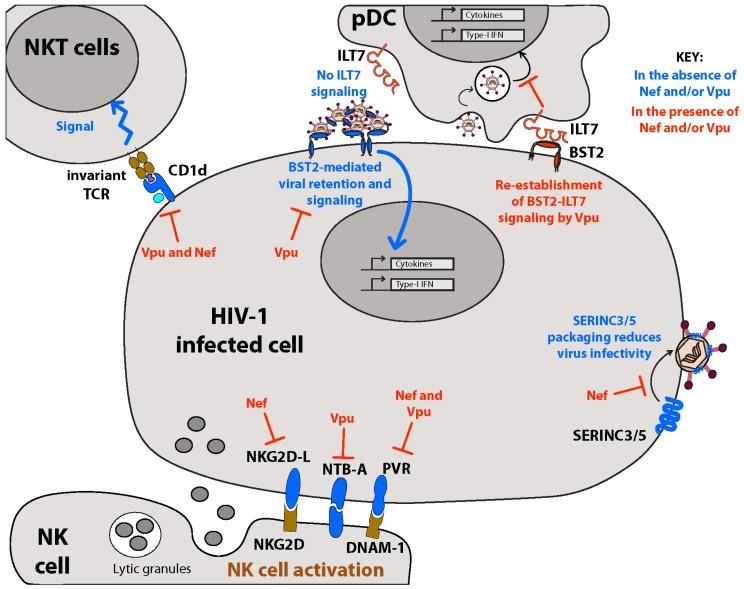
The plasma membrane protects the cell from its surroundings and regulates cellular communication, homing, and metabolism. Not surprisingly, the composition of this membrane is highly controlled through the vesicular trafficking of proteins to and from the cell surface. As intracellular pathogens, most viruses exploit the host plasma membrane to promote viral replication while avoiding immune detection. This is particularly true for the enveloped human immunodeficiency virus (HIV), which assembles and obtains its lipid shell directly at the plasma membrane. HIV-1 encodes two proteins, negative factor (Nef) and viral protein U (Vpu), which function primarily by altering the quantity and localization of cell surface molecules to increase virus fitness despite host antiviral immune responses. These proteins are expressed at different stages in the HIV-1 life cycle and employ a variety of mechanisms to target both unique and redundant surface proteins, including the viral receptor CD4, host restriction factors, immunoreceptors, homing molecules, tetraspanins and membrane transporters. In this review, we discuss recent progress in the study of the Nef and Vpu targeting of host membrane proteins with an emphasis on how remodeling of the cell membrane allows HIV-1 to avoid host antiviral immune responses leading to the establishment of systemic and persistent infection.
质膜保护细胞免受周围环境的影响,并调节细胞通讯、归巢和代谢。毫不奇怪,通过蛋白质进出细胞表面的囊泡运输,这种膜的组成受到高度控制。作为细胞内病原体,大多数病毒利用宿主质膜来促进病毒复制,同时避免免疫检测。对于包膜的人类免疫缺陷病毒(HIV)来说尤其如此,它直接在质膜上组装并获得其脂质外壳。HIV-1编码两种蛋白质,负因子(Nef)和病毒蛋白U(Vpu),它们主要通过改变细胞表面分子的数量和定位来发挥作用,以提高病毒适应性,尽管宿主存在抗病毒免疫反应。这些蛋白质在HIV-1生命周期的不同阶段表达,并采用多种机制靶向独特和冗余的表面蛋白,包括病毒受体CD4、宿主限制因子、免疫受体、归巢分子、四跨膜蛋白和膜转运蛋白。在这篇综述中,我们讨论了Nef和Vpu靶向宿主膜蛋白研究的最新进展,重点是细胞膜的重塑如何使HIV-1避免宿主抗病毒免疫反应,从而导致全身性和持续性感染的建立。