Zhu Qingling, Li Feng, Wang Junli, Shen Lixiao, Sheng Xiaoyang
Department of Child and Adolescent Healthcare, MOE-Shanghai Key Laboratory of Children's Environmental Health, Xinhua Hospital Affiliated to Shanghai Jiao Tong University School of Medicine, Shanghai, 200092, China.
PLoS One. 2016 Mar 7;11(3):e0150725. doi: 10.1371/journal.pone.0150725. eCollection 2016.
Calprotectin has been well emulated recently in adults as well as in children. The aim of this study was to assess fecal calprotectin concentrations in healthy children aged from 1 to 4 years.
Volunteers were enlisted from 3 nurseries. A brief questionnaire was used to ensure these children meet the inclusion criteria, and some clinical and sociodemographic factors were collected. Anthro software (version 3.1) was used to calculated Length-for-age Z-scores (LAZ), weight-for-age Z-scores (WAZ), and weight-for-length Z-scores (WLZ) respectively. Fecal calprotectin was detected by a commercially available ELISA.
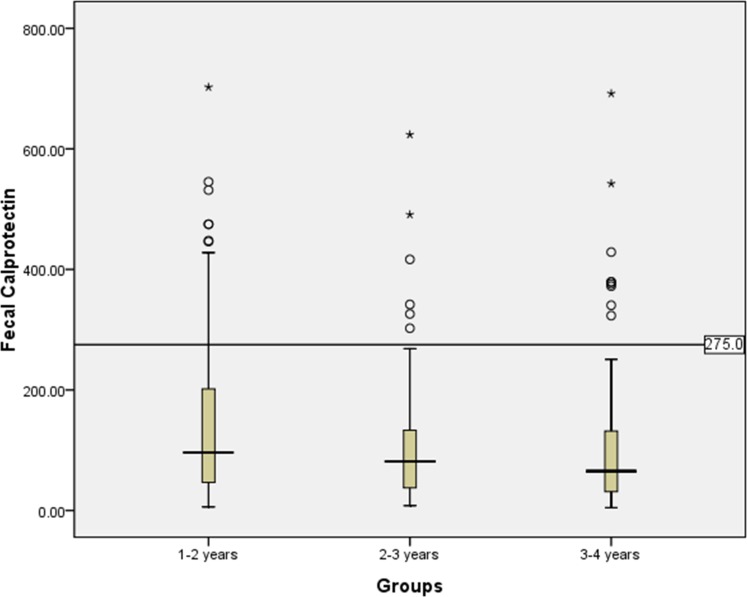
In total 274 children were recruited, with age ranging from 1 to 4 years old. The median FC concentration was 83.19 μg/g [range 4.58 to 702.50 μg/g, interquartile range (IQR) 14.69-419.45 μg/g] or 1.92 log10 μg/g (range 0.66 log10 to 2.85 log10 μg/g, IQR 1.17 log10-2.62 log10 μg/g). All of the children were divided into three groups, 1-2 years (12-24 months), 2-3 years (24-36 months), 3-4 years (36-48 months), with median FC concentrations 96.14 μg/g (1.98 log10 μg/g), 81.48 μg/g (1.91 log10 μg/g), 65.36 μg/g (1.82 log10 μg/g), respectively. There was similar FC level between boys and girls. FC concentrations showed a downward trend by the growing age groups. A statistic difference was found in FC concentrations among groups 1-2 years, 2-3 years and 3-4 years (P = 0.016). In inter-groups comparison, a significant difference was found between children aged 1-2 years and children aged 3-4 years (P = 0.007). A negative correlation trend was found between age and FC concentration (Spearman's rho = -0.167, P = 0.005) in all the participants. A simple correlation was performed among WLZ, WAZ, birth weight, or birth length with FC, and there was no correlation being observed.
Children aged from 1 to 4 years old have lower FC concentrations compared with healthy infants (<1years), and higher FC concentrations when comparing with children older than 4 years and adults.
近年来,钙卫蛋白在成人和儿童中都得到了广泛研究。本研究旨在评估1至4岁健康儿童的粪便钙卫蛋白浓度。
从3家托儿所招募志愿者。通过一份简短问卷确保这些儿童符合纳入标准,并收集一些临床和社会人口统计学因素。使用Anthro软件(3.1版)分别计算年龄别身长Z评分(LAZ)、年龄别体重Z评分(WAZ)和身长别体重Z评分(WLZ)。采用市售酶联免疫吸附测定法(ELISA)检测粪便钙卫蛋白。
共招募了274名年龄在1至4岁的儿童。粪便钙卫蛋白(FC)浓度中位数为83.19μg/g[范围4.58至702.50μg/g,四分位数间距(IQR)14.69 - 419.45μg/g]或1.92log₁₀μg/g(范围0.66log₁₀至2.85log₁₀μg/g,IQR 1.17log₁₀ - 2.62log₁₀μg/g)。所有儿童分为三组,1 - 2岁(12 - 24个月)、2 - 3岁(24 - 36个月)、3 - 4岁(36 - 48个月),FC浓度中位数分别为96.14μg/g(1.98log₁₀μg/g)、81.48μg/g(1.91log₁₀μg/g)、65.36μg/g(1.82log₁₀μg/g)。男孩和女孩的FC水平相似。FC浓度随年龄增长呈下降趋势。1 - 2岁、2 - 3岁和3 - 4岁组之间的FC浓度存在统计学差异(P = 0.016)。组间比较发现,1 - 2岁儿童与3 - 4岁儿童之间存在显著差异(P = 0.007)。在所有参与者中,年龄与FC浓度呈负相关趋势(Spearman秩相关系数=-0.167,P = 0.005)。对WLZ、WAZ、出生体重或出生身长与FC进行简单相关性分析,未观察到相关性。
1至4岁儿童的FC浓度低于健康婴儿(<1岁),但高于4岁以上儿童和成人。