Jiao Xiao-Li, Jing Jiong-Jie, Qiao Li-Ying, Liu Jian-Hua, Li Liu-An, Zhang Jing, Jia Xia-Li, Liu Wen-Zhong
College of Animal Science and Technology, Shanxi Agricultural University, Taigu 030-801, China ; College of Animal Science and Veterinary medicine, Tianjin Agricultural University, Tianjin 300-384, China .
College of Animal Science and Technology, Shanxi Agricultural University, Taigu 030-801, China.
Asian-Australas J Anim Sci. 2016 Mar;29(3):333-42. doi: 10.5713/ajas.15.0467. Epub 2016 Mar 1.
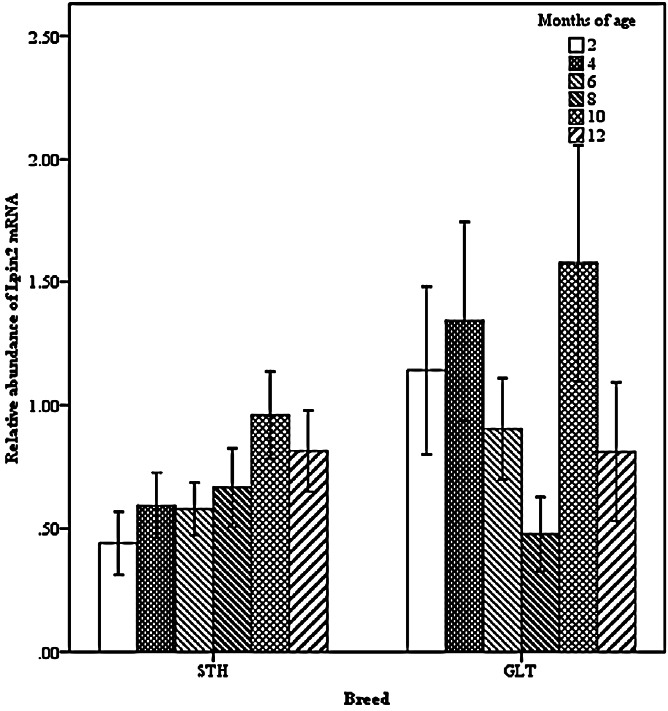
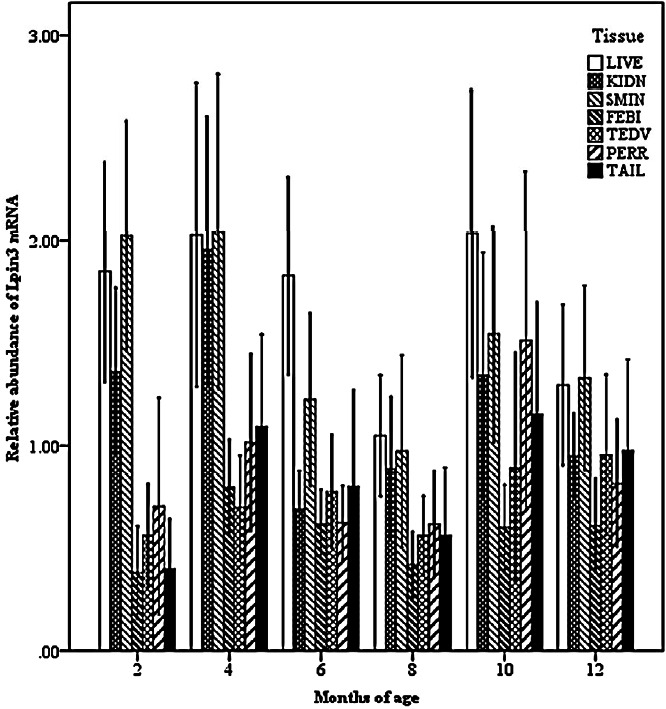
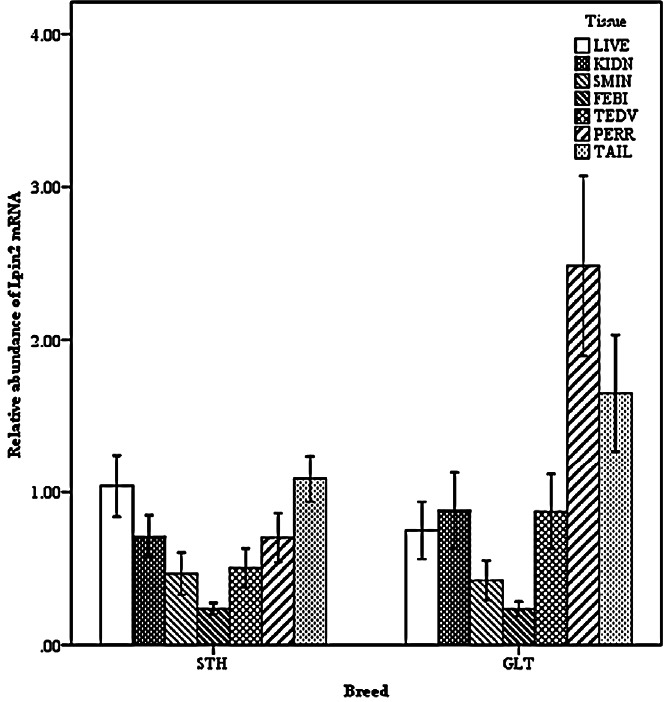
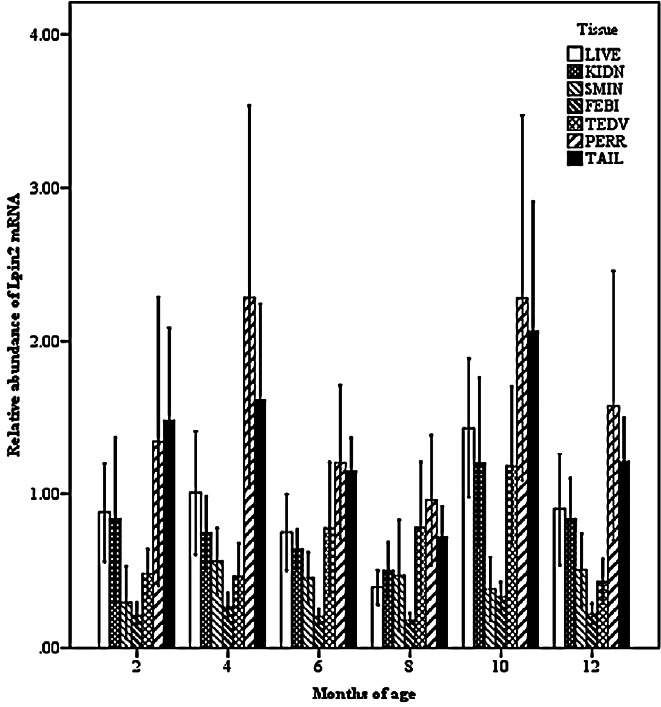
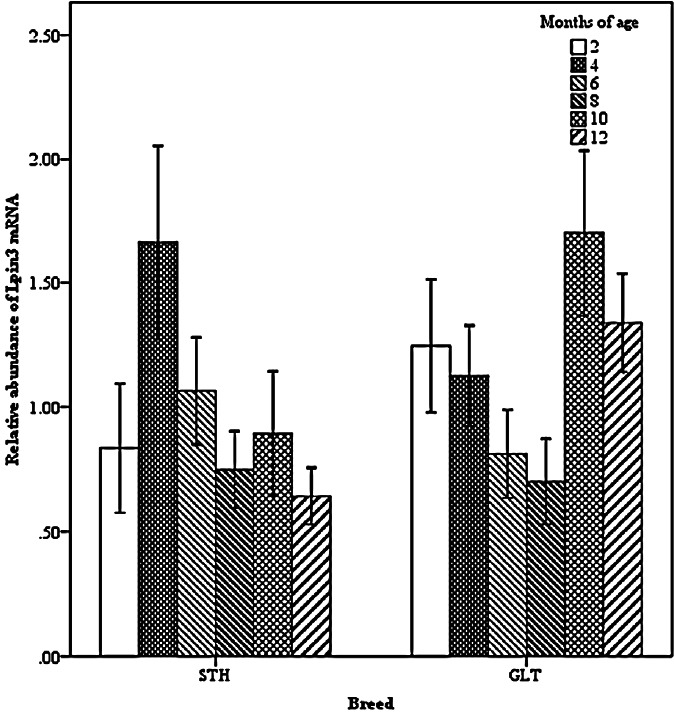
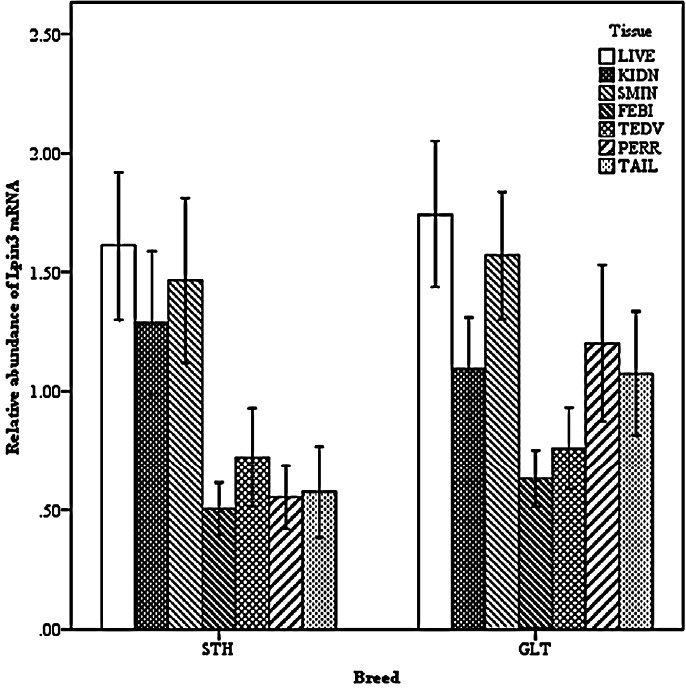
Lipins play dual function in lipid metabolism by serving as phosphatidate phosphatase and transcriptional co-regulators of gene expression. Mammalian lipin proteins consist of lipin1, lipin2, and lipin3 and are encoded by their respective genes Lpin1, Lpin2, and Lpin3. To date, most studies are concerned with Lpin1, only a few have addressed Lpin2 and Lpin3. Ontogenetic expression of Lpin2 and Lpin3 and their associations with traits would help to explore their molecular and physiological functions in sheep. In this study, 48 animals with an equal number of males and females each for both breeds of fat-tailed sheep such as Guangling Large Tailed (GLT) and Small Tailed Han (STH) were chosen to evaluate the ontogenetic expression of Lpin2 and Lpin3 from eight different tissues and months of age by quantitative real-time polymerase chain reaction (PCR). Associations between gene expression and slaughter and tail traits were also analyzed. The results showed that Lpin2 mRNA was highly expressed in perirenal and tail fats, and was also substantially expressed in liver, kidney, reproductive organs (testis and ovary), with the lowest levels in small intestine and femoral biceps. Lpin3 mRNA was prominently expressed in liver and small intestine, and was also expressed at high levels in kidney, perirenal and tail fats as well as reproductive organs (testis and ovary), with the lowest level in femoral biceps. Global expression of Lpin2 and Lpin3 in GLT both were significantly higher than those in STH. Spatiotemporal expression showed that the highest levels of Lpin2 expression occurred at 10 months of age in two breeds of sheep, with the lowest expression at 2 months of age in STH and at 8 months of age in GLT. The greatest levels of Lpin3 expression occurred at 4 months of age in STH and at 10 months of age in GLT, with the lowest expression at 12 months of age in STH and at 8 months of age in GLT. Breed and age significantly influenced the tissue expression patterns of Lpin2 and Lpin3, respectively, and sex significantly influenced the spatiotemporal expression patterns of Lpin3. Meanwhile, Lpin2 and Lpin3 mRNA expression both showed significant correlations with slaughter and tail traits, and the associations appear to be related with the ontogenetic expression as well as the potential functions of lipin2 and lipin3 in sheep.
脂联素在脂质代谢中发挥双重作用,既作为磷脂酸磷酸酶,又作为基因表达的转录共调节因子。哺乳动物脂联素蛋白由脂联素1、脂联素2和脂联素3组成,分别由各自的基因Lpin1、Lpin2和Lpin3编码。迄今为止,大多数研究关注的是Lpin1,只有少数研究涉及Lpin2和Lpin3。Lpin2和Lpin3的个体发育表达及其与性状的关联,将有助于探索它们在绵羊中的分子和生理功能。在本研究中,选取了48只动物,其中包括广灵大尾羊(GLT)和小尾寒羊(STH)这两个品种的脂肪尾羊,每个品种的雄性和雌性数量相等,通过定量实时聚合酶链反应(PCR)评估Lpin2和Lpin3在八个不同组织和月龄中的个体发育表达。还分析了基因表达与屠宰和尾部性状之间的关联。结果表明,Lpin2 mRNA在肾周脂肪和尾部脂肪中高表达,在肝脏、肾脏、生殖器官(睾丸和卵巢)中也有大量表达,在小肠和股二头肌中表达水平最低。Lpin3 mRNA在肝脏和小肠中显著表达,在肾脏、肾周脂肪和尾部脂肪以及生殖器官(睾丸和卵巢)中也高水平表达,在股二头肌中表达水平最低。GLT中Lpin2和Lpin3的整体表达均显著高于STH。时空表达显示,两个品种的绵羊中,Lpin2表达的最高水平出现在10月龄,STH在2月龄时表达最低,GLT在8月龄时表达最低。Lpin3表达的最高水平在STH中出现在4月龄,在GLT中出现在10月龄,STH在12月龄时表达最低,GLT在8月龄时表达最低。品种和年龄分别显著影响Lpin2和Lpin3的组织表达模式,性别显著影响Lpin3的时空表达模式。同时,Lpin2和Lpin3 mRNA表达均与屠宰和尾部性状显著相关,这些关联似乎与脂联素2和脂联素3在绵羊中的个体发育表达及其潜在功能有关。