Pham M, Bendszus M
Department of Neuroradiology, Heidelberg University Hospital, INF 400, 69120, Heidelberg, Germany.
Clin Neuroradiol. 2016 Jun;26(2):141-51. doi: 10.1007/s00062-016-0507-2. Epub 2016 Mar 7.
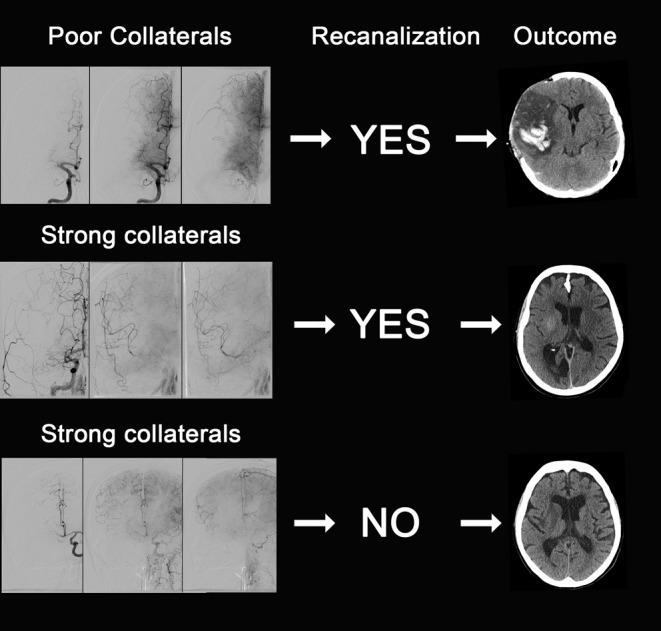
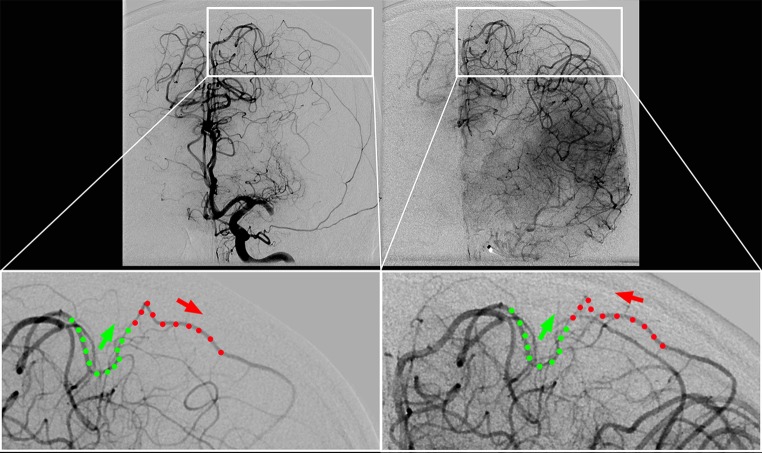
Several randomized-controlled trials could recently demonstrate that ischemic stroke which is caused by large-cerebral-artery-occlusion can be treated effectively by endovascular recanalization. Among these studies, particularly the data from the ESCAPE study further corroborated the strong association between macrovascular pial collateral flow (before recanalization) and clinical outcome after recanalization. This review briefly gives an overview on these data and on the clinical key observations demonstrating this association in practice. Since the ischemic penumbra can only be sustained by collateral flow, the collapse of collateral blood flow or poor collateral filling, observed for example by DSA or CTA before recanalization, seems to be a primary cause of rapidly progressive infarction and futile therapeutic recanalization. However, it needs to be emphasized that the true cause-effect relationship between collateral failure and rapidly progressive infarction of the penumbra, i.e. the high probability of unfavorable clinical outcome despite recanalization, remains unclear. Along this line, an alternative hypothesis is offered viewing the collapse of collateral flow not as a cause but possibly as an inevitable secondary consequence of increasing peripheral/microvascular resistance during progressive infarction.
最近的几项随机对照试验表明,大脑大动脉闭塞所致的缺血性卒中可通过血管内再通得到有效治疗。在这些研究中,尤其是ESCAPE研究的数据进一步证实了(再通前的)软脑膜大血管侧支血流与再通后的临床结局之间存在密切关联。本综述简要概述了这些数据以及在实践中证明这种关联的临床关键观察结果。由于缺血半暗带只能由侧支血流维持,再通前通过数字减影血管造影(DSA)或CT血管造影(CTA)观察到的侧支血流中断或侧支充盈不佳,似乎是梗死快速进展和治疗性再通无效的主要原因。然而,需要强调的是,侧支循环衰竭与半暗带梗死快速进展之间的真正因果关系,即尽管再通但临床结局不佳的高概率情况,仍不清楚。据此,有人提出了另一种假说,认为侧支血流中断不是原因,而可能是进展性梗死期间外周/微血管阻力增加的必然继发后果。