Department of Neurology, University of Würzburg, Würzburg, Germany.
Institute for Experimental Biomedicine and Rudolf-Virchow-Center, University of Würzburg, Würzburg, Germany.
J Cereb Blood Flow Metab. 2022 Sep;42(9):1561-1567. doi: 10.1177/0271678X221105764. Epub 2022 Jun 8.
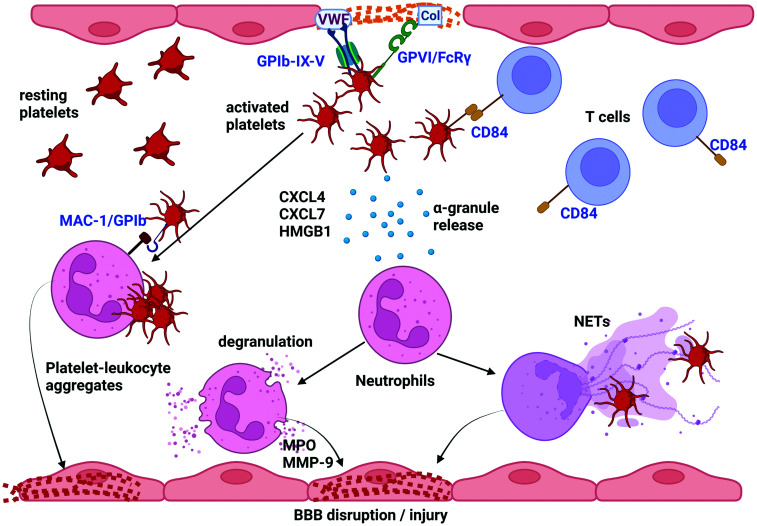
In stroke patients, local sampling of pial blood within the occluded vasculature before recanalization by mechanical thrombectomy emerged as powerful tool enabling insights into ultra-early stroke pathophysiology. Thereby, a strong intravascular inflammatory response hallmarked by hyper-acute neutrophil recruitment, altered lymphocyte composition and platelet activation could be observed. These human findings mirror experimental stroke. Here, neutrophil and T-cell activation are driven by platelets involving engagement of platelet glycoprotein receptor (GP)Ib, GPVI and CD84 as well as α-granule release orchestrating infarct progression. Thus, targeting of early intravascular inflammation may evolve as a new therapeutic strategy to augment the effects of recanalization.
在接受机械取栓治疗以再通的缺血性卒中患者中,血管内取栓前对阻塞血管段的软脑膜血进行局部采样,这一方法已成为了解超早期卒中病理生理学的有力工具。通过这种方法,可以观察到强烈的血管内炎症反应,其特征为超急性中性粒细胞募集、淋巴细胞组成改变和血小板激活。这些人体研究结果与实验性卒中相吻合。在实验性卒中模型中,血小板通过结合血小板糖蛋白受体(GP)Ib、GPVI 和 CD84 以及α-颗粒释放,激活中性粒细胞和 T 细胞,进而调控梗死进展。因此,针对早期血管内炎症的靶向治疗可能会成为一种新的治疗策略,以增强再通的效果。