Ezzat Abdelrahman E M, Hamoud Hesham S
Department of ENT, Faculty of Medicine, Al-Azhar University, Cairo, Egypt.
Department of Rheumatology, Faculty of Medicine, Al-Azhar University, Cairo, Egypt.
Avicenna J Med. 2016 Jan-Mar;6(1):3-7. doi: 10.4103/2231-0770.173579.
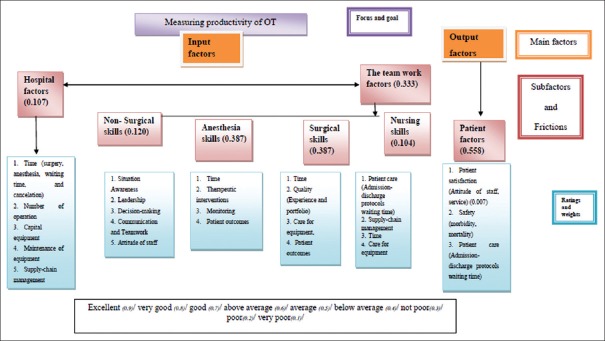
The analytic hierarchy process (AHP) is a theory of measurement through pairwise comparisons and relies on the judgments of experts to derive priority scales, these scales that measure intangibles in relative terms. The aim of the article was to develop a model for productivity measurement of the operation theater (OT), which could be applied as a model for quality improvement and decision-making. AHP is used in this article to evolve such a model. The steps consist of identifying the critical success factors for measuring the productivity of OT, identifying subfactors that inflauence the critical factors, comparing the pairwise, deriving their relative importance and ratings, and calculating the cumulative effect according to the attributes in OT. The cumulative productivitycan be calculated by the end and can be compared Ideal productivity to measure the productive of OT in percentage fraction. Hence, the productivity could be calculated. Hence, AHP is a very useful model to measure the productivity in OT.
层次分析法(AHP)是一种通过两两比较进行测量的理论,它依赖专家的判断来得出优先尺度,这些尺度用于相对地衡量无形资产。本文的目的是开发一个手术室(OT)生产率测量模型,该模型可作为质量改进和决策的模型。本文使用层次分析法来发展这样一个模型。步骤包括确定衡量手术室生产率的关键成功因素,识别影响关键因素的子因素,进行两两比较,得出它们的相对重要性和评级,并根据手术室的属性计算累积效应。最终可以计算出累积生产率,并将其与理想生产率进行比较,以百分比形式衡量手术室的生产率。因此,可以计算出生产率。因此,层次分析法是衡量手术室生产率的一个非常有用的模型。