Kim Byung Moon, Shin Yong Sam, Baik Min Woo, Lee Deok Hee, Jeon Pyoung, Baik Seung Kug, Lee Tae Hong, Kang Dong-Hoon, Suh Sang-Il, Byun Jun Soo, Jung Jin-Young, Kwon Kihun, Kim Dong Joon, Park Keun Young, Kim Bum-Soo, Park Jung Cheol, Kim Seong Rim, Kim Young Woo, Kim Hoon, Jo Kyungil, Yoon Chang Hyo, Kim Young Soo
Department of Radiology, Severance Hospital, Yonsei University College of Medicine, Seoul, Korea.
Department of Neurosurgery, Seoul St' Mary's Hospital, The Catholic University of Korea, Seoul, Korea.
Neurointervention. 2016 Mar;11(1):10-7. doi: 10.5469/neuroint.2016.11.1.10. Epub 2016 Mar 3.
The purpose of this study was to assess the safety and early outcomes of the Pipeline device for large/giant or fusiform aneurysms.
The Pipeline was implanted in a total of 45 patients (mean age, 58 years; M:F=10:35) with 47 large/giant or fusiform aneurysms. We retrospectively evaluated the characteristics of the treated aneurysms, the periprocedural events, morbidity and mortality, and the early outcomes after Pipeline implantation.
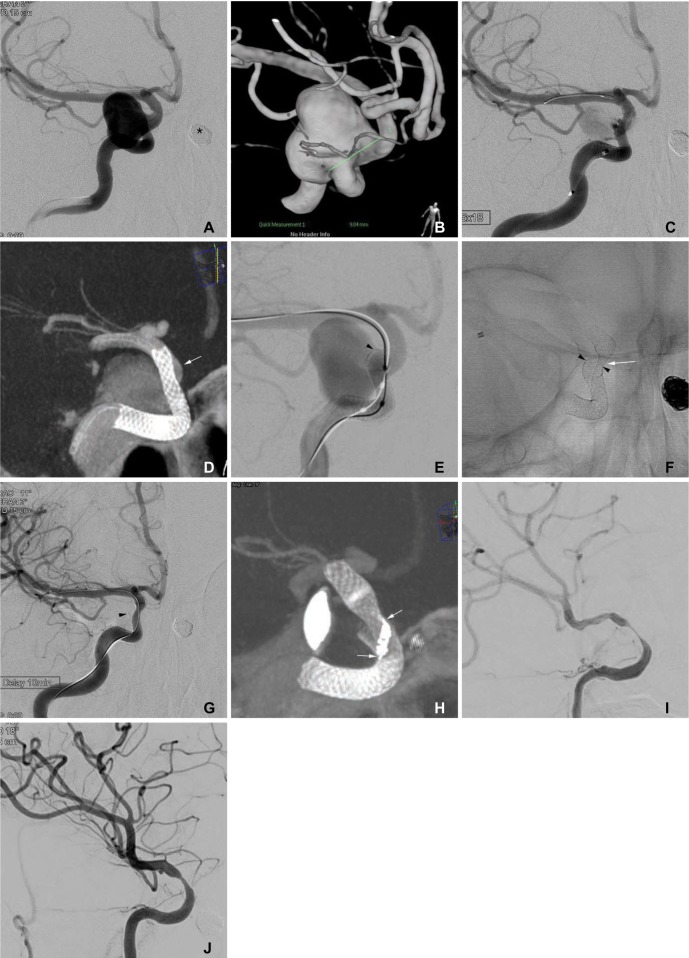
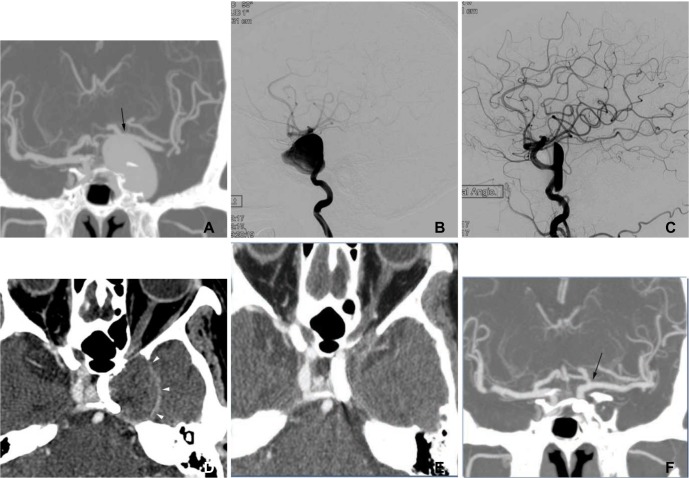
The aneurysms were located in the internal carotid artery (ICA) cavernous segment (n=25), ICA intradural segment (n=11), vertebrobasilar trunk (n=8), and middle cerebral artery (n=3). Procedure-related events occurred in 18 cases, consisting of incomplete expansion (n=8), shortening-migration (n=5), transient occlusion of a jailed branch (n=3), and in-stent thrombosis (n=2). Treatment-related morbidity occurred in two patients, but without mortality. Both patients had modified Rankin scale (mRS) scores of 2, but had an improved mRS score of 0 at 1-month follow-up. Of the 19 patients presenting with mass effect, 16 improved but three showed no changes in their presenting symptoms. All patients had excellent outcomes (mRS, 0 or 1) during the follow-up period (median, 6 months; range, 2-30 months). Vascular imaging follow-up (n=31, 65.9%; median, 3 months, range, 1-25 months) showed complete or near occlusion of the aneurysm in 24 patients (77.4%) and decreased sac size in seven patients (22.6%).
In this initial multicenter study in Korea, the Pipeline seemed to be safe and effective for large/giant or fusiform aneurysms. However, a learning period may be required to alleviate device-related events.
本研究旨在评估用于大型/巨大型或梭形动脉瘤的Pipeline装置的安全性和早期疗效。
共45例患者(平均年龄58岁;男:女 = 10:35)的47个大型/巨大型或梭形动脉瘤植入了Pipeline装置。我们回顾性评估了治疗动脉瘤的特征、围手术期事件、发病率和死亡率以及Pipeline植入后的早期疗效。
动脉瘤位于颈内动脉(ICA)海绵窦段(n = 25)、ICA硬膜内段(n = 11)、椎基底动脉干(n = 8)和大脑中动脉(n = 3)。18例发生了与手术相关的事件,包括扩张不完全(n = 8)、缩短移位(n = 5)、被栓塞分支的短暂闭塞(n = 3)和支架内血栓形成(n = 2)。2例患者出现了与治疗相关的并发症,但无死亡病例。这2例患者改良Rankin量表(mRS)评分均为2分,但在1个月随访时mRS评分改善为0分。19例有占位效应的患者中,16例症状改善,但3例症状无变化。所有患者在随访期间(中位时间6个月;范围2 - 30个月)均获得了良好的疗效(mRS,0或1)。血管成像随访(n = 31,65.9%;中位时间3个月,范围1 - 25个月)显示,24例患者(77.4%)的动脉瘤完全或接近闭塞,7例患者(22.6%)的瘤囊大小减小。
在韩国的这项初步多中心研究中,Pipeline装置对于大型/巨大型或梭形动脉瘤似乎是安全有效的。然而,可能需要一个学习阶段来减少与装置相关的事件。