Abascal Juan F P J, Abella Monica, Marinetto Eugenio, Pascau Javier, Desco Manuel
Departamento de Bioingeniería e Ingeniería Aeroespacial, Universidad Carlos III de Madrid, Madrid, Spain.
Instituto de Investigación Sanitaria Gregorio Marañón (IiSGM), Madrid, Spain.
PLoS One. 2016 Mar 9;11(3):e0149841. doi: 10.1371/journal.pone.0149841. eCollection 2016.
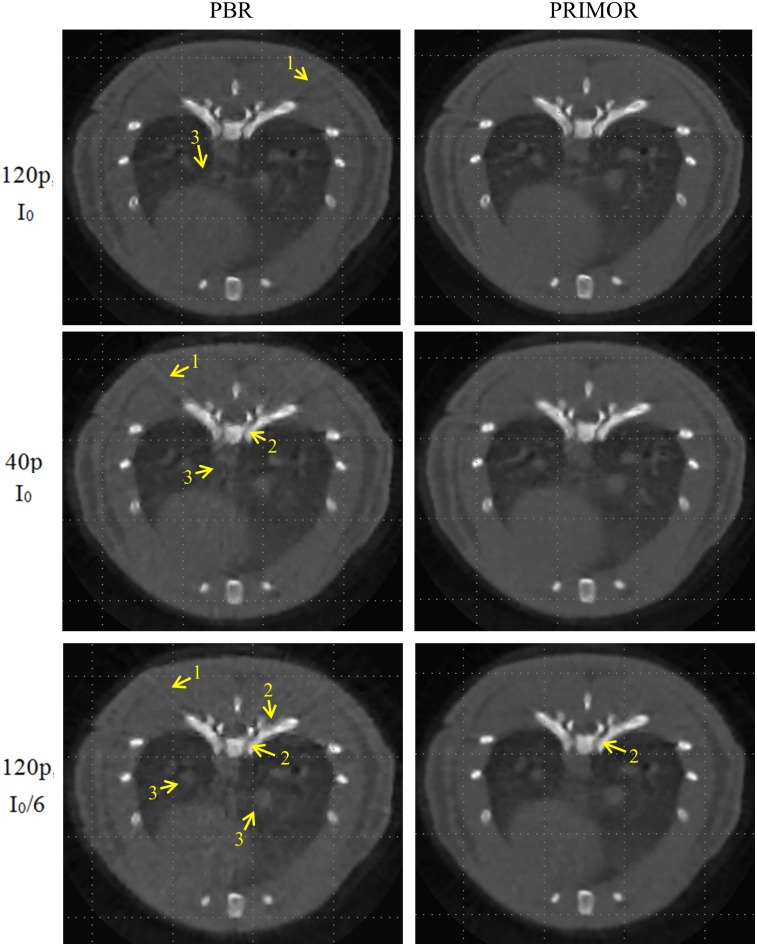
Low-dose protocols for respiratory gating in cardiothoracic small-animal imaging lead to streak artifacts in the images reconstructed with a Feldkamp-Davis-Kress (FDK) method. We propose a novel prior- and motion-based reconstruction (PRIMOR) method, which improves prior-based reconstruction (PBR) by adding a penalty function that includes a model of motion. The prior image is generated as the average of all the respiratory gates, reconstructed with FDK. Motion between respiratory gates is estimated using a nonrigid registration method based on hierarchical B-splines. We compare PRIMOR with an equivalent PBR method without motion estimation using as reference the reconstruction of high dose data. From these data acquired with a micro-CT scanner, different scenarios were simulated by changing photon flux and number of projections. Methods were evaluated in terms of contrast-to-noise-ratio (CNR), mean square error (MSE), streak artefact indicator (SAI), solution error norm (SEN), and correction of respiratory motion. Also, to evaluate the effect of each method on lung studies quantification, we have computed the Jaccard similarity index of the mask obtained from segmenting each image as compared to those obtained from the high dose reconstruction. Both iterative methods greatly improved FDK reconstruction in all cases. PBR was prone to streak artifacts and presented blurring effects in bone and lung tissues when using both a low number of projections and low dose. Adopting PBR as a reference, PRIMOR increased CNR up to 33% and decreased MSE, SAI and SEN up to 20%, 4% and 13%, respectively. PRIMOR also presented better compensation for respiratory motion and higher Jaccard similarity index. In conclusion, the new method proposed for low-dose respiratory gating in small-animal scanners shows an improvement in image quality and allows a reduction of dose or a reduction of the number of projections between two and three times with respect to previous PBR approaches.
心胸小动物成像中用于呼吸门控的低剂量方案会在使用费尔德坎普-戴维斯-克雷斯(FDK)方法重建的图像中产生条纹伪影。我们提出了一种新颖的基于先验和运动的重建(PRIMOR)方法,该方法通过添加一个包含运动模型的惩罚函数来改进基于先验的重建(PBR)。先验图像是通过FDK重建所有呼吸门控的平均值生成的。使用基于分层B样条的非刚性配准方法估计呼吸门控之间的运动。我们将PRIMOR与一种不进行运动估计的等效PBR方法进行比较,以高剂量数据的重建作为参考。从使用微型CT扫描仪获取的这些数据中,通过改变光子通量和投影数量模拟了不同的场景。从对比度噪声比(CNR)、均方误差(MSE)、条纹伪影指标(SAI)、解误差范数(SEN)以及呼吸运动校正方面对方法进行了评估。此外,为了评估每种方法对肺部研究量化的影响,我们计算了将每个图像分割得到的掩码与高剂量重建得到的掩码相比的杰卡德相似性指数。在所有情况下,两种迭代方法都极大地改进了FDK重建。当使用较少的投影数量和低剂量时,PBR容易出现条纹伪影,并且在骨骼和肺部组织中呈现模糊效应。以PBR作为参考,PRIMOR将CNR提高了33%,并分别将MSE、SAI和SEN降低了20%、4%和13%。PRIMOR在呼吸运动补偿方面也表现更好,并且具有更高的杰卡德相似性指数。总之,为小动物扫描仪中的低剂量呼吸门控提出的新方法在图像质量方面有改进,并且相对于之前的PBR方法能够将剂量降低或投影数量减少两到三倍。