Otto Angela M
Institute of Medical Engineering (IMETUM), Technische Universitaet Muenchen, Boltzmannstr. 11, D-85748 Garching, Germany.
Cancer Metab. 2016 Mar 8;4:5. doi: 10.1186/s40170-016-0145-9. eCollection 2016.
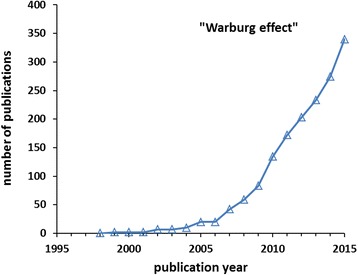
Virtually everyone working in cancer research is familiar with the "Warburg effect", i.e., anaerobic glycolysis in the presence of oxygen in tumor cells. However, few people nowadays are aware of what lead Otto Warburg to the discovery of this observation and how his other scientific contributions are seminal to our present knowledge of metabolic and energetic processes in cells. Since science is a human endeavor, and a scientist is imbedded in a network of social and academic contacts, it is worth taking a glimpse into the biography of Otto Warburg to illustrate some of these influences and the historical landmarks in his life. His creative and innovative thinking and his experimental virtuosity set the framework for his scientific achievements, which were pioneering not only for cancer research. Here, I shall allude to the prestigious family background in imperial Germany; his relationships to Einstein, Meyerhof, Krebs, and other Nobel and notable scientists; his innovative technical developments and their applications in the advancement of biomedical sciences, including the manometer, tissue slicing, and cell cultivation. The latter were experimental prerequisites for the first metabolic measurements with tumor cells in the 1920s. In the 1930s-1940s, he improved spectrophotometry for chemical analysis and developed the optical tests for measuring activities of glycolytic enzymes. Warburg's reputation brought him invitations to the USA and contacts with the Rockefeller Foundation; he received the Nobel Prize in 1931. World politics and world wars heavily affected Warburg's scientific survival in Berlin. But, after his second postwar recovery, Warburg's drive for unraveling the energetic processes of life, both in plants and in tumor cells, continued until his death in 1970. The legacy of Otto Warburg is not only the Warburg effect, but also the identification of the "respiratory ferment" and hydrogen-transferring cofactors and the isolation of glycolytic enzymes. His hypothesis of respiratory damage being the cause of cancer remains to be a provocative scientific issue, along with its implications for cancer treatment and prevention. Warburg is therefore still stimulating our thinking, as documented in a soaring increase in publications citing his name in the context of tumor metabolism.
几乎每个从事癌症研究的人都熟知“瓦伯格效应”,即肿瘤细胞在有氧条件下进行无氧糖酵解。然而,如今很少有人了解是什么促使奥托·瓦伯格发现了这一现象,以及他的其他科学贡献如何对我们目前关于细胞代谢和能量过程的认识具有开创性意义。由于科学是人类的一项事业,而科学家置身于社会和学术联系的网络之中,因此值得简要了解一下奥托·瓦伯格的生平,以说明其中的一些影响以及他人生中的历史里程碑。他富有创造性和创新性的思维以及精湛的实验技巧为他的科学成就奠定了基础,这些成就不仅在癌症研究领域具有开创性。在此,我将提及他在德意志帝国时期享有声望的家庭背景;他与爱因斯坦、迈耶霍夫、克雷布斯以及其他诺贝尔奖获得者和著名科学家的关系;他的创新性技术发展及其在生物医学科学进步中的应用,包括压力计、组织切片和细胞培养。后者是20世纪20年代首次对肿瘤细胞进行代谢测量的实验前提。在20世纪30年代至40年代,他改进了用于化学分析的分光光度法,并开发了用于测量糖酵解酶活性的光学测试方法。瓦伯格的声誉使他受邀前往美国,并与洛克菲勒基金会建立了联系;他于1931年获得诺贝尔奖。世界政治和世界大战严重影响了瓦伯格在柏林的科研生涯。但是,在战后的第二次恢复之后,瓦伯格探索植物和肿瘤细胞中生命能量过程的动力一直持续到1970年他去世。奥托·瓦伯格的遗产不仅包括瓦伯格效应,还包括对“呼吸酶”和氢转移辅助因子的识别以及糖酵解酶的分离。他关于呼吸损伤是癌症病因的假说,连同其对癌症治疗和预防的影响,仍然是一个具有启发性的科学问题。因此,瓦伯格仍在激发我们的思考,正如在肿瘤代谢背景下引用他名字的出版物数量急剧增加所证明的那样。