Kragstrup Tue Wenzel, Greisen Stinne Ravn, Nielsen Morten Aagaard, Rhodes Christopher, Stengaard-Pedersen Kristian, Hetland Merete Lund, Hørslev-Petersen Kim, Junker Peter, Østergaard Mikkel, Hvid Malene, Vorup-Jensen Thomas, Robinson William H, Sokolove Jeremy, Deleuran Bent
Department of Biomedicine, Aarhus University, Aarhus, Denmark.
Department of Immunology and Rheumatology, Stanford University, Stanford, CA, USA.
Arthritis Res Ther. 2016 Mar 11;18:61. doi: 10.1186/s13075-016-0964-7.
Rheumatoid arthritis (RA) is often characterized by the presence of rheumatoid factor, anti-citrullinated protein antibodies, and bone erosions. Current therapies can compromise immunity, leading to risk of infection. The interleukin-20 receptor (IL-20R) axis comprising IL-19, IL-20, and IL-24 and their shared receptors activates tissue homeostasis processes but not the immune system. Consequently, modulation of the IL-20R axis may not lead to immunosuppression, making it an interesting drug target. We evaluated the role of the IL-20R axis in RA and associations between plasma cytokine levels and clinical disease.
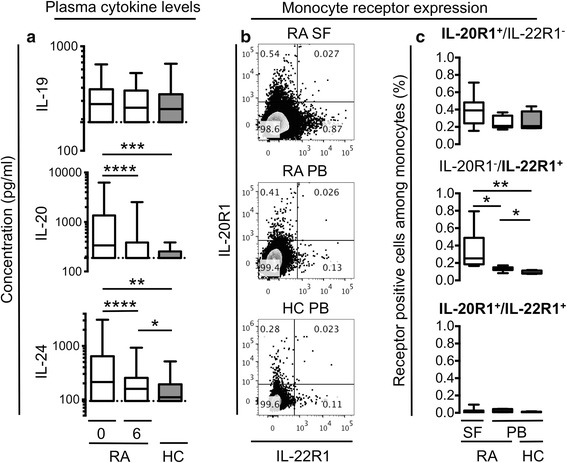
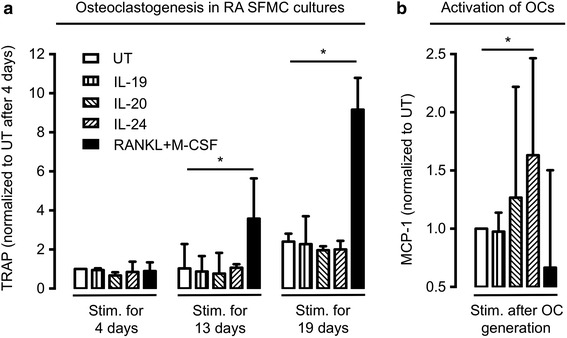
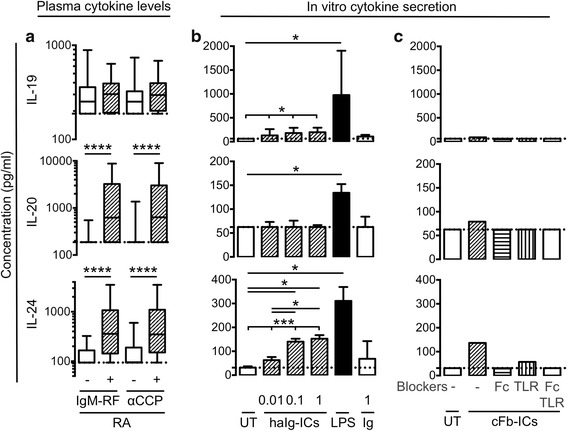
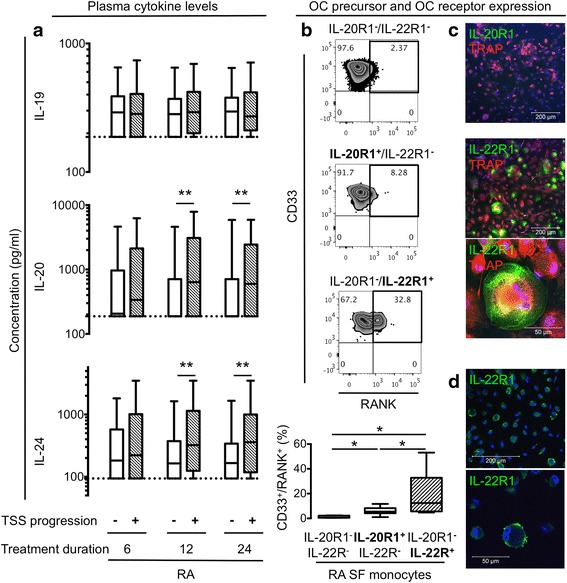
Plasma IL-19, IL-20, and IL-24 levels were measured in early RA patients during a treat-to-target strategy by enzyme-linked immunosorbent assays. The IL-20R1 and IL-22R1 levels in paired peripheral blood mononuclear cells and synovial fluid mononuclear cells from a different cohort of RA patients were evaluated by flow cytometry and confocal microscopy. Monocytes/macrophages were stimulated with heat-aggregated human immunoglobulin immune complexes and immune complexes containing citrullinated fibrinogen, and osteoclasts were incubated with IL-19, IL-20, and IL-24.
The plasma concentrations of IL-20 and IL-24 (but not IL-19) were increased in early RA patients compared with healthy controls (both P < 0.002) and decreased after 6 months of treatment (both P < 0.0001). The expression of IL-22R1 (but not IL-20R1) was increased on monocytes from RA synovial fluid compared with monocytes from both RA and healthy control peripheral blood. The plasma concentrations of IL-20 and IL-24 were increased in rheumatoid factor and anti-citrullinated protein antibody positive compared with negative early RA patients (all P < 0.0001). Immune complexes stimulated the production of the IL-20R cytokines by monocytes/macrophages. Increased baseline plasma concentrations of IL-20 and IL-24 were associated with Sharp-van der Heijde score progression after 24 months (Spearman's rho = 0.19 and 0.26, both P < 0.05) in the early RA patients. The IL-22R1 was expressed by osteoclast precursors and in multinucleated osteoclasts. IL-20 and IL-24 increased the secretion of monocyte chemoattractant protein 1 by these cells.
This study suggests that IL-20 and IL-24 link RA-associated autoantibodies with radiographic progression via the IL-22R1. Modulation of this axis holds promise as feasible anti-erosive treatment modalities in seropositive RA.
类风湿关节炎(RA)通常以类风湿因子、抗瓜氨酸化蛋白抗体和骨侵蚀的存在为特征。目前的治疗方法可能会损害免疫力,导致感染风险。由白细胞介素-19(IL-19)、白细胞介素-20(IL-20)和白细胞介素-24(IL-24)及其共同受体组成的白细胞介素-20受体(IL-20R)轴激活组织稳态过程,但不激活免疫系统。因此,调节IL-20R轴可能不会导致免疫抑制,使其成为一个有趣的药物靶点。我们评估了IL-20R轴在RA中的作用以及血浆细胞因子水平与临床疾病之间的关联。
通过酶联免疫吸附测定法,在早期RA患者采用达标治疗策略期间测量血浆IL-19、IL-20和IL-24水平。通过流式细胞术和共聚焦显微镜评估来自另一组RA患者的配对外周血单个核细胞和滑膜液单个核细胞中的IL-20R1和IL-22R1水平。用热聚集的人免疫球蛋白免疫复合物和含瓜氨酸化纤维蛋白原的免疫复合物刺激单核细胞/巨噬细胞,并用IL-19、IL-20和IL-24孵育破骨细胞。
与健康对照相比,早期RA患者血浆中IL-20和IL-24(而非IL-19)的浓度升高(均P<0.002),治疗6个月后降低(均P<0.0001)。与来自RA和健康对照外周血的单核细胞相比,RA滑膜液单核细胞上IL-22R1(而非IL-20R1)的表达增加。与类风湿因子和抗瓜氨酸化蛋白抗体阴性的早期RA患者相比,阳性患者血浆中IL-20和IL-24的浓度升高(均P<0.0001)。免疫复合物刺激单核细胞/巨噬细胞产生IL-20R细胞因子。早期RA患者中,IL-20和IL-24的基线血浆浓度升高与24个月后Sharp-van der Heijde评分进展相关(Spearman秩相关系数分别为0.19和0.26,均P<0.05)。IL-22R1在破骨细胞前体和多核破骨细胞中表达。IL-20和IL-24增加了这些细胞单核细胞趋化蛋白1的分泌。
本研究表明,IL-20和IL-24通过IL-22R1将RA相关自身抗体与影像学进展联系起来。调节该轴有望成为血清阳性RA中可行的抗侵蚀治疗方式。