Laustsen Julie K, Rasmussen Tue K, Stengaard-Pedersen Kristian, Hørslev-Petersen Kim, Hetland Merete L, Østergaard Mikkel, Junker Peter, Hvid Malene, Deleuran Bent
Arthritis Res Ther. 2014 Oct 30;16(5):474. doi: 10.1186/s13075-014-0474-4.
OX40 and its ligand OX40L are key components in the generation of adaptive memory response and provide necessary co-stimulatory signals for activated effector T cells. Here we investigate the dual roles of the membrane and soluble (s) forms of OX40 and OX40L in plasma and synovial fluid and their association with autoantibodies and disease activity in rheumatoid arthritis (RA).
Soluble OX40 and sOX40L plasma levels were measured in treatment-naïve early RA patients (eRA) at baseline and after 3, 6, and 12 months of treatment with methotrexate and adalimumab (n = 39) and with methotrexate alone (n = 37). Adalimumab was discontinued after the first year, and patients were followed for additional 12 months. For comparison, sOX40 and sOX40L were measured in patients with chronic RA (cRA, n = 15) and healthy volunteers (HV, n = 34). Membrane-bound OX40 and OX40L expression on T cells, B cells and monocytes were quantified.
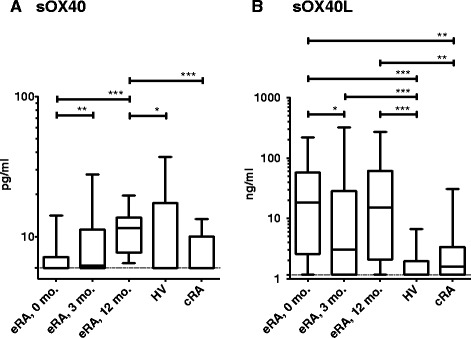
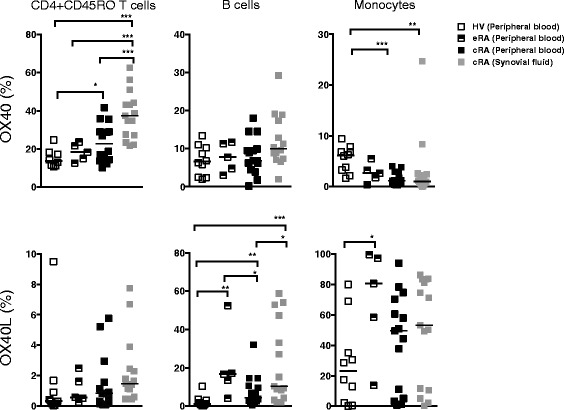
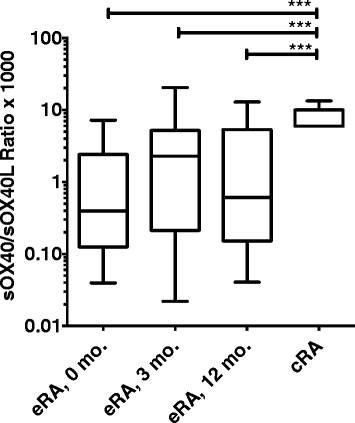
Soluble OX40 plasma levels of eRA patients were not different at the time of treatment initiation, but were significantly higher after 12 months of treatment, compared with HV or cRA patients. Soluble OX40L was significantly elevated throughout the first 12 months of treatment compared with HVs and patients with cRA. Adalimumab treatment did not influence sOX40 or sOX40L plasma levels. At baseline, sOX40L levels were strongly associated with the presence of anti-citrullinated protein antibodies (ACPA) (P <0.001) and IgM-RF (P <0.0001). The sOX40/sOX40L ratio was decreased in eRA, and a low ratio at the time of adalimumab discontinuation was associated with increased DAS28CRP and risk of flare the following year. T cells in the synovial fluid had the highest expression of OX40, while monocytes and B cells were the main expressers of OX40L in the joint.
Plasma levels of sOX40 and sOX40L were increased in eRA and sOX40L was correlated with ACPA and IgM-RF. Further, expression of membrane-bound OX40 and OX40L was increased in eRA and cRA. Combined, these findings could reflect that increased activity in the OX40 systems facilitate to drive disease activity and autoantibody production in RA.
Clincaltrials.gov NCT00660647, 10 April 2008.
OX40及其配体OX40L是适应性记忆反应产生的关键成分,为活化的效应T细胞提供必要的共刺激信号。在此,我们研究血浆和滑液中OX40和OX40L的膜结合形式和可溶性形式的双重作用,以及它们与类风湿关节炎(RA)中自身抗体和疾病活动的关联。
在未接受过治疗的早期RA患者(eRA)基线时以及使用甲氨蝶呤和阿达木单抗治疗3、6和12个月后(n = 39)以及仅使用甲氨蝶呤治疗(n = 37)时,测量可溶性OX40和sOX40L的血浆水平。第一年之后停用阿达木单抗,并对患者额外随访12个月。为作比较,在慢性RA患者(cRA,n = 15)和健康志愿者(HV,n = 34)中测量sOX40和sOX40L。对T细胞、B细胞和单核细胞上膜结合的OX40和OX40L表达进行定量。
eRA患者可溶性OX40血浆水平在治疗开始时与HV或cRA患者无差异,但在治疗12个月后显著高于HV或cRA患者。与HV和cRA患者相比,可溶性OX40L在治疗的前12个月中均显著升高。阿达木单抗治疗不影响sOX40或sOX40L血浆水平。基线时,sOX40L水平与抗瓜氨酸化蛋白抗体(ACPA)的存在(P <0.001)和IgM-RF(P <0.0001)密切相关。eRA中sOX40/sOX40L比值降低,阿达木单抗停用之时的低比值与DAS28CRP升高及次年病情复发风险相关。滑液中的T细胞OX40表达最高,而单核细胞和B细胞是关节中OX40L的主要表达细胞。
eRA中sOX40和sOX40L的血浆水平升高,且sOX40L与ACPA和IgM-RF相关。此外,eRA和cRA中膜结合的OX40和OX40L表达增加。综合来看,这些发现可能反映出OX40系统活性增加有助于推动RA中的疾病活动和自身抗体产生。
Clincaltrials.gov NCT00660647,2008年4月10日。