Friemel Juliane, Foraita Ronja, Günther Kathrin, Heibeck Mathias, Günther Frauke, Pflueger Maren, Pohlabeln Hermann, Behrens Thomas, Bullerdiek Jörn, Nimzyk Rolf, Ahrens Wolfgang
Leibniz Institute for Prevention Research and Epidemiology - BIPS, Achterstraße 30, D-28359, Bremen, Germany.
Institute for Prevention and Occupational Medicine of the German Social Accident Insurance, Institute of the Ruhr-Universität Bochum (IPA), Bochum, Germany.
BMC Oral Health. 2016 Mar 11;16:33. doi: 10.1186/s12903-016-0185-0.
The survival time of patients with head and neck squamous cell carcinoma (HNSCC) is related to health behavior, such as tobacco smoking and alcohol consumption. Poor oral health (OH), dental care (DC) and the frequent use of mouthwash have been shown to represent independent risk factors for head and neck cancerogenesis, but their impact on the survival of HNSCC patients has not been systematically investigated.
Two hundred seventy-six incident HNSCC cases recruited for the ARCAGE study were followed through a period of 6-10 years. Interview-based information on wearing of dentures, gum bleeding, teeth brushing, use of floss and dentist visits were grouped into weighted composite scores, i.e. oral health (OH) and dental care (DH). Use of mouthwash was assessed as frequency per day. Also obtained were other types of health behavior, such as smoking, alcohol drinking and diet, appreciated as both confounding and study variables. Endpoints were progression-free survival, overall survival and tumor-specific survival. Prognostic values were estimated using Kaplan-Meier analysis and Cox proportional hazards regression models.
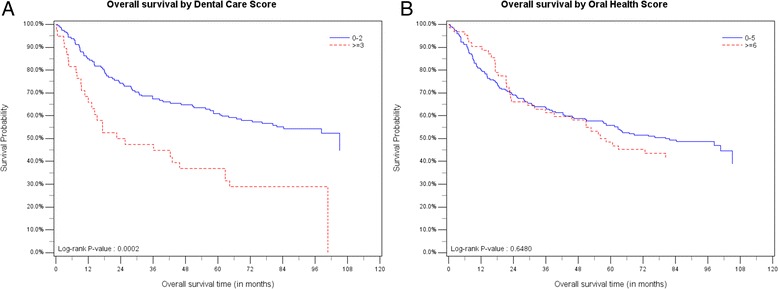
A good dental care score, summarizing annual dental visits, daily teeth cleaning and use of floss was associated with longer overall survival time (p = .001). The results of the Cox regression models similarly suggested a higher risk of tumor progression and shortened overall survival in patients with poor dental care, but the results lost their statistical significance after other types of health behavior had been controlled for. Frequent use of mouthwash (≥ 2 times/day) significantly increased the risk of tumor-specific death (HR = 2.26; CI = 1.19-4.32). Alcohol consumption and tobacco smoking were dose-dependently associated with tumor progression and shorter overall survival.
Frequent mouthwash use of ≥ 2 times/day seems to elevate the risk of tumor-specific death in HNSCC patients. Good dental care scores are associated with longer overall survival.
头颈部鳞状细胞癌(HNSCC)患者的生存时间与健康行为有关,如吸烟和饮酒。口腔健康差(OH)、牙齿护理(DC)和频繁使用漱口水已被证明是头颈部癌症发生的独立危险因素,但它们对HNSCC患者生存的影响尚未得到系统研究。
对ARCAGE研究招募的276例新发HNSCC病例进行了6至10年的随访。基于访谈的关于佩戴假牙、牙龈出血、刷牙、使用牙线和看牙医的信息被分组为加权综合评分,即口腔健康(OH)和牙齿护理(DH)。漱口水的使用以每天的频率进行评估。还获得了其他类型的健康行为,如吸烟、饮酒和饮食,将其视为混杂变量和研究变量。终点指标为无进展生存期、总生存期和肿瘤特异性生存期。使用Kaplan-Meier分析和Cox比例风险回归模型估计预后价值。
一个良好的牙齿护理评分,综合年度看牙医次数、每日牙齿清洁和使用牙线情况,与更长的总生存时间相关(p = 0.001)。Cox回归模型的结果同样表明,牙齿护理差的患者肿瘤进展风险更高,总生存期缩短,但在控制了其他类型的健康行为后,结果失去了统计学意义。频繁使用漱口水(≥2次/天)显著增加了肿瘤特异性死亡的风险(HR = 2.26;CI = 1.19 - 4.32)。饮酒和吸烟与肿瘤进展和较短的总生存期呈剂量依赖性相关。
每天频繁使用漱口水≥2次似乎会增加HNSCC患者肿瘤特异性死亡的风险。良好的牙齿护理评分与更长的总生存期相关。