Wu Chenyi, McGeehan John E, Travers Andrew
Molecular Biophysics Laboratories, School of Biological Sciences, University of Portsmouth, UK.
MRC Laboratory of Molecular Biology, Cambridge, UK.
FEBS Lett. 2016 Apr;590(7):935-42. doi: 10.1002/1873-3468.12128. Epub 2016 Mar 30.
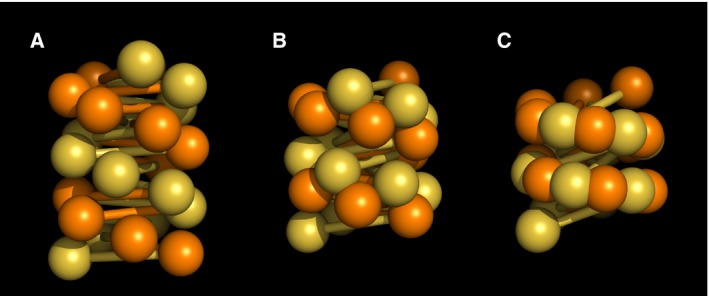
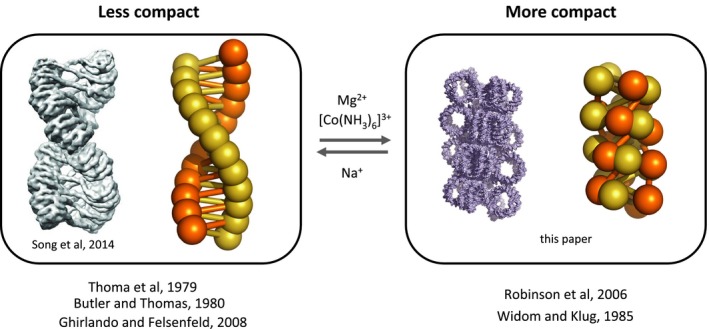
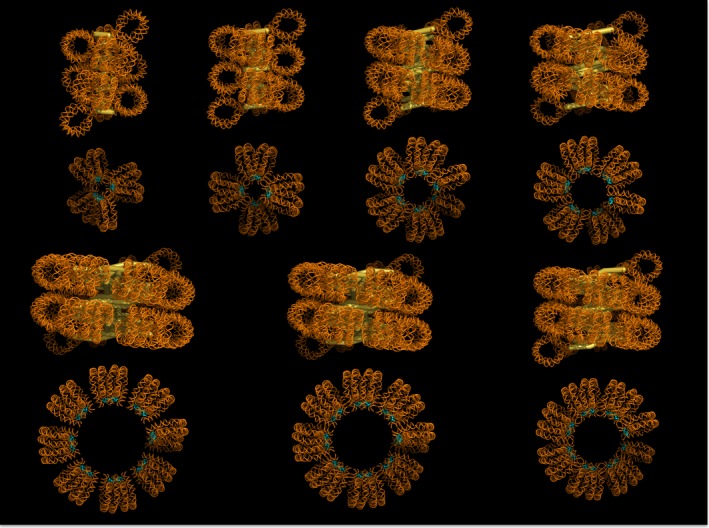
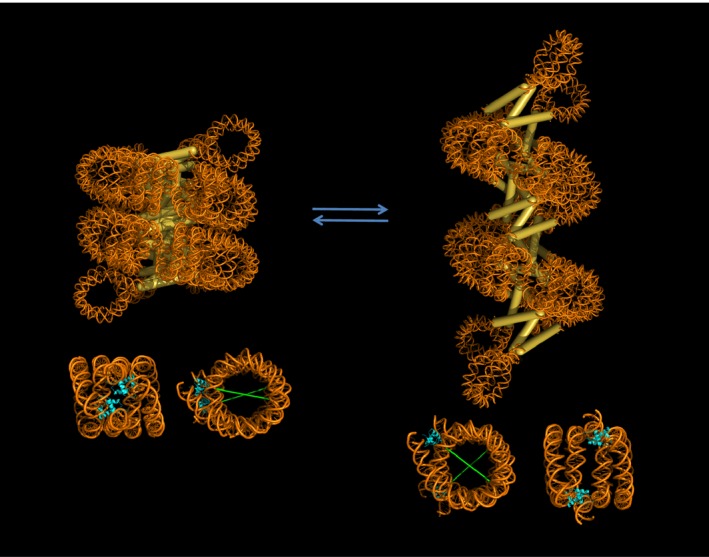
The structure of compact 30-nm chromatin fibres is still debated. We present here a novel unified model that reconciles all experimental observations into a single framework. We propose that compact fibres are formed by the interdigitation of the two nucleosome stacks in a 2-start crossed-linker structure to form a single stack. This process requires that the dyad orientation of successive nucleosomes relative to the helical axis alternates. The model predicts that, as observed experimentally, the fibre-packing density should increase in a stepwise manner with increasing linker length. This model structure can also incorporate linker DNA of varying lengths.
紧密的30纳米染色质纤维的结构仍存在争议。我们在此提出一个新颖的统一模型,将所有实验观察结果整合到一个单一框架中。我们认为紧密纤维是由两个核小体堆叠以双起始交联结构相互交错形成一个单一堆叠而形成的。这个过程要求连续核小体相对于螺旋轴的二分体方向交替变化。该模型预测,正如实验观察到的那样,随着连接子长度增加,纤维堆积密度应逐步增加。这种模型结构也可以纳入不同长度的连接子DNA。