Binkley Michael S, Shrager Joseph B, Chaudhuri Aadel, Popat Rita, Maxim Peter G, Shultz David Benjamin, Diehn Maximilian, Loo Billy W
Department of Radiation Oncology, Stanford University School of Medicine, 875 Blake Wilbur Drive, Stanford, CA, 94305, USA.
Stanford Cancer Institute, Stanford University School of Medicine, 875 Blake Wilbur Drive, Stanford, CA, 94305, USA.
Radiat Oncol. 2016 Mar 15;11:40. doi: 10.1186/s13014-016-0616-8.
Stereotactic ablative volume reduction (SAVR) is a potential alternative to lung-volume reduction surgery in patients with severe emphysema and excessive surgical risk. Having previously observed a dose-volume response for localized lobar volume reduction after stereotactic ablative radiotherapy (SABR) for lung tumors, we investigated the time course and factors associated with volume reduction.
We retrospectively identified 70 eligible patients receiving lung tumor SABR during 2007-2013. We correlated lobar volume reduction (relative to total, bilateral lung volume [TLV]) with volume receiving high biologically effective doses (VXXBED3) and other pre-treatment factors in all patients, and measured the time course of volume changes on 3-month interval CT scans in patients with large V60BED3 (n = 21, V60BED3 ≥4.1 % TLV).
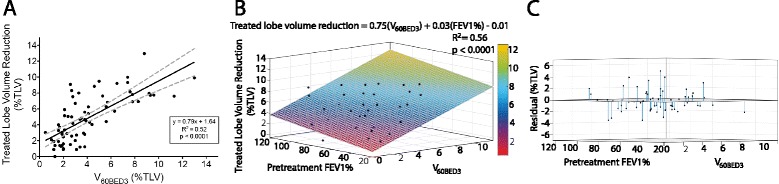
Median CT follow-up was 15 months. Median volume reduction of treated lobes was 4.5 % of TLV (range 0.01-13.0 %), or ~9 % of ipsilateral lung volume (ILV); median expansion of non-target adjacent lobes was 2.2 % TLV (-4.6-9.9 %; ~4 % ILV). Treated lobe volume reduction was significantly greater with larger VXXBED3 (XX = 20-100 Gy, R (2) = 0.52-0.55, p < 0.0001) and smaller with lower pre-treatment FEV1% (R (2) = 0.11, p = 0.005) in a multivariable linear model. Maximum volume reduction was reached by ~12 months and persisted.
We identified a multivariable model for lobar volume reduction after SABR incorporating dose-volume and pre-treatment FEV1% and characterized its time course.
立体定向消融减容术(SAVR)是重度肺气肿且手术风险过高患者肺减容手术的一种潜在替代方案。此前我们观察到立体定向消融放疗(SABR)治疗肺部肿瘤后局部肺叶减容存在剂量 - 体积反应,因此我们对减容的时间进程及相关因素进行了研究。
我们回顾性纳入了2007年至2013年间接受肺部肿瘤SABR的70例符合条件的患者。我们将所有患者的肺叶减容(相对于双侧肺总体积[TLV])与接受高生物等效剂量的体积(VXXBED3)及其他治疗前因素进行关联,并对V60BED3较大的患者(n = 21,V60BED3≥4.1%TLV)每隔3个月进行CT扫描,测量体积变化的时间进程。
CT随访的中位数为15个月。治疗肺叶的体积减少中位数为TLV的4.5%(范围0.01 - 13.0%),即同侧肺体积(ILV)的约9%;非靶相邻肺叶的体积增加中位数为TLV的2.2%(-4.6 - 9.9%;约4%ILV)。在多变量线性模型中,VXXBED3越大,治疗肺叶的体积减少越显著(XX = 20 - 100 Gy,R(2)= 0.52 - 0.55,p < 0.0001),而治疗前FEV1%越低,体积减少越不明显(R(2)= 0.11,p = 0.005)。最大体积减少在约12个月时达到并持续存在。
我们确定了一个包含剂量 - 体积和治疗前FEV1%的SABR后肺叶减容多变量模型,并对其时间进程进行了描述。