Rubin Jonathan, Matsushita Kunihiro, Lazo Mariana, Ballantyne Christie M, Nambi Vijay, Hoogeveen Ron, Sharrett A Richey, Blumenthal Roger S, Coresh Josef, Selvin Elizabeth
Department of Medicine, Columbia University Medical Center, New York, NY, USA; Department of Medicine, Johns Hopkins Hospital, Baltimore, MD, USA.
Department of Epidemiology, Johns Hopkins Bloomberg School of Public Health, Baltimore, MD, USA.
Clin Biochem. 2016 Jun;49(9):657-662. doi: 10.1016/j.clinbiochem.2016.01.024. Epub 2016 Mar 11.
To study the relationship between cardiovascular risk factors and detectable cardiac troponin-T using a highly sensitive assay (hs-cTnT) among persons without a history of cardiovascular disease.
We examined the cross-sectional associations between cardiovascular risk factors and hs-cTnT in 9593 participants (mean age 65.6 (SD, 5.6), 41% female, 22% black) free of cardiovascular disease in a community-based cohort, through the Atherosclerosis Risk in Communities (ARIC) Study. We used multivariable logistic regression to characterize the association between cardiovascular risk factors and detectable (≥3.0 to 13.9ng/L) and elevated (≥14.0ng/L) hs-cTnT.
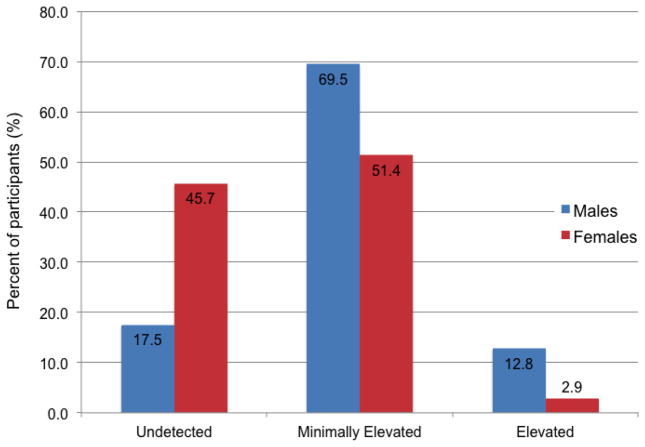
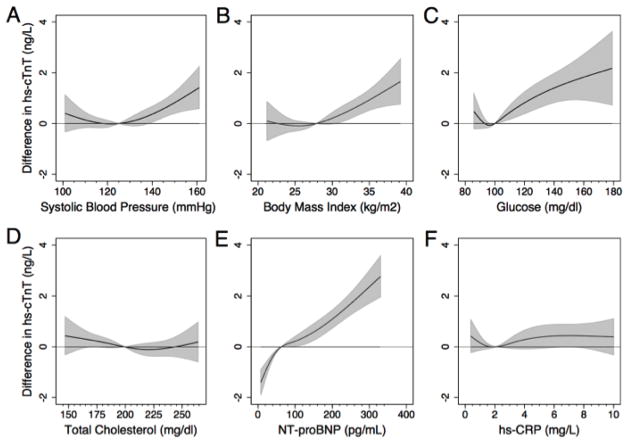
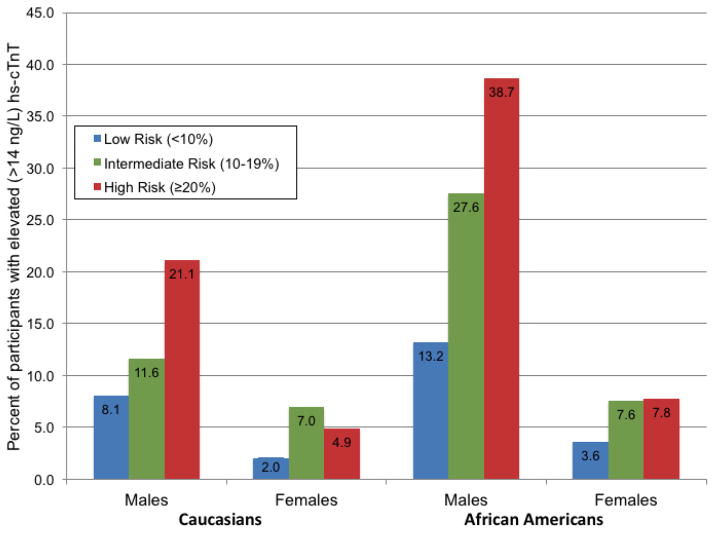
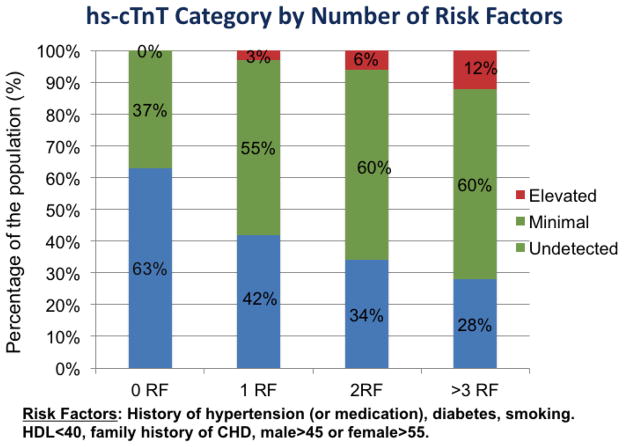
hs-cTnT was detectable in 59% and elevated in 7% of the study population. Among persons with ideal cardiovascular health, hs-cTnT was detectable in 44%. In models adjusting for significant determinants of hs-cTnT concentration, detectable hs-cTnT was more frequent among males, blacks and persons with diabetes and hypertension and less frequent among statin users, current smokers and drinkers. Other risk factors associated with detectable hs-cTnT were older age, lower kidney function and higher body mass index. These risk factors were associated with elevated hs-cTnT in a similar pattern.
In a community-based sample without cardiovascular disease hs-cTnT is detectable in most adults, even among those with ideal cardiovascular health. Although most traditional cardiovascular risk factors were significant determinants of detectable and elevated hs-cTnT, the associations were particularly robust for sex, age, race, hypertension and diabetes.
在无心血管疾病病史的人群中,使用高敏检测法(hs-cTnT)研究心血管危险因素与可检测到的心肌肌钙蛋白T之间的关系。
通过社区动脉粥样硬化风险(ARIC)研究,我们在一个基于社区的队列中检查了9593名无心血管疾病的参与者(平均年龄65.6岁(标准差5.6),41%为女性,22%为黑人)心血管危险因素与hs-cTnT之间的横断面关联。我们使用多变量逻辑回归来描述心血管危险因素与可检测到的(≥3.0至13.9ng/L)和升高的(≥14.0ng/L)hs-cTnT之间的关联。
在59%的研究人群中可检测到hs-cTnT,7%的人hs-cTnT升高。在心血管健康理想的人群中,44%的人可检测到hs-cTnT。在调整了hs-cTnT浓度的重要决定因素的模型中,可检测到的hs-cTnT在男性、黑人以及患有糖尿病和高血压的人群中更为常见,而在他汀类药物使用者、当前吸烟者和饮酒者中则较少见。与可检测到的hs-cTnT相关的其他危险因素包括年龄较大、肾功能较低和体重指数较高。这些危险因素与hs-cTnT升高的关联模式相似。
在一个无心血管疾病的社区样本中,大多数成年人甚至是那些心血管健康理想的成年人中都可检测到hs-cTnT。虽然大多数传统心血管危险因素是可检测到的和升高的hs-cTnT的重要决定因素,但性别、年龄、种族、高血压和糖尿病之间的关联尤为显著。