Reinišová Markéta, Plachý Jiří, Kučerová Dana, Šenigl Filip, Vinkler Michal, Hejnar Jiří
Institute of Molecular Genetics, Academy of Sciences of the Czech Republic, Videnska 1083, CZ-14220, Prague 4, Czech Republic.
Charles University in Prague, Faculty of Science, Department of Zoology, Vinicna 7, CZ-12844, Prague 2, Czech Republic.
PLoS One. 2016 Mar 15;11(3):e0150589. doi: 10.1371/journal.pone.0150589. eCollection 2016.
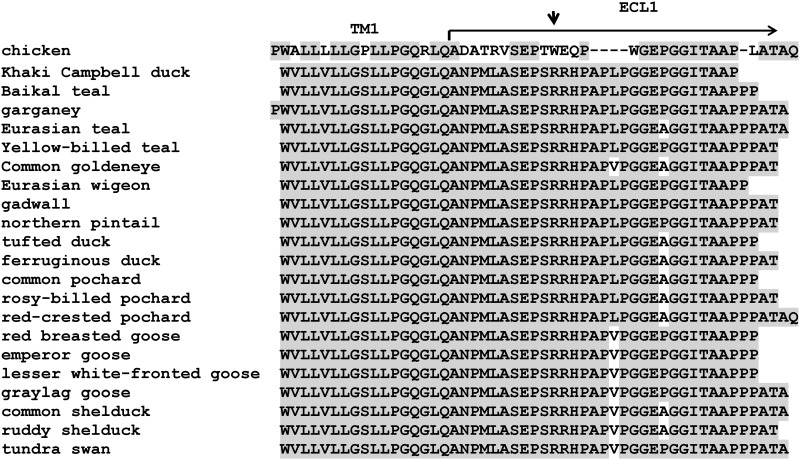
J subgroup avian leukosis virus (ALV-J) infects domestic chicken, jungle fowl, and turkey and enters the host cell through a receptor encoded by tvj locus and identified as Na+/H+ exchanger 1 (NHE1). The resistance to ALV-J in a great majority of examined galliform species was explained by deletions or substitutions of the critical tryptophan 38 in the first extracellular loop of NHE1, and genetic polymorphisms around this site predict the susceptibility or resistance of a given species or individual. In this study, we examined the NHE1 polymorphism in domestic chicken breeds and documented quantitative differences in their susceptibility to ALV-J in vitro. In a panel of chicken breeds assembled with the aim to cover the maximum variability encountered in domestic chickens, we found a completely uniform sequence of NHE1 extracellular loop 1 (ECL1) without any source of genetic variation for the selection of ALV-J-resistant poultry. In parallel, we studied the natural polymorphisms of NHE1 in wild ducks and geese because of recent reports on ALV-J positivity in feral Asian species. In anseriform species, we demonstrate a specific and highly conserved critical ECL1 sequence without any homologue of tryptophan 38 in accordance with the resistance of duck cells to prototype ALV-J. Last, we demonstrated that the new Asian strains of ALV-J have not evolved their envelope glycoprotein to the entry the duck cells. Our results contribute substantially to the current discussion of possible heterotransmission of ALV-J and its spill-over into the wild ducks and geese.
J亚群禽白血病病毒(ALV-J)可感染家鸡、原鸡和火鸡,并通过由tvj基因座编码且被鉴定为Na+/H+交换体1(NHE1)的受体进入宿主细胞。在绝大多数被检测的鸡形目物种中,对ALV-J的抗性是由NHE1第一个细胞外环中关键色氨酸38的缺失或替代所解释的,并且该位点周围的基因多态性可预测给定物种或个体的易感性或抗性。在本研究中,我们检测了家鸡品种中的NHE1多态性,并记录了它们在体外对ALV-J易感性的定量差异。在一组旨在涵盖家鸡中遇到的最大变异性而组装的鸡品种中,我们发现NHE1细胞外环1(ECL1)的序列完全一致,没有任何可用于选择抗ALV-J家禽的遗传变异来源。同时,由于最近有关于野生亚洲物种中ALV-J阳性的报道,我们研究了野鸭和野鹅中NHE1的自然多态性。在雁形目物种中,根据鸭细胞对原型ALV-J的抗性,我们证明了一个特定且高度保守的关键ECL1序列,其中没有色氨酸38的任何同源物。最后,我们证明了新的亚洲ALV-J毒株尚未进化出其包膜糖蛋白以进入鸭细胞。我们的结果对当前关于ALV-J可能的异种传播及其向野鸭和野鹅的溢出的讨论有很大贡献。