Jun Yun Ju, Lee Jinhee, Hwang Sehee, Kwak Jung Hyun, Ahn Hyeon Yeong, Bak Youn Kyung, Koh Jihoon, Lee Jong Ho
Department of Food and Nutrition, National Research Laboratory for Clinical Nutrigenetics/Nutrigenomics, Yonsei University, Sudamun-Gu, Seoul, Republic of Korea.
Department of Food Science and Biotechnology, CHA University, Pocheon-si, Gyeonggi-do, Republic of Korea.
Trials. 2016 Mar 15;17(1):139. doi: 10.1186/s13063-016-1261-0.
Previous studies have reported that xylose selectively inhibited the activity of sucrase. Xylose supplementation may have a beneficial effect on the postprandial glycemic response. However, no studies have investigated patients with IFG or the effectivity of a dose of D-xylose less than 10 % (w/w).
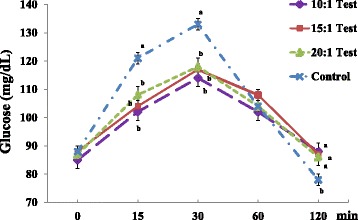
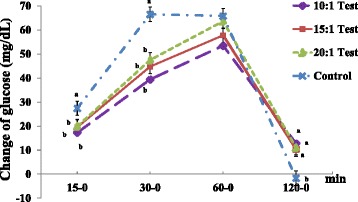
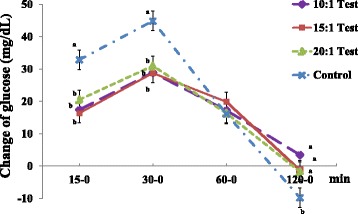
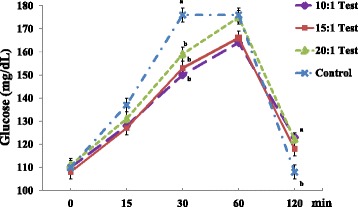
The present study determined the effect of xylose consumption on postprandial hyperglycemia in normal (n = 25) and hyperglycemic subjects (n = 50). Subjects in this double-blind crossover design study were randomly assigned to consume a sucrose drink (Control, sucrose 50 g + deionized water 100 g) or a sucrose drink additionally containing 5 g (Test 1, sucrose:xylose = 10:1), 3.33 g (Test 2, sucrose:xylose = 15:1), or 2.5 g (Test 3, sucrose:xylose = 20:1) of D-xylose separated by a one-week interval.
Normal subjects in all test groups exhibited a significant decrease in serum glucose levels 15 min and 30 min after consuming the xylose-containing drinks compared to the control group. Significantly lower serum levels of insulin were observed at 15 min and 30 min after consuming the xylose-containing drinks compared to the control group. The test 1 group also exhibited a significantly lower insulin area under the curve than the control group. Hyperglycemic subjects (n = 50) in all test groups exhibited a significant decrease in serum glucose levels at 30 min compared to the control group. However, the test 1 group exhibited a significant increase in serum glucose levels at 120 min compared to the control group. Glucose-related markers did not significantly differ in each group.
Xylose supplementation may exert a beneficial effect on postprandial glycemic responses in subjects with normal glucose levels and prediabetes.
ClinicalTrials.gov identifier: NCT02654301 . Registered 12 January 2016.
既往研究报道木糖可选择性抑制蔗糖酶的活性。补充木糖可能对餐后血糖反应产生有益影响。然而,尚无研究对空腹血糖受损(IFG)患者或低于10%(w/w)剂量的D-木糖的有效性进行调查。
本研究确定了食用木糖对正常受试者(n = 25)和高血糖受试者(n = 50)餐后高血糖的影响。在这项双盲交叉设计研究中,受试者被随机分配饮用蔗糖饮料(对照组,蔗糖50 g + 去离子水100 g)或额外含有5 g(试验1,蔗糖:木糖 = 10:1)、3.33 g(试验2,蔗糖:木糖 = 15:1)或2.5 g(试验3,蔗糖:木糖 = 20:1)D-木糖的蔗糖饮料,间隔一周。
与对照组相比,所有试验组的正常受试者在饮用含木糖饮料后15分钟和30分钟时血清葡萄糖水平显著降低。与对照组相比,饮用含木糖饮料后15分钟和30分钟时观察到胰岛素血清水平显著降低。试验1组的胰岛素曲线下面积也显著低于对照组。所有试验组的高血糖受试者(n = 50)在30分钟时血清葡萄糖水平与对照组相比显著降低。然而,试验1组在120分钟时血清葡萄糖水平与对照组相比显著升高。各组葡萄糖相关标志物无显著差异。
补充木糖可能对血糖水平正常和糖尿病前期受试者的餐后血糖反应产生有益影响。
ClinicalTrials.gov标识符:NCT02654301。2016年1月12日注册。