Sado Edao, Sufa Alemu
Department of Pharmacy, Pharmacoepidemiology and Social Pharmacy Unit, College of Medical and Health Sciences, Wollega University Ethiopia, P.O. Box 395, Nekemte, Ethiopia.
Department of Public health, Reproductive Health Unit, College of Medical and Health Sciences, Wollega University Ethiopia, P.O. Box 395, Nekemte, Ethiopia.
BMC Pediatr. 2016 Mar 15;16:40. doi: 10.1186/s12887-016-0572-3.
Essential medicines (EMs) are those medicines which satisfy the priority health care needs of the population. Although it is a fundamental human right, access to essential medicines has been a big challenge in developing countries particularly for children. WHO recommends assessing the current situations on availability and affordability of EMs as the first step towards enhancing access to them. Therefore, the aim of this study was to assess access to EMs for children based on availability, affordability, and price.
We adapted the WHO and Health Action International tools to measure availability, affordability, and prices of EMs. We collected data on 22 EMs for children from 15 public to 40 private sectors' drug outlets in east Wollega zone. Availability was expressed as percentage of drug outlets per sector that stocked surveyed medicines on the day of data collection, and prices were expressed as median price ratio. Affordability was measured as the number of daily wages required for the lowest-paid government unskilled worker (1.04 US $per day) to purchase one standard treatment of an acute condition or treatment for a chronic condition for a month.
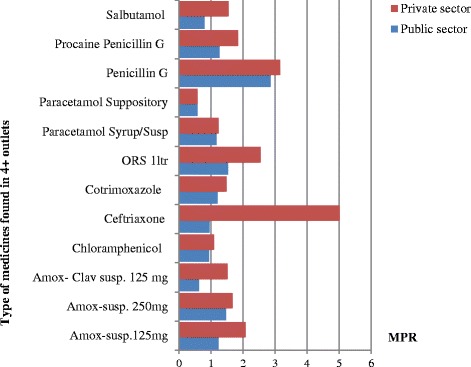
The average availability of essential medicines was 43 % at public and 42.8 % at private sectors. Lowest priced medicines were sold at median of 1.18 and 1.54 times their international reference prices (IRP) in the public and private sectors, respectively. Half of these medicines were priced at 0.90 to 1.3 in the public sector and 1.23 to 2.07 in the private sector times their respective IRP. Patient prices were 36 % times higher in the private sector than in the public sector. Medicines were unaffordable for treatment of common conditions prevalent in the zone at both public and private sectors as they cost a day or more days' wages for the lowest paid government unskilled worker.
Access to EMs to children is hampered by low availability and high price which is unaffordable. Thus, further study on larger scale is critical to identify acute areas for policy interventions such as price and or supply, and to enhance access to EMs to children.
基本药物是指满足民众优先医疗保健需求的药物。尽管获取基本药物是一项基本人权,但在发展中国家,尤其是对儿童而言,获取基本药物一直是一项巨大挑战。世界卫生组织建议,评估基本药物的可获得性和可负担性现状是增强其可及性的第一步。因此,本研究的目的是基于可获得性、可负担性和价格来评估儿童获取基本药物的情况。
我们采用了世界卫生组织和国际卫生行动组织的工具来衡量基本药物的可获得性、可负担性和价格。我们从东沃莱加区15家公立和40家私立药店收集了22种儿童基本药物的数据。可获得性以数据收集当天各部门有库存被调查药物的药店百分比表示,价格以中位数价格比表示。可负担性通过政府最低薪非技术工人(每天1.04美元)购买一种急性病标准治疗药物或一种慢性病一个月治疗药物所需的日工资数量来衡量。
基本药物的平均可获得性在公立部门为43%,在私立部门为42.8%。价格最低的药物在公立和私立部门的售价分别为其国际参考价格(IRP)的1.18倍和1.54倍。这些药物中有一半在公立部门的定价为其各自IRP的0.90至1.3倍,在私立部门为1.23至2.07倍。私立部门的患者支付价格比公立部门高36%。对于该地区普遍存在的常见病症,公立和私立部门的药物都难以负担,因为这需要政府最低薪非技术工人一天或多天的工资。
儿童获取基本药物受到可获得性低和价格高昂且难以负担的阻碍。因此,开展更大规模的进一步研究对于确定价格和/或供应等政策干预的关键领域以及增强儿童获取基本药物的机会至关重要。