Shapiro Lori R, Scully Erin D, Straub Timothy J, Park Jihye, Stephenson Andrew G, Beattie Gwyn A, Gleason Mark L, Kolter Roberto, Coelho Miguel C, De Moraes Consuelo M, Mescher Mark C, Zhaxybayeva Olga
Department of Organismic and Evolutionary Biology, Harvard University
Grain, Forage, and Bioenergy Research Unit, USDA-ARS, Lincoln, Nebraska and Department of Agronomy and Horticulture, University of Nebraska-Lincoln.
Genome Biol Evol. 2016 Mar 18;8(3):649-64. doi: 10.1093/gbe/evw016.
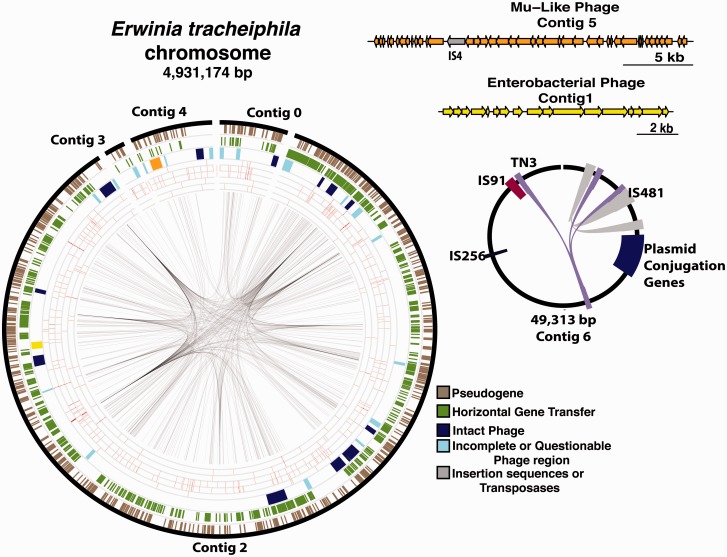
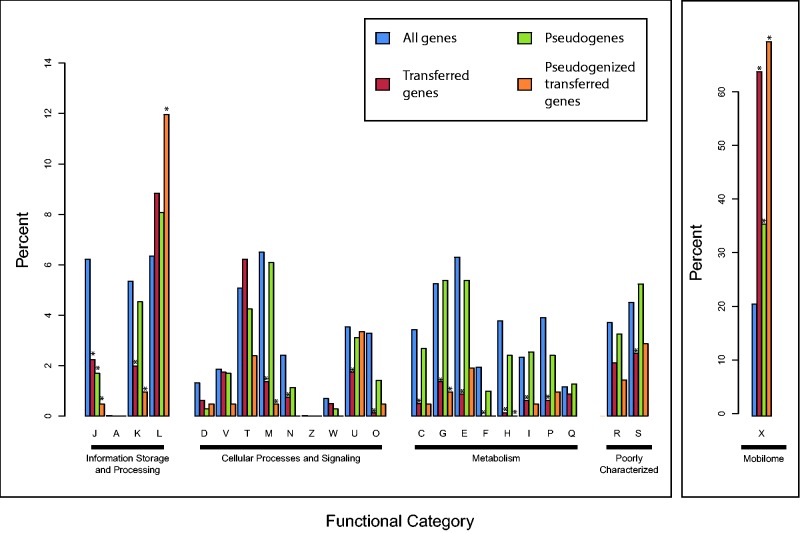
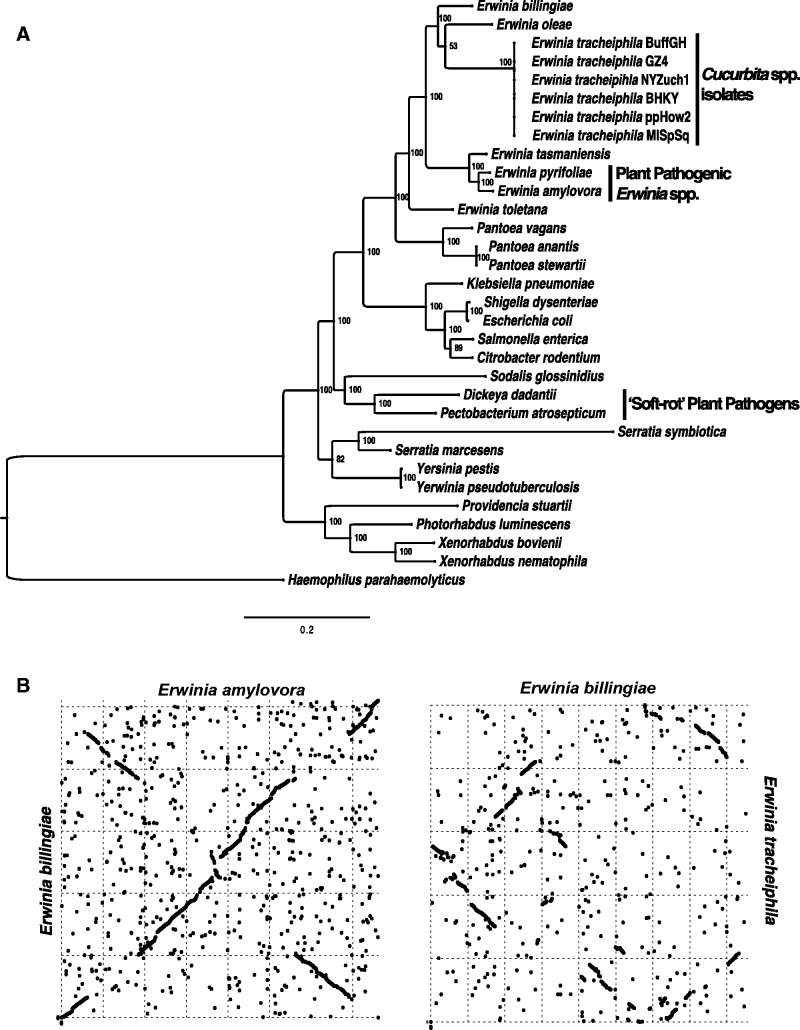
Modern industrial agriculture depends on high-density cultivation of genetically similar crop plants, creating favorable conditions for the emergence of novel pathogens with increased fitness in managed compared with ecologically intact settings. Here, we present the genome sequence of six strains of the cucurbit bacterial wilt pathogen Erwinia tracheiphila (Enterobacteriaceae) isolated from infected squash plants in New York, Pennsylvania, Kentucky, and Michigan. These genomes exhibit a high proportion of recent horizontal gene acquisitions, invasion and remarkable amplification of mobile genetic elements, and pseudogenization of approximately 20% of the coding sequences. These genome attributes indicate that E. tracheiphila recently emerged as a host-restricted pathogen. Furthermore, chromosomal rearrangements associated with phage and transposable element proliferation contribute to substantial differences in gene content and genetic architecture between the six E. tracheiphila strains and other Erwinia species. Together, these data lead us to hypothesize that E. tracheiphila has undergone recent evolution through both genome decay (pseudogenization) and genome expansion (horizontal gene transfer and mobile element amplification). Despite evidence of dramatic genomic changes, the six strains are genetically monomorphic, suggesting a recent population bottleneck and emergence into E. tracheiphila's current ecological niche.
现代工业化农业依赖于基因相似的农作物的高密度种植,与生态完整的环境相比,这为在人工管理环境中适应性增强的新型病原体的出现创造了有利条件。在此,我们展示了从纽约、宾夕法尼亚州、肯塔基州和密歇根州受感染的南瓜植株中分离出的六种葫芦科细菌性枯萎病病原体嗜气管欧文氏菌(肠杆菌科)菌株的基因组序列。这些基因组显示出近期水平基因获得的比例很高、移动遗传元件的入侵和显著扩增,以及约20%的编码序列发生假基因化。这些基因组特征表明嗜气管欧文氏菌最近作为一种宿主受限病原体出现。此外,与噬菌体和转座元件增殖相关的染色体重排导致六种嗜气管欧文氏菌菌株与其他欧文氏菌属物种之间在基因含量和遗传结构上存在显著差异。综合这些数据,我们推测嗜气管欧文氏菌最近通过基因组衰退(假基因化)和基因组扩张(水平基因转移和移动元件扩增)经历了进化。尽管有证据表明基因组发生了巨大变化,但这六种菌株在遗传上是单态的,这表明近期存在种群瓶颈,并进入了嗜气管欧文氏菌当前的生态位。