Jerome Neil P, Miyazaki Keiko, Collins David J, Orton Matthew R, d'Arcy James A, Wallace Toni, Moreno Lucas, Pearson Andrew D J, Marshall Lynley V, Carceller Fernando, Leach Martin O, Zacharoulis Stergios, Koh Dow-Mu
Division of Radiotherapy & Imaging, The Institute of Cancer Research, Cancer Research UK Cancer Imaging Centre, 123 Old Brompton Road, London, SW7 3RP, UK.
Department of Radiology, Royal Marsden NHS Foundation Trust, Sutton, Surrey, SM2 5PT, UK.
Eur Radiol. 2017 Jan;27(1):345-353. doi: 10.1007/s00330-016-4318-2. Epub 2016 Mar 22.
To examine repeatability of parameters derived from non-Gaussian diffusion models in data acquired in children with solid tumours.
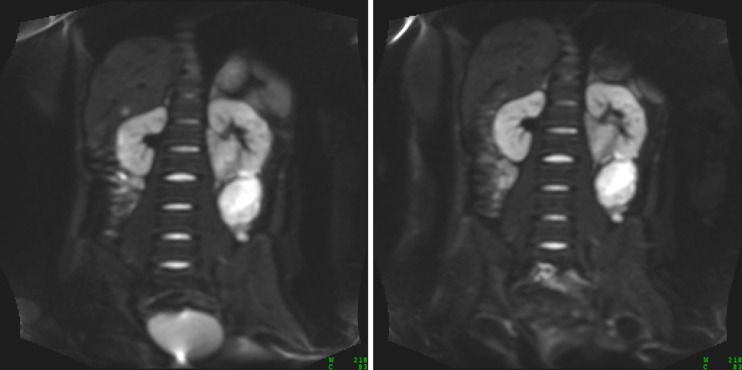
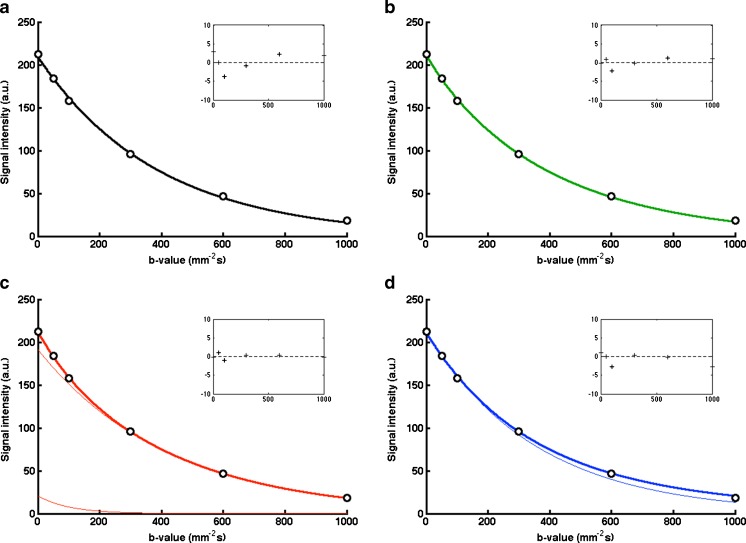
Paediatric patients (<16 years, n = 17) were scanned twice, 24 h apart, using DWI (6 b-values, 0-1000 mm s) at 1.5 T in a prospective study. Tumour ROIs were drawn (3 slices) and all data fitted using IVIM, stretched exponential, and kurtosis models; percentage coefficients of variation (CV) calculated for each parameter at all ROI histogram centiles, including the medians.
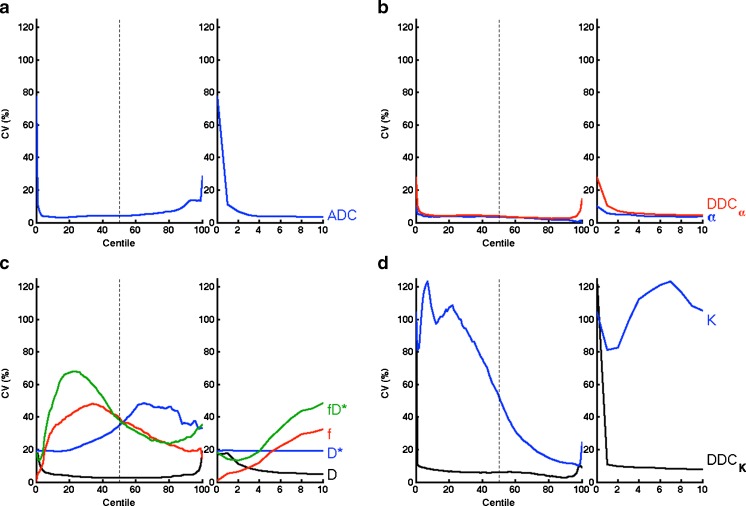
The values for ADC, D, DDC, α, and DDC gave CV < 10 % down to the 5th centile, with sharp CV increases below 5th and above 95th centile. K, f, and D* showed increased CV (>30 %) over the histogram. ADC, D, DDC, and DDC were strongly correlated (ρ > 0.9), DDC and α were not correlated (ρ = 0.083).
Perfusion- and kurtosis-related parameters displayed larger, more variable CV across the histogram, indicating observed clinical changes outside of D/DDC in these models should be interpreted with caution. Centiles below 5th for all parameters show high CV and are unreliable as diffusion metrics. The stretched exponential model behaved well for both DDC and α, making it a strong candidate for modelling multiple-b-value diffusion imaging data.
• ADC has good repeatability as low 5th centile of the histogram distribution. • High CV was observed for all parameters at extremes of histogram. • Parameters from the stretched exponential model showed low coefficients of variation. • The median ADC, D, DDC , and DDC are highly correlated and repeatable. • Perfusion/kurtosis parameters showed high CV variations across their histogram distributions.
研究在实体瘤患儿所采集数据中,非高斯扩散模型得出的参数的可重复性。
在一项前瞻性研究中,对17名16岁以下的儿科患者在1.5T场强下进行两次扫描,间隔24小时,采用扩散加权成像(6个b值,0 - 1000mm²/s)。绘制肿瘤感兴趣区(3个层面),并使用体素内不相干运动(IVIM)、拉伸指数和峰度模型拟合所有数据;计算所有感兴趣区直方图百分位数(包括中位数)下每个参数的变异系数百分比(CV)。
表观扩散系数(ADC)、扩散系数(D)、双扩散系数(DDC)、α以及DDC在第5百分位数及以下时CV < 10%,在第5百分位数以下和第95百分位数以上时CV急剧增加。峰度(K)、灌注分数(f)和伪扩散系数(D*)在直方图上显示出CV增加(>30%)。ADC、D、DDC和DDC高度相关(ρ > 0.9),DDC和α不相关(ρ = 0.083)。
灌注和峰度相关参数在直方图上显示出更大、更可变的CV,表明在这些模型中,除了D/DDC之外观察到的临床变化应谨慎解释。所有参数在第5百分位数以下时CV较高,作为扩散指标不可靠。拉伸指数模型对DDC和α的表现良好,使其成为多b值扩散成像数据建模的有力候选模型。
• ADC在直方图分布的低第5百分位数处具有良好的可重复性。• 在直方图两端,所有参数均观察到高CV。• 拉伸指数模型的参数显示出低变异系数。• 中位数ADC、D、DDC和DDC高度相关且可重复。• 灌注/峰度参数在其直方图分布上显示出高CV变化。