Lyu Ya-Su, Shi Pei-Liang, Chen Xiao-Ling, Tang Yue-Xiao, Wang Yan-Fang, Liu Rong-Rong, Luan Xiao-Rui, Fang Yu, Mei Ru-Huan, Du Zhen-Fang, Ke Hai-Ping, Matro Erik, Li Ling-En, Lin Zhao-Yu, Zhao Jing, Gao Xiang, Zhang Xian-Ning
Department of Cell Biology and Medical Genetics, Research Center for Molecular Medicine, National Education Base for Basic Medical Sciences, Institute of Cell Biology, Zhejiang University School of Medicine, Hangzhou, Zhejiang, China.
Key Laboratory of Model Animals for Disease Study of The Ministry of Education, Model Animal Research Center of Nanjing University, Nanjing, Jiangsu, China.
Mol Ther Nucleic Acids. 2016 Mar 22;5(3):e299. doi: 10.1038/mtna.2016.17.
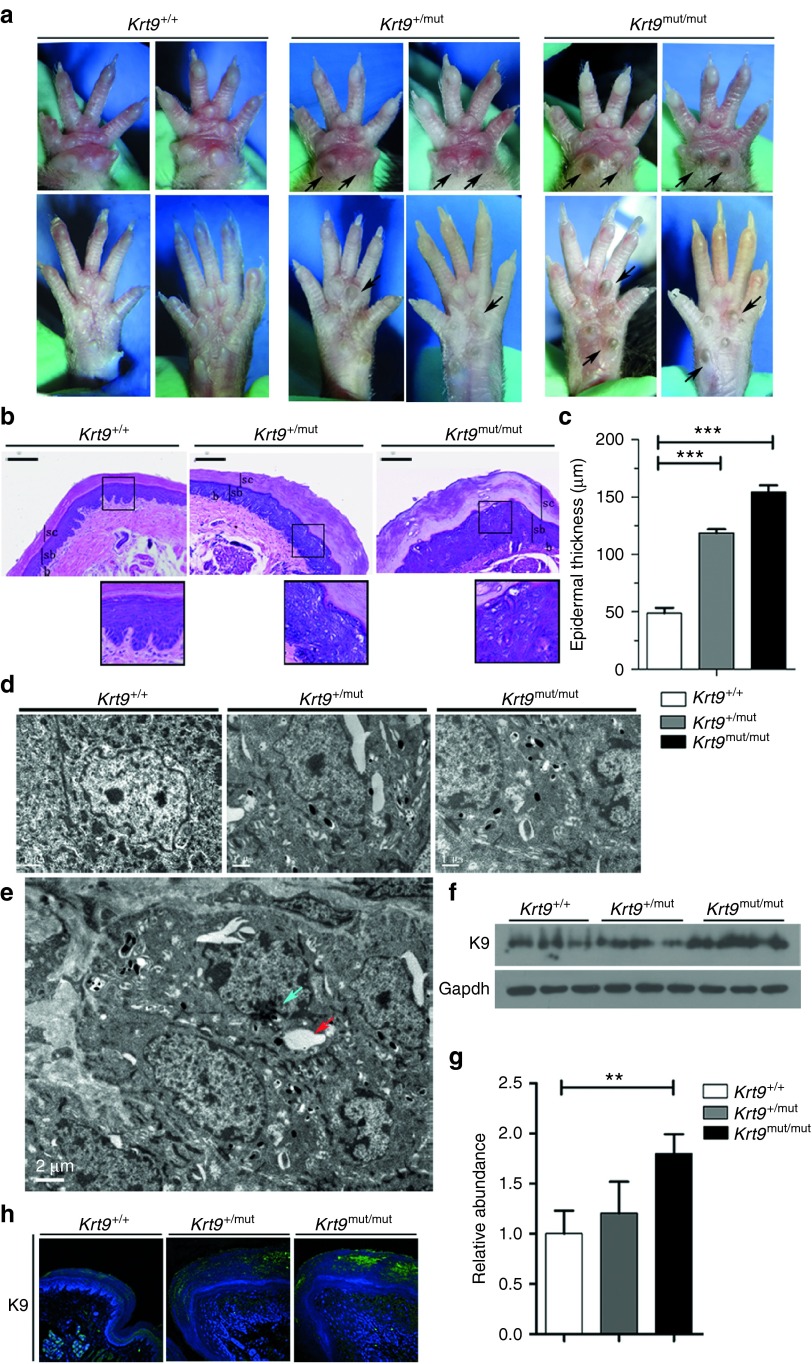
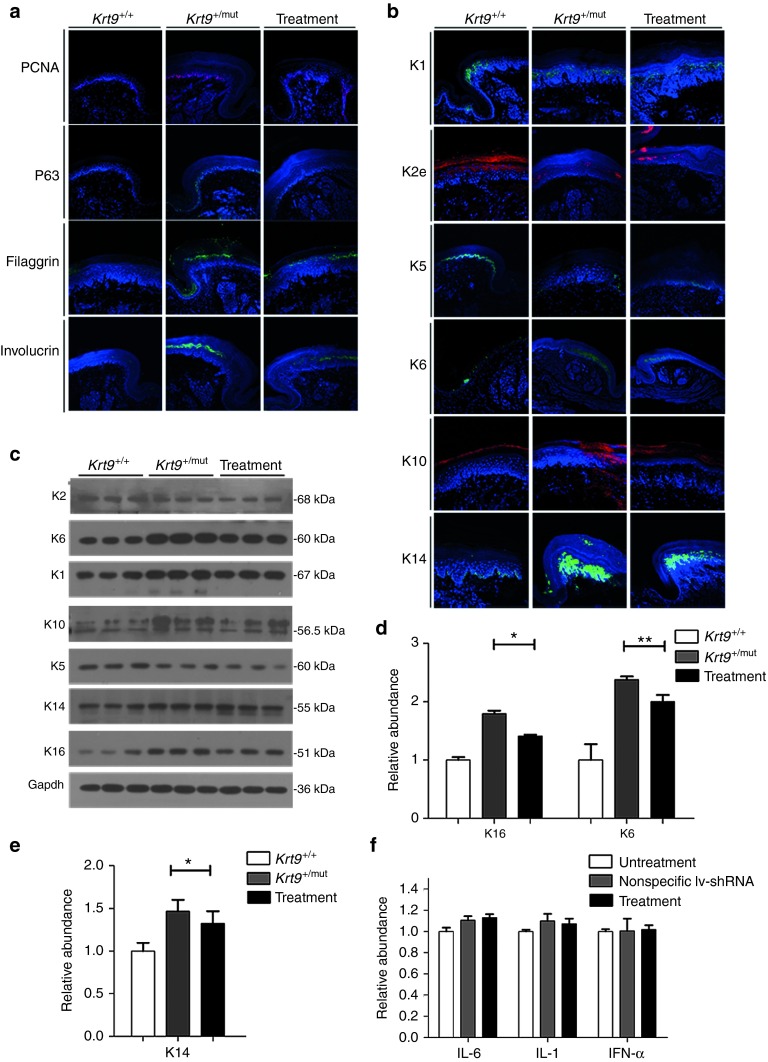
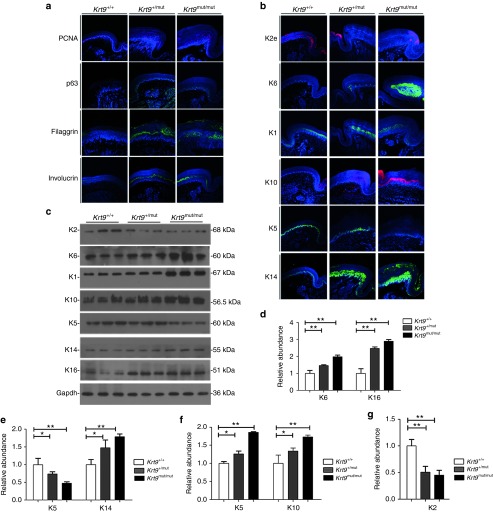
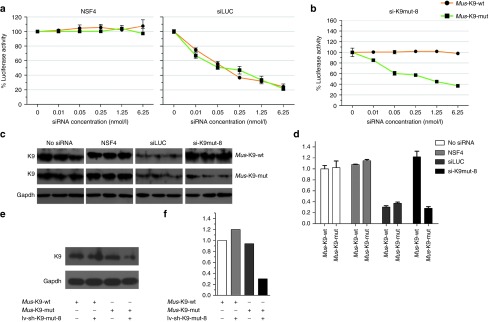
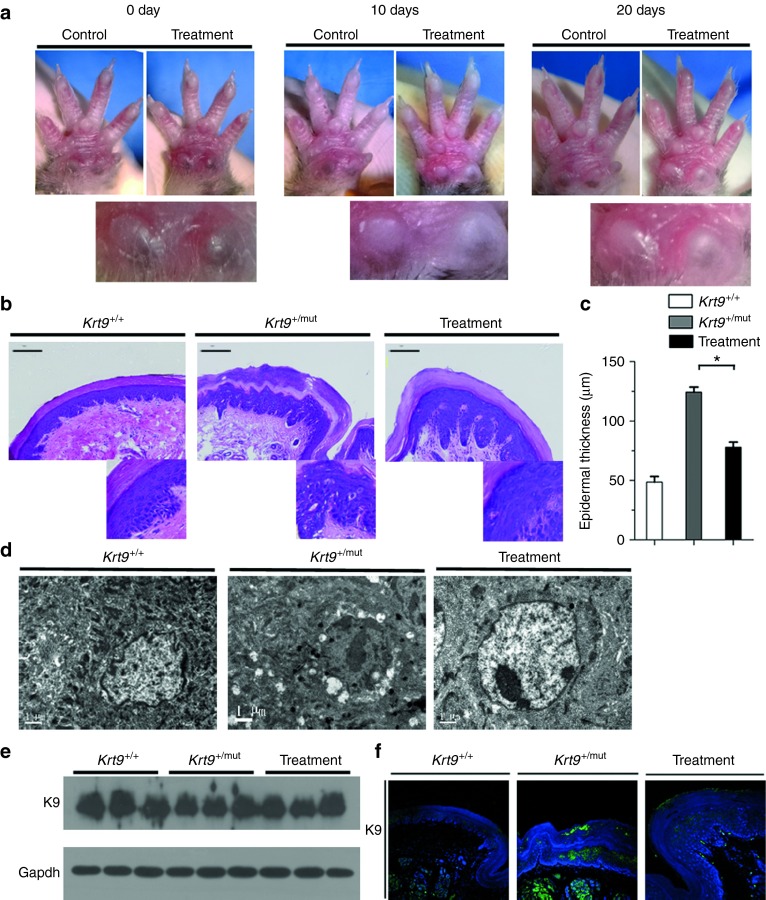
Epidermolytic palmoplantar keratoderma (EPPK) is a relatively common autosomal-dominant skin disorder caused by mutations in the keratin 9 gene (KRT9), with few therapeutic options for the affected so far. Here, we report a knock-in transgenic mouse model that carried a small insertion-deletion (indel) mutant of Krt9, c.434delAinsGGCT (p.Tyr144delinsTrpLeu), corresponding to the human mutation KRT9/c.500delAinsGGCT (p.Tyr167delinsTrpLeu), which resulted in a human EPPK-like phenotype in the weight-stress areas of the fore- and hind-paws of both Krt9(+/mut) and Krt9(mut/mut) mice. The phenotype confirmed that EPPK is a dominant-negative condition, such that mice heterozygotic for the K9-mutant allele (Krt9(+/mut)) showed a clear EPPK-like phenotype. Then, we developed a mutant-specific short hairpin RNA (shRNA) therapy for EPPK mice. Mutant-specific shRNAs were systematically identified in vitro using a luciferase reporter gene assay and delivered into Krt9(+/mut) mice. shRNA-mediated knockdown of mutant protein resulted in almost normal morphology and functions of the skin, whereas the same shRNA had a negligible effect in wild-type K9 mice. Our results suggest that EPPK can be treated by gene therapy, and this has significant implications for future clinical application.
表皮松解性掌跖角化病(EPPK)是一种相对常见的常染色体显性遗传性皮肤病,由角蛋白9基因(KRT9)突变引起,迄今为止,针对该病患者的治疗选择很少。在此,我们报告一种敲入转基因小鼠模型,该模型携带Krt9的一个小插入缺失(indel)突变体,即c.434delAinsGGCT(p.Tyr144delinsTrpLeu),对应于人类突变KRT9/c.500delAinsGGCT(p.Tyr167delinsTrpLeu),该突变在Krt9(+/mut)和Krt9(mut/mut)小鼠的前爪和后爪的负重区域导致了类似人类EPPK的表型。该表型证实EPPK是一种显性负性疾病,使得K9突变等位基因杂合的小鼠(Krt9(+/mut))表现出明显的类似EPPK的表型。然后,我们为EPPK小鼠开发了一种突变体特异性短发夹RNA(shRNA)疗法。使用荧光素酶报告基因测定法在体外系统鉴定突变体特异性shRNAs,并将其导入Krt9(+/mut)小鼠体内。shRNA介导的突变蛋白敲低导致皮肤形态和功能几乎正常,而相同的shRNA对野生型K9小鼠的影响可忽略不计。我们的结果表明,EPPK可通过基因治疗,这对未来的临床应用具有重要意义。